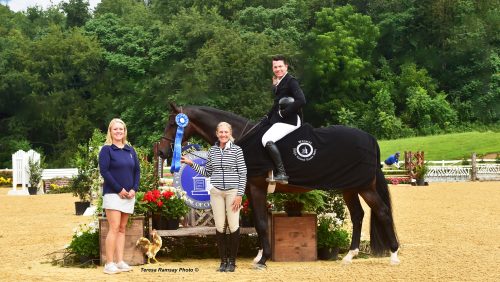
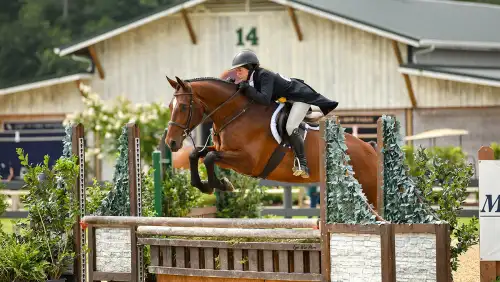
A life with horses means a life outdoors, hours spent in shadeless arenas and caring for horses under the glare of the sun. For many equestrians, excessive exposure to ultraviolet rays is a fact of life—and for those equestrians who spend much of their life on the road, getting to a dermatologist for regular skin screenings to detect sun damage and potential skin cancer can be a challenge.
That’s why a horse show family from Louisiana has created SunSafe Equestrian, a nonprofit organization that brings skin care to the horse show, offering free skin cancer screenings, skin protection tips and free sunscreen samples at horse shows.
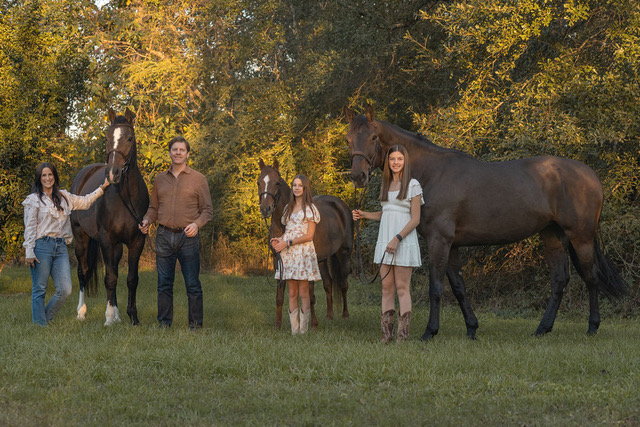
Sisters Stella and Vivian Prather-Silva, ages 14 and 12, respectively, have been riding ever since Stella took her first lesson at age 6. The girls have grown up knowing the importance of sun safety thanks to their father, Dr. Chad Prather, a dermatologist with a practice based in their hometown of Baton Rouge, Louisiana. Prather has been a dermatologist for the past 20 years and specializes in detecting and treating skin cancer, cosmetic reconstruction, and cosmetic work.
“I see patients from all walks of life,” he said. “There are certain fields that we see people with lots of skin damage [from the sun], and we see that in such a big degree within our equestrian community. Many of my days are spent removing skin cancer and fighting the effects of long-term sun exposure.”
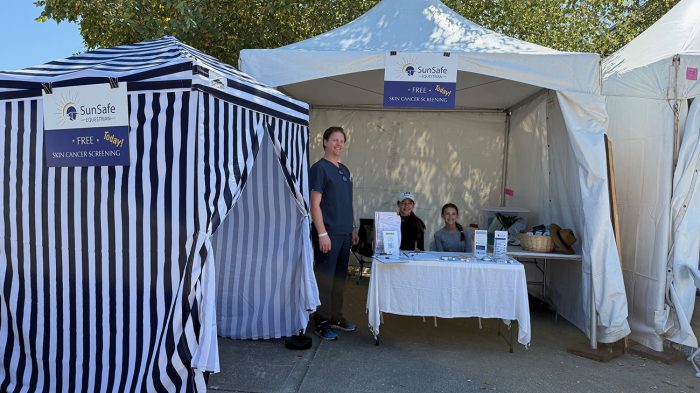
Late last year, the family created SunSafe Equestrian to offers free skin cancer screenings at horse shows to grooms, trainers, horse show staff, riders and others. Their mission is to “promote sun safety in equestrian riders through education, prevention, and early detection of skin cancer.”
“Vivian and I observed how many of our fellow equestrians were out in the sun without proper sun shirts, sunscreen, or visors,” Stella said. “We decided to come up with a way to help people educate themselves on sun safety and also provide a way for people to do skin checks in a convenient way.”
“Over the years, our national dermatology organizations have done programs like this in Major League Soccer and baseball,” Prather said. “We thought it would be a great opportunity to bring it to the horse show world, whether that was partnering with [U.S. Equestrian Federation] or [U.S. Hunter Jumper Association] or another national organization within the horse world, to help bring this type of program to equestrians, where I think it’s really needed.”
SunSafe Equestrian has had a booth at two horse shows this year: one at the Gulf Coast Classic at the Gulfport Horse Show Circuit (Mississippi). and another at USEF Pony Finals (Kentucky). They offered free cancer screenings to anyone present at the horse show, and they also handed out educational pamphlets and free sunscreen to anyone who stopped by their booth.
“We know trainers and folks involved in the horse show world have trouble getting to the doctor while they’re on the road,” Prather said. “We can do a complete skin cancer screening at our booth to say, ‘That looks completely fine,’ or, ‘We should be concerned about that.’ ”
While competing on the road, the girls train with Mississippi-based hunter/jumper trainer Meghan Felts. Stella competes By Starlight in the children’s hunters and Nightcall in the 1.0-meter jumpers. This year, Vivian qualified her medium pony, Shenandoah Moonspinner, for Pony Finals, and the whole Prather-Silva family traveled to Kentucky to watch her compete.
ADVERTISEMENT
With the help of USEF’s Marketing Events Manager Olivia Woodruff and Kentucky Horse Shows’ Cindy Bozan, SunSafe Equestrian was able to secure a vacated vendor’s booth outside the Rolex Stadium during the final Friday and Saturday of Pony Finals. They offered skin cancer screenings from 10 a.m. to noon both days, and Prather did more than 30 skin cancer screenings in that time. Many exhibitors stopped by the booth for free information and free sunscreen samples. Woodruff also added free SunSafe Equestrian SPF 15 lip balms to all the Pony Finals welcome bags for riders.
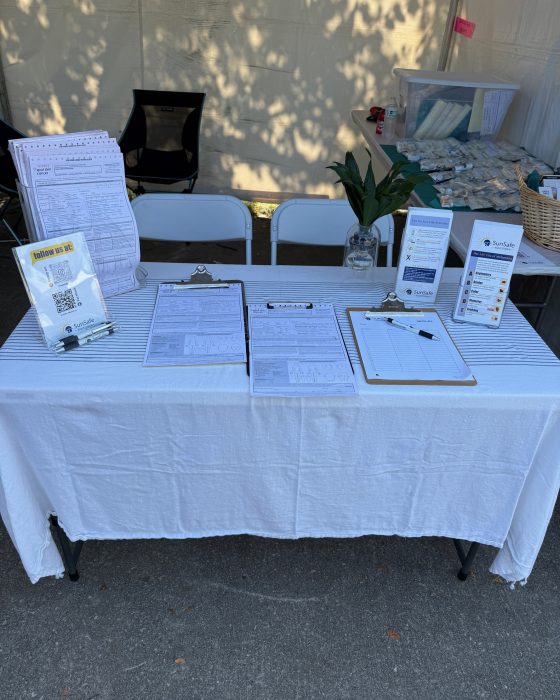
Prather’s skin cancer screening in the SunSafe tent is not done with machines. He uses magnification loupes to tell if a spot on someone’s body is concerning or not. Each patient is required to sign a consent form prior to each cancer screening.
“Once the paperwork is filled out, we can step into the tent where there is privacy,” he said. “Many people just want to show me a spot on their face or arms or other exposed areas so they don’t have to get undressed. Some people want to show me a spot on their back—we do have gowns available if patients want that.”
The screening itself only takes a couple of minutes to complete. Prather assesses the spot and recommends whether it needs further workup by a dermatologist, like a treatment or biopsy. Then Prather fills out an American Academy of Dermatology form, which states his clinical observations.
“If the spot I screened is anything concerning, I’ll refer that person back to a dermatologist in their home zip code,” he said. “Patients are usually happy to get either the reassurance or confirmation that it is something that they need to get check out. They are appreciative that we are there, and they can stop by for a minute on the way back to their barn. I’m glad to screen as much or as little as you would like to show me.”
Prather also shares with the horse people who stop by his best advice for preventing sun damage to their skin, like reapplying 1 ounce (a shot glass’s worth) of sunscreen every two hours to exposed skin. He stresses not brand names but the need to pay attention to the SPF number of the sunscreen—he recommends SPF 30 or higher—and remembering to reapply often.
“Sunscreen can actually break down,” he said. “There are two components to most sunscreens: a chemical component and a physical component. The physical component is a zinc [oxide] or titanium dioxide. That stays on the skin and will come off with sweat. The chemical component absorbs the sun’s rays and protects your skin from the sun.
“The chemical part can be broken down over time,” he continued. “After a couple of hours of riding, the chemical component has been broken down by the sun, and the physical component has been wiped away from sweat. When you’re doing equestrian sports, it’s going to be a matter of sweating and physical wiping away and the chemical breakdown. Reapplying every two hours is a great rule of thumb.”
Prather also recommends a lip balm with an SPF of 15 or higher, riding before 10 a.m. and after 4 p.m. to avoid the day’s strongest UV rays, wearing sleeves and sunglasses, and always wearing a hat or visor when outside.
“One of the things equestrians are known for are their fashionable hats,” Prather added. “Wide brim hats with a lot of coverage are the most helpful.”
Vivian and Stella created the educational pamphlets that are distributed at their booth, and their hope is to spread as much knowledge about sun safety as possible.
ADVERTISEMENT
“Our pamphlets talk about the ABCDEs of skin cancer,” Stella said. “That’s an acronym for asymmetry, border, color, diameter, and evolution of a spot or a mole. We tell our patients that if you notice this, you should probably go get it checked out. We also can do that for them at the SunSafe show booth.”
The girls have also created a social media page for SunSafe Equestrian on both Facebook and Instagram, where they post educational content related to sun safety. SunSafe booth visitors can also scan a QR code, which takes them right to the SunSafe Equestrian social media pages.
“The posts are the same tips we give at the horse shows: how to protect yourself, from the sun, what to wear, when to reapply sunscreen, etc.,” Stella said. “When they scanned the QR code at Pony Finals, they were automatically entered into winning our giveaway basket, which consisted of the hat, the sunscreen, sunglasses, the sleeves, and the neck gator.”
The girls have now set their sights on creating a website for SunSafe Equestrian, which they hope will be completed soon.
SunSafe Equestrian has one more show on their calendar for this year: the 26th Annual Halloween Horse Show, Oct. 24-26 in Folsom, Louisiana. Their hope is that in the future, SunSafe Equestrian will be invited to more shows, either across different disciplines or shows that the girls do not normally compete at themselves. They have already been asked to return to Gulfport in 2026.
“Our booth has been really well-received by the equestrian community,” said their mother, Camile Silva. “I think it’s fun to see people’s positive response to it—it energizes you. It’s nice when you put effort into something, and people are excited about it and grateful to you.”
Prather is grateful for the ability to help educate horse people on the importance of sun safety.
“For me, this is my job and calling as a professional,” he said. “To be able to do that on the side that has become our family’s hobby is really rewarding as well. I can see that the need for education and early detection is there, and it’s nice to be able to do that for the horse community as well.”
Although SunSafe Equestrian has not officially partnered with any organizations yet, the Prather-Silva family see this as an option in the future.
“The girls want to expand SunSafe through future partnerships, other trainers, and sponsors, to try to make the sun safety and prevention a part of the national equestrian community,” Prather said. “The safety from the sun is just part of responsible riding.”
“It’s important to take care of your skin,” Stella said. “Our long-term goal is to make sun care a normal part of every equestrian’s daily routine: You put on your helmet, you put on your sunscreen, and then you go ride.”