After dedicating most of the first 25 years of his life to horses, by early 2024 Adam Edgar needed a break. He was still getting up at the crack of dawn, but those days it was to serve customers coffee as a barista in Washington, D.C., as he worked to get sober after years battling addiction and struggling to find his way in life. Edgar felt lost, and at that time, the horse show world didn’t feel like a safe place for him.
But with the help of true friends and a special horse, over the next year and a half Edgar found his way back to health, to the sport he loved, and to the front of the victory gallop.
Finding Derby Blue
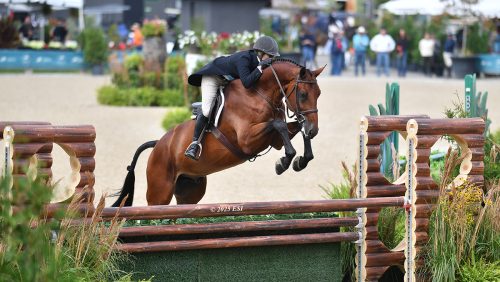
The lead-up to this year’s Lexington National Horse Show (Virginia), held the first week in August, was a bit of a roller coaster for Edgar and Black Rock, the horse he credits for his return to showing. The month before they left HITS Culpeper (Virginia) with a performance hunter reserve championship and a fourth-placed ribbon in the USHJA National Hunter Derby, but then Black Rock ripped off two shoes in succession and ended up a bit sore.
As a WCHR show, Lexington was an important stop for “Blue” and the young professional, but Edgar didn’t want to chance Lisa Rossi’s 10-year-old Oldenburg (Diatendro—Citina) if he wasn’t ready to roll.
“The foot needed to heal, and you can’t rush feet or make the feet grow any faster,” Edgar said. “So I told him, I said, ‘Blue, you’re not going to go to the horse show if you’re not feeling good.’ I kid you not, I went out the next day, and the horse was 100 percent.”
After some back and forth about whether to compete at Lexington, Edgar, Rossi and trainer Rachel Kennedy decided to enter Blue in a single class. That decision paid off when Blue and Edgar jumped to the top of the USHJA National Hunter Derby with marks of 90 and 92—a first derby win for horse and rider alike.
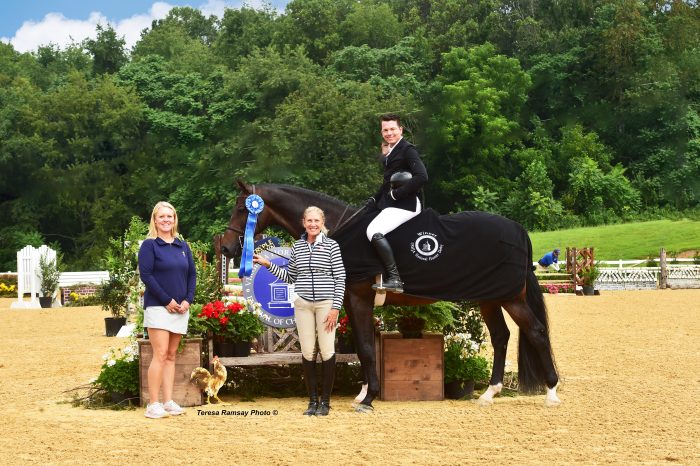
“His riding comes from the heart,” Rossi said. “He just rides the horse that he’s on and connects with them. He’s got the technical skills and know-how to ride all kinds of different horses, but it comes from feel first. He’s very aware of the horses, their surroundings, their psyche and [creates] a real partnership with them.”
Working His Way To Opportunities
Edgar grew up in Virginia, catching the horse bug as a third-grader, and when his parents didn’t have the funds to match his burgeoning talent, he got to work. Throughout his teenage years, when he wasn’t in the barn, he sold dog treats, assisted horse show photographers and worked polishing belts and bracelets for the Kenyan Collection to help pay his bills.
“I still have a binder that has my pony’s Coggins in it, and all my membership papers, back when it all had to be printed out,” he recalled. “I had my checkbook, and I would go to the office by myself with my little binder, and I would pay my bills, and I would pay the braider. I remember I used to find horse shows that were all where the pony hunters only went one day, so then I could trailer and not have to get a stall.”
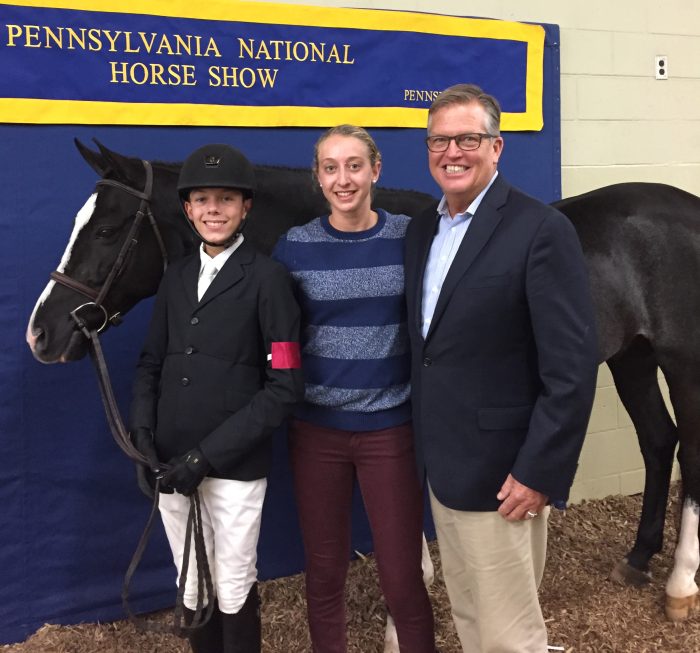
Edgar rode medium pony Damingo with trainer Carol Eichner, and one day Lisa Rossi’s daughter, Anna, saw a video of the two online.
“She was like, ‘Hey, I have this great large pony. He’s just coming back; he needs a rider. You’re a really good rider,’ ” recalled Edgar. “I was finishing up the year, and I was aging out of mediums, so I needed a pony, and they needed a rider. When Anna reached out to me, we were on the phone for two hours.”
Anna, Lisa and Edgar became fast friends, and through the Rossis’ pony, One More Time, Edgar met Kennedy. The partnership with the Rossis also enabled him to go to USEF Pony Finals (Kentucky) for the first time, where they introduced him to trainer Bill Schaub. A year later at that same show, Schaub to invite Edgar to be his working student and travel to Wellington, Florida, for the Winter Equestrian Festival. When he got back to the hotel he screamed in excitement, before starting the process of convincing his mother that he had to switch to online school, and that he had the maturity to go to Florida by himself.
Edgar started catch riding for the likes of Schaub and Ken and Emily Smith, sometimes straightforward mounts, but often ones who came with some baggage and required all Edgar’s horsemanship.
“I was living my dreams, and it was just crazy, because I was—as a kid and as a junior—always such a rule follower, and I was very much the kid that people really wanted their children around, and the kid that the younger generation looked up to,” he said.
A Difficult Transition
ADVERTISEMENT
As his college years approached, Edgar couldn’t shake the feeling that he’d missed out on the biggest goal of his junior years: winning a national equitation final. He had earned good ribbons at major shows, like ASPCA Maclay Regionals and Devon, but a big win was always just out of his grasp.
“I had a good run in the equitation and I did well, but I would always get to the major finals, and I would kind of crack a little bit, I would get really nervous,” he said. “I would have little mistakes.”
Aging out of the juniors, he reluctantly set aside his ambitions to go pro immediately and followed his trainers’ advice to head to college instead. Sue Ashe helped connect him with the Savannah College of Art and Design (Georgia), where he earned a scholarship.
It was a hard change. On the ride to school with his mom, Edgar broke down.
“I was just so scared because it was the unknown; it was change,” said Edgar. “And I never did well with change. Going to college was the best thing I ever could have done for myself. But I’m not going to sit here and say that it was easy-peasy lemon breezy. I had to really push myself and get out of my comfort zone.”
At college he found a different horse community—and new opportunities to achieve the equitation goals that had eluded him.
“I thought when my junior years were over, that when I didn’t when I didn’t win a final, I thought my career was over,” he said. “SCAD gave me the opportunity to do a national final, and I didn’t have to own a horse.”
In his sophomore year Edgar, who majored in equestrian studies, won the IHSA Cacchione Cup, fulfilling his dream of winning an equitation final. After riding on a cloud for a week or so, Edgar’s feeling of accomplishment waned, and he felt himself wondering what was next. Without an immediate goal, he felt rudderless, and what had started as occasional partying morphed into full-fledged drug and alcohol abuse. By 2019, Edgar said, “things were bad.”
“In reality, I may have been showing up and finding eight jumps, but all other aspects of my life were falling apart.”
Adam Edgar
“I was a boy who once cared more about horses and being the best role model I could be more than anything,” he said. “And then slowly but surely, I only cared about finishing the day as quickly as possible so I was able to escape reality with substances, and the one thing that mattered to me most, which was horses, even that couldn’t save me from the powerful control that substances had over my life.”
In hindsight Edgar could see that his drug and alcohol abuse affected his relationships, schoolwork, and the trust that people had in him. He blames no one but himself for getting to that position, and said his perfectionism and the pressure he put on himself as a junior contributed to his difficulties.
“I think the biggest thing that was really hard for me was that, even going through hard times and struggling, I could still show up and find eight jumps,” he said. “The horses felt for me, and they tried for me, because they knew I was struggling. So I don’t think I was ever as successful as I could have been, but even my version of not being as successful was still successful, right? That’s what was a hard struggle for me, because I validated my behavior by being like, ‘Well, I’m still showing up on time. I’m still doing well. So why is it a problem?’ In reality, I may have been showing up and finding eight jumps, but all other aspects of my life were falling apart.”
Edgar stopped paying bills on time and racked up debt and parking tickets. He got arrested, and his relationships with family and friends went downhill sharply. His romantic relationships were a mess.
He got sober for the first time in 2021 and stayed clean for a while, but it didn’t stick.
“I stayed sober for nine months,” he recalled. “Then I told myself, ‘Everyone gets in trouble at least once; I’m young.’ I came up with all these excuses and validated them and started drinking again. I got in trouble again so fast; as soon as I started drinking again, it was back to the races.”
In an effort to give sobriety a fair shot, Edgar decided to quit riding and get away from the people, places and things he associated with his addictions. He moved to Washington, D.C., where he started working at a coffee shop. He was making progress, but he still wasn’t sober, until a friend invited him on a group trip to Rehoboth Beach, Delaware, that he swore would change Edgar’s life. Edgar was doubtful.
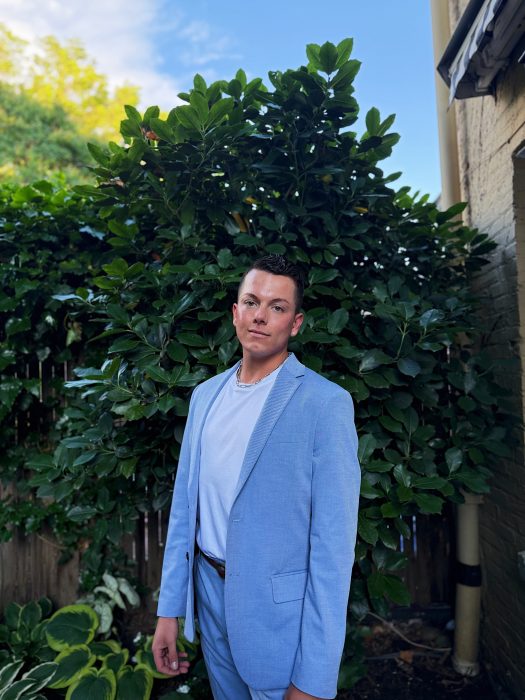
“Everyone just welcomed me with open arms and literally pulled me in and helped me and hugged me,” he said. “I had this moment where I was like, ‘This is what I’ve been looking for.’
ADVERTISEMENT
“These people were happy. They were hardworking, normal people that were sober,” he continued. “They had something that I wanted, so I decided on that trip, ‘I’m going to do everything that they tell me to do, and I’m going to throw myself into this world.’ When I talked to my friend who told me it was going to change my life, I was like, ‘It kills me to say it, but you were a hundred percent right.’ ”
‘We Are So Back’
When newly sober Edgar wanted to get back in the saddle after four months away, he wanted to be mindful about how he did it, and he wanted to work with people he knew would support him. He called his longtime friend Lisa, who kept her horses with Kennedy, who Edgar knew was also in his corner. Lisa immediately thought of Blue.
“We had started him and then finances got a little tight, and he’d been on the back burner,” Lisa said. “He needed a professional to get started, and [Kennedy] travels so much, so it was hard to get a groove going. I love Adam, and always have, and he was in the neighborhood. I was daydreaming with Anna one day and said, ‘He would ride Blue so well.’ ”
In the sensitive gelding Edgar found a kindred spirit, and he empathized with the gelding’s perfectionist nature.
“I often say to people that horses find us when we need them most, and that we find horses when they need us most,” Edgar said. “And that’s precisely what happened: He was trying to find his place, and I was trying to find my place, and we found each other.”
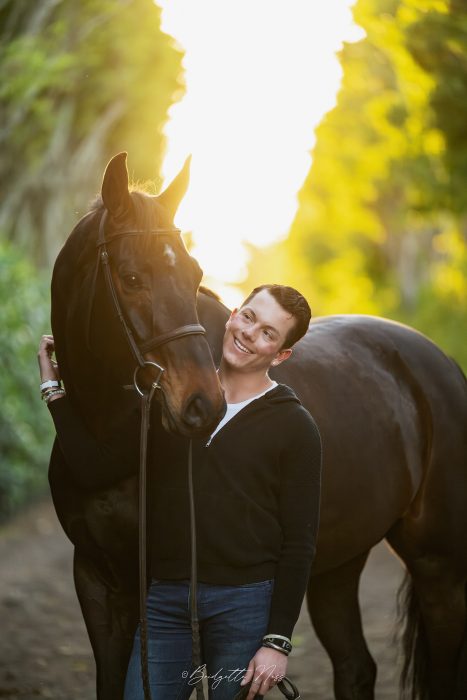
Edgar knew it was a special connection from the first ride, but he tried to convince himself not to fall for the gelding. He took his return to the saddle slowly, commuting from D.C. to Kennedy’s ESP Farm in Brookeville, Maryland, a few days each week to ride, gradually building up his time at the barn. For their first show together, in November 2024, they went to Swan Lake (Pennsylvania) and won a class.
“I laid down this round that was just really good, and I remember Anna Rossi was standing at the in-gate, and I just hear her go, ‘We are so back,’ ” Edgar recalled. “And it was amazing, because here’s this horse that couldn’t really find his way, and here’s this rider that was trying to find his way. And then we found each other, and then we got to step back into the show ring, and it was successful. And we’ve really been able to grow together, one step at a time.”
Edgar saw a big difference in both himself and Blue as they bonded.
“In the barn, he didn’t really have his person yet, so he was a little dull,” he said. “And as we started forming our partnership, I think I got happier. My friends in D.C. would be like, ‘Oh, my God, you’re so much nicer now that you’re riding horses again.’ And the guys in the barn would say, ‘This horse is so much happier.’ ”
“[H]ere’s this horse that couldn’t really find his way, and here’s this rider that was trying to find his way. And then we found each other, and then we got to step back into the show ring, and it was successful. And we’ve really been able to grow together, one step at a time.”
Adam Edgar
With support from Lisa, Kennedy and others, Edgar eventually quit his job as a barista and went back to riding full time, commuting to The Plains, Virginia, to work at Jonelle Mullen’s TuDane Farm, while still driving to ESP Farm in Maryland ride Blue.
“He’s just a good guy; he’s honest and hardworking with a big heart,” Lisa said. “He’s just a caring human being who’s never hurt another person or been mean to a horse. He tries his best with everyone and everything he does. He’s really funny and at the same time very serious when he’s working with the horses. He and Rachel have a long history together, and they trust each other. Having her on the ground with him riding Blue has been a magical combination.”
These days Edgar is riding and working for Kennedy at ESP Farm and aiming Blue toward the Capital Challenge Horse Show (Maryland).
“I just feel like he saved me,” Edgar said. “He saved me because I was at a point where I didn’t know if I wanted to do this. I was thinking about going back to school and looking into different avenues, and maybe I just want to be an amateur, and maybe I want to look at a different career and then, you know, he just popped into my life.
“What makes it even more special to me is that Lisa owns him … so to be able to go back and do this with them makes it that much more special, because [the Rossis are] family to me, and they have stood by me through everything I’ve been through, and they’ve been there through it all,” he continued. “They’ve gotten to see me turn my life around, to get happy again, and get right again, and to be able to give back to them is just really special to me.”
Since becoming sober 16 months ago, Edgar eased into horse show life, and he’s learned to lean on people who support his sobriety within and outside the horse show world.
“To go in the ring and feel an animal rise to the occasion for you and want it just as much as you want it, and try for you, is better than anything that alcohol or drugs could have ever given me,” he said. “That is what makes it all worth it, that feeling of having a 1,500-pound animal that can’t talk go in the ring and perform for you. That’s the magic beauty of it.”