The post Ringside Chat: Kayenne Z Is Spicing Up Kyle King’s Career appeared first on The Chronicle of the Horse.
]]>Show jumper Kyle King has long thought of Spruce Meadows, where the native Californian first competed as a 14-year-old, as a second home. That decades-long connection to the venue made his clear round and jump-off aboard Kayenne Z in the $5 million ($3.62 million USD) CPKC ‘International’ CSI5 Grand Prix on Sept. 7 an especially meaningful career milestone. King stood second on the podium beside winner Scott Brash, collecting $735,300 USD of the biggest purse in the show’s 50-year history.
King’s 10-year-old partner “Kaya” (Kannan—Alexsandria, Canezaro) had previously competed up to the four-star level in Europe before King took on the mare as a sale project in early 2025. It took only a few months of working with the Zangersheide before he realized that with every increasing challenge, Kaya got better. He made a plan to secure the mare, knowing he’d never had a horse quite like her, and moved her up to the five-star level in June.

“She’s impressive,” said King, 50, who now lives in Langley, British Columbia. “When you’re around her, you feel it. She’s got the ‘it factor.’ ”
In Sunday’s grand prix, King felt the mare rise to the occasion once again, tackling one of the sport’s most demanding courses with her signature sense of ease.
“Honestly it felt like I was jumping a 1.20-meter course the other day,” he said. “You’re not looking at the jump cantering down to them thinking, ‘Oh, they’re big,’ when you’re on her. You really feel like you have this tremendous power underneath you—tons of ability, careful, smart. She’s got it all.”
We caught up with King to learn more about Kaya, whom his team lovingly calls “Big Momma,” and to learn more about his plans for the talented mare following their near-win at Spruce Meadows.
Congratulations on your weekend. Can you tell me about the first round and the feeling of making the jump-off?
You know, when I walked the first round, everybody’s always so excited to see what’s going to be set out there in a class like that. We knew there would be something special. The first thing we kind of all noticed was the water jump with a pole in the middle of it. So, you know, it’s a 10- or 11-foot water jump and then, like, a 1.50-meter vertical in the middle of it. It was very intimidating looking. We don’t get to see that kind of stuff very often. So that was the first thing that got everybody’s attention, and it turned out to be a pretty good jump to jump.
Then there was the skinny [before the open water]. It was a little bit of a question; some people were getting seven or eight to the water. When I walked it, my first instinct was to get the seven, which I thought would make the six, and then the five [to the next two fences] ride better for my mare. That’s what I ended up doing, and that worked out pretty good. That was about the time I kind of settled down.
Kaya tried really hard. I got some really lucky rubs through the triple combination [which led into the last fence]. It was a great feeling, jumping the last jump, looking up and realizing you’re clean in a class like that. Those are the little moments you dream about. For sure, it was one of those moments—all these years and training build up to a moment like that. Then to be able to pull it off was pretty cool.
[Watch their second-round performance, which earned them a jump-off spot as just one of two riders with a single rail down.]
What did you think when you’re suddenly in a two rider jump-off with Scott Brash, the only person who’s ever won the Rolex Grand Slam?
Again, it’s one of those dream scenarios. That’s exactly what you dream up. I was pretty happy with myself—the way I conducted my head, anyway—through the whole thing. I was in a good zone. I was in there to compete, and I was going to win it.
It was just down to us two. So I got on and they said [Brash] was heading up to the ring. I got ready and jumped; I just wanted to jump in the paddock, because I had just come out of the ring. They said he pulled a shoe. So then it was kind of like icing the kicker; I had to sit there for about five or six minutes—the longest five or six minutes of my life. But I kept it together.
My wife [Emily King] was there, and I had Tiffany Foster on the ground. She’s been in that situation a lot, and it was really nice to have her kind of there on the ground just kind of helping me through.
I stood in the in-gate and watched [Brash] go and saw what I needed to do. And, oh man, I thought I did it! I knew I was pretty quick on the rollback to the wall. That showed up just beautiful. And then I just caught a really good one coming around the end of the double. I knew I was ahead on time. I slowed down, got on her hocks to the planks to make the rollback [on the third to last fence] and just rubbed it behind.
Watch King’s jump-off round, courtesy of ClipMyHorse.tv:
Honestly, I haven’t really had time to watch it. Obviously I ended up second, but like I said, it’s a career moment—what you dreamed about your whole life and to be lined up and have a seat at the table and walk in there, I was very proud of my mare’s performance and my performance.
“It’s a career moment—what you dreamed about your whole life and to be lined up and have a seat at the table and walk in there, I was very proud of my mare’s performance and my performance.”
Kyle King
I read that you do like to watch videos of your riding. What do you think it will feel like to watch this one?
Oh, it’ll be super exciting. I’m sure I’ll analyze it. Nick Skelton told me after that if I would have left that step out, I probably had a better chance of leaving that plank up. I’m kind of dying to watch that, because in my head, I was thinking about making the turn on the backside of it. You don’t want to go run at the planks either, but he’s obviously the master, and I’m kind of curious to watch that back and see.
Tell me about this mare. Where did she come from, and how did that partnership come together for you two?
I got super lucky. She was [ridden] by Ann Carton-Grootjans. Very good friends of mine for many years, Michael Korompis and Kirsten Rombouts, they’re partners in Europe, and they’re who I trust finding horses for me over there. I had gone over looking for a horse this time last, and they had taken me to Ann’s stables to try another horse.
I wasn’t in any position to try that mare; I was trying some younger horses. And then when I came back this winter, Michael called me and asked me if I’d be interested in taking Kayenne, and getting her sold in America.
I think she got there kind of the middle of February. She’d been in quarantine for a month, so I put her in a couple 1.30-meter rounds. Didn’t think all that much. I’d seen some videos of her jumping some 1.50-meter classes, but the rideability was a little different, and I wasn’t totally sold on her. Then I moved her up to the 1.40 meters, and she was a lot better. Then I put her in a 1.45-meter class, and she was even better.
Then I put her in a 1.50-meter class one night in really weird conditions: a windstorm, very spooky. I almost scratched, but I’m glad I didn’t because I learned a lot about her that night. She went clear and ended up really good in the jump-off. And then at that moment, I knew that I had something pretty cool. I was sitting on a really cool horse, and was trying to figure out how to secure her for my future for myself.
One of my very good friends, Greg Tomb, stepped up and backed me on securing her for the future, and that was just done right before we went to Spruce Meadows. We went to Spruce, and she just kind of grew and grew and grew. We got second the Queen Elizabeth Cup, and then got ourselves invited to the [Spruce Meadows ‘Masters’]. We fought hard all week and got qualified, which it was not an easy task to even qualify for the grand prix this year. She then fought her way all the way into second place in the biggest grand prix in the world. That’s pretty cool.
It seems like you have spent a lot of time at Spruce Meadows over the years. I’m wondering if there’s a familiarity with the venue that you think kind of helped you with this recent success.
Oh, one hundred percent. Spruce Meadows, I know very, very well. I’ve been coming up here since I rode in that ring when I was 14 for the first time, which, you do the math! That’s a long time ago. I know that ring very well, and I’m very comfortable in it.
I’ve lived in Calgary for a lot of time, a lot of summers, and it does feel like home. I feel like I have a home-field advantage, and then I also show up there all summer. So I couldn’t have had a better training grounds to get ready for what we just did.
It’s so interesting to hear you say that the higher you raise the fences, and the tougher the conditions, the more the horse rises to the occasion. What in her personality do you attribute that to?
She’s just one of those special mares. I used to always get the mares and stallions that were difficult back in the day, but I haven’t had a really good mare in a while—and maybe never quite like this one. She’s very intelligent. She’s like a bull, very strong in her body, but very willing.
What’s next? What are your goals with Kaya?
What’s next up is pretty cool. I caught a spot on one of the Major League Show Jumping teams, the Northern Lights. So I’m going to join up with the Major League five-star tour here starting in two weeks. I go back and do Connecticut, New York and then Tryon.
So she gets a few weeks to recover, we go back, and we do one big five-star, and then a week off, and then two more big five-stars. She’s got a lot of work ahead of her, but she does need the miles at this level and some different venues.
We’re going to be busy the rest of the season. I gave her a really big break after the summer series of Spruce, anticipating this big push. She had six weeks of downtime after Spruce Meadows in the summer, so she should be just right for this push.
The post Ringside Chat: Kayenne Z Is Spicing Up Kyle King’s Career appeared first on The Chronicle of the Horse.
]]>The post Adrienne Sternlicht Is Back In The Big Leagues With A ‘Golden Retriever’ appeared first on The Chronicle of the Horse.
]]>Since Cristalline’s retirement in 2023, Sternlicht has been building up her group of international horses and representing the U.S. on several Nations Cup teams with Starlight Farms 1 LLC’s Benny’s Legacy.
Now, she’s got another up-and-coming star in the barn in Origa V/H Zuid-Pajottenland, an 11-year-old Belgian Warmblood gelding (Thunder VD Zuuthoeve—Kwinta V/H Zuid-Pajottenland, Ogano Sitte) also owned by Starlight Farms 1 LLC.
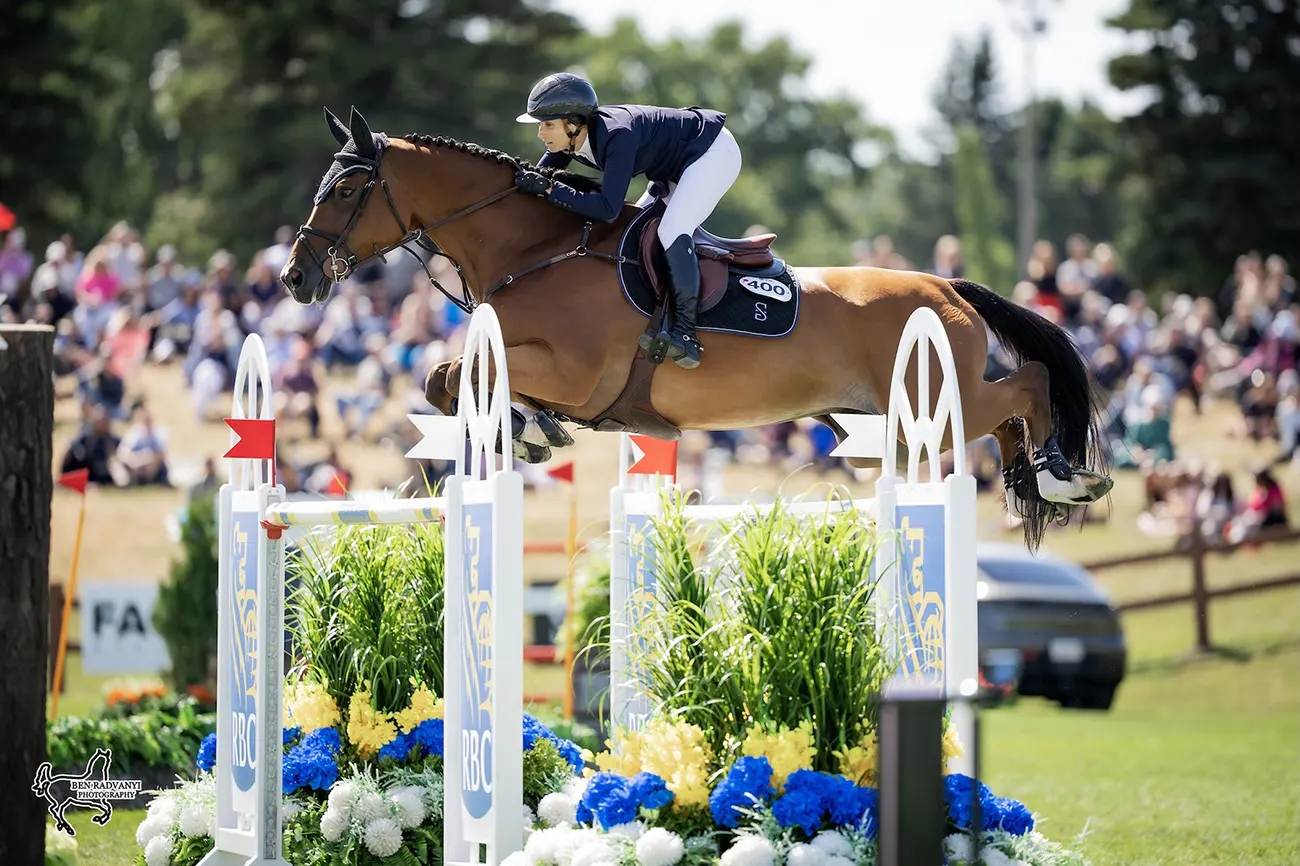
Sternlicht first paired up with “Rigi” in fall 2022, about a year after he’d moved up to the five-star level with Sweden’s Jonna Ekberg. A freak accident where he broke his hip at Sternlicht’s farm in Wellington, Florida, meant he was out of jumping at the top level for almost a year.
The pair spent the latter part of 2023 and most of 2024 campaigning at the five-star level in Europe and the U.S. before a leg injury last fall meant Rigi had to sit out the winter season. Since coming back to competition in June, he and Sternlicht have been working up to the five-star level again, and they topped the $340,000 Grand Prix CSI5* at the RBC Ottawa International Horse Show on Aug. 17 in Ottawa, Ontario. Sternlicht also won the $35,000 1.45-meter Grand Prix CSI2* the same day on Starlight Farms 1 LLC’s Corablue Z, a 9-year-old Zangersheide mare (Corydon Van T&L—Linsey, Los Angeles).
We caught up with Sternlicht, 32, of Greenwich, Connecticut, to learn more about Rigi’s journey to his big win and her plans for the future.
Congratulations on your weekend! Tell me about winning the big grand prix with Rigi. You were one of only three riders to make the jump-off.
It had rained earlier in the day, and it was the last class on the field after having been jumped on all week. So, I think [the small jump-off was the result of] a combination of the ground and Marina Azevedo built a very difficult track. She built a proper five-star grand prix. Even though the entries were limited [there were 24 that jumped], she was not messing around, which personally I love.
I love when the course is difficult, because I also think it’s really important that the level in the [North America] stays as comparable to five-stars in Europe as possible in order for us to feel adequately prepared when we go over there for championships and Nations Cups, and not just in Florida.
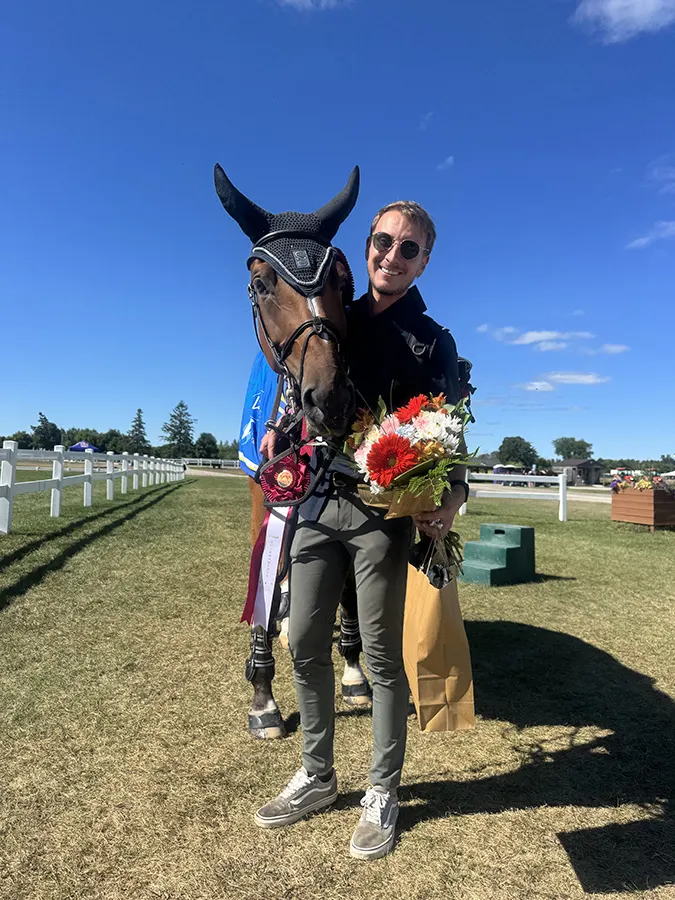
You’ve had Rigi since 2022. What’s his journey been like with you?
I thought he was a horse to jump any class in the world. And then, my third ride on him, he broke his third trochanter, which is basically his hip.
He’s really sharp. He’s a funny horse because he seems quite relaxed—a bit like a golden retriever—but then he actually has a lot of blood, and he’s quite sharp outside of the ring. I remember in that ride, he had actually broken a draw rein bucking after a cavaletti. … I could feel that I was about to get hurt, so I jumped off, and he ran back into the barn, and at that point there were still some stone pavers, and he slid and slipped and fell on stone pavers when he took off. He ended up being on stall rest for about 45 days, then I spent the whole winter in Florida just rehabbing him.
[When he came back], he moved up really quickly during his 9-year-old year, I think in six months he went from jumping 1.45 to 1.55 meters. I think as any partnership does, it ebbs and flows a bit, especially as horses move up the levels.
In the fall of 2023 he was already doing four-star grand prix. And that was not only because of his character—he’s incredibly brave and scopey—but also just my horse situation. I haven’t traditionally had three or more horses; I’ve traditionally had one or two horses to jump the bigger classes, because I’m always trying to produce horses a little bit up to the level.
[After his leg injury in the fall of 2024], he feels actually better than he did before. It’s been a bit of an off year for me, really. The past couple of years I haven’t been jumping so much on the world stage. I’ve jumped some five-star classes and things like that, but not in a super competitive manner. This winter I really took my time bringing him back.
Watch their winning round from the RBC Grand Prix CSI5*, courtesy of Horse Network:
What’s he like to ride, and what’s he like in the barn?
He’s lovely on the ground. He’s probably the sweetest horse I’ve ever had. He will lick anything. He’s kind of like a golden retriever to ride. He has a fair amount of character. He’s quite opinionated, and he knows how strong he is. He’s built like an ox. He’s not huge, but he’s quite stout in how he’s built, and he’s a horse who, honestly, I’ve had trouble connecting with at certain moments. Sometimes it’s hard to read him and what he wants.
In the past year, I did the majority of his rehab myself. I think any time that you take that down time to spend with a horse, and also whenever a horse is out from sport, [it is valuable].
I always go back and watch videos and reflect on previous rounds. And during that time, I know I also grew a lot as a rider, because I learned new fundamentals from working with [Dutch Olympic gold medalist and former world champion] Jeroen Dubbeldam. Being able to apply those now, I feel like I have so much of a better understanding of the horse, and I’m able to serve him better in the ring.
He’s always a bit distracted—like he often lands on the wrong lead. He’s not a horse who’s super focused and honed in, because I think everything is quite easy for him that he’s been presented with thus far in his life.
My mental approach to him has been that I don’t really like to grind on the horses. I ask him a question, and then when he does it, I leave him alone. Like, I rode him for 10 minutes before the grand prix just to make sure he was listening to me. And once he was listening, I give him his peace. Every horse has their own way. Many riders would work their horse for 40 minutes before the grand prix. But for him, I found that’s not what works.
McLain Ward has been an important mentor in your riding career, but you’ve made a change in trainers fairly recently. Tell me about working with Jeroen Dubbeldam.
McLain and I stopped working together the end of 2021. It was very mutual. We had been together for many years, and he and I both felt it was important that I went on my own for a bit. I think as riders, it’s one of the most amazing things about our sport that you never stop learning, and I was eager to learn from somebody else. I think when horses are your life, you spend so much time at the shows, and you kind of get glimpses into other systems and other methodologies. I knew that it was important for my own personal growth that I go out on my own.
I was on my own for a year and a half, then during the fall of 2023, I wasn’t training with anyone specifically, and I ended up reaching out to Jeroen Dubbeldam. Obviously, he’s one of the most respected horse professionals—he’s a legend, and I have an insatiable quest for knowledge in every aspect of my life. I really wanted to learn a new system because I felt like I knew the American system quite well.
When I moved to Europe in April of last year, [Rigi] was my only horse jumping big classes at that point in time. I stayed there for four or five months. During that time, I learned the nuts and bolts of Jeroen’s system, which as I was there, I realized how much different it was from what I knew.
What are your goals for the rest of 2025 and looking into the future?
For the remainder of the calendar year, my focus is really on getting my [FEI] ranking up so that I can ride on teams again. I will definitely make a bid for the world championships next year, but I believe in breaking down a goal.
I have one horse who hasn’t jumped a five-star grand prix yet. His name is Los Angeles De La Cense [an 11-year-old Westphalian gelding (Los Angeles—Lancley, Lancer III) owned by Starlight Farms 1 LLC], and I think a lot of him, so to move him up to the five-star level this fall, just to be consistently jumping at the top level and be quite competitive, so that I set myself up to have a big year next year.
You are a 2016 graduate of Brown University (Rhode Island) with a degree in public policy, and you earned a master’s degree in human rights at Columbia University (New York). As an equestrian, how important is education and a broader worldview to you?
I do a bunch of things. I don’t just ride at the minute. I’m working on a political project that isn’t something I can speak publicly about yet, but I’m really excited about, and that’s quite a serious time commitment. So, I spend a fair amount of time working with a small group of other passionate, kind of young, politicized people. I also work a bit in finance. I keep myself super busy, which I feel incredibly lucky to be able to do. I know how privileged I am to be able to ride the way that I do. And I know that I always want to lead a multi-dimensional life, and I don’t feel that that interferes with my commitment or my dedication to my sport. And I’m really, really lucky to have a really good team around me.
The post Adrienne Sternlicht Is Back In The Big Leagues With A ‘Golden Retriever’ appeared first on The Chronicle of the Horse.
]]>The post Guenter Seidel Has A New Job But Same Dreams appeared first on The Chronicle of the Horse.
]]>As a three-time Olympic medalist, Guenter Seidel has spent his entire career pursuing competitive excellence in dressage. His next chapter will be no different.
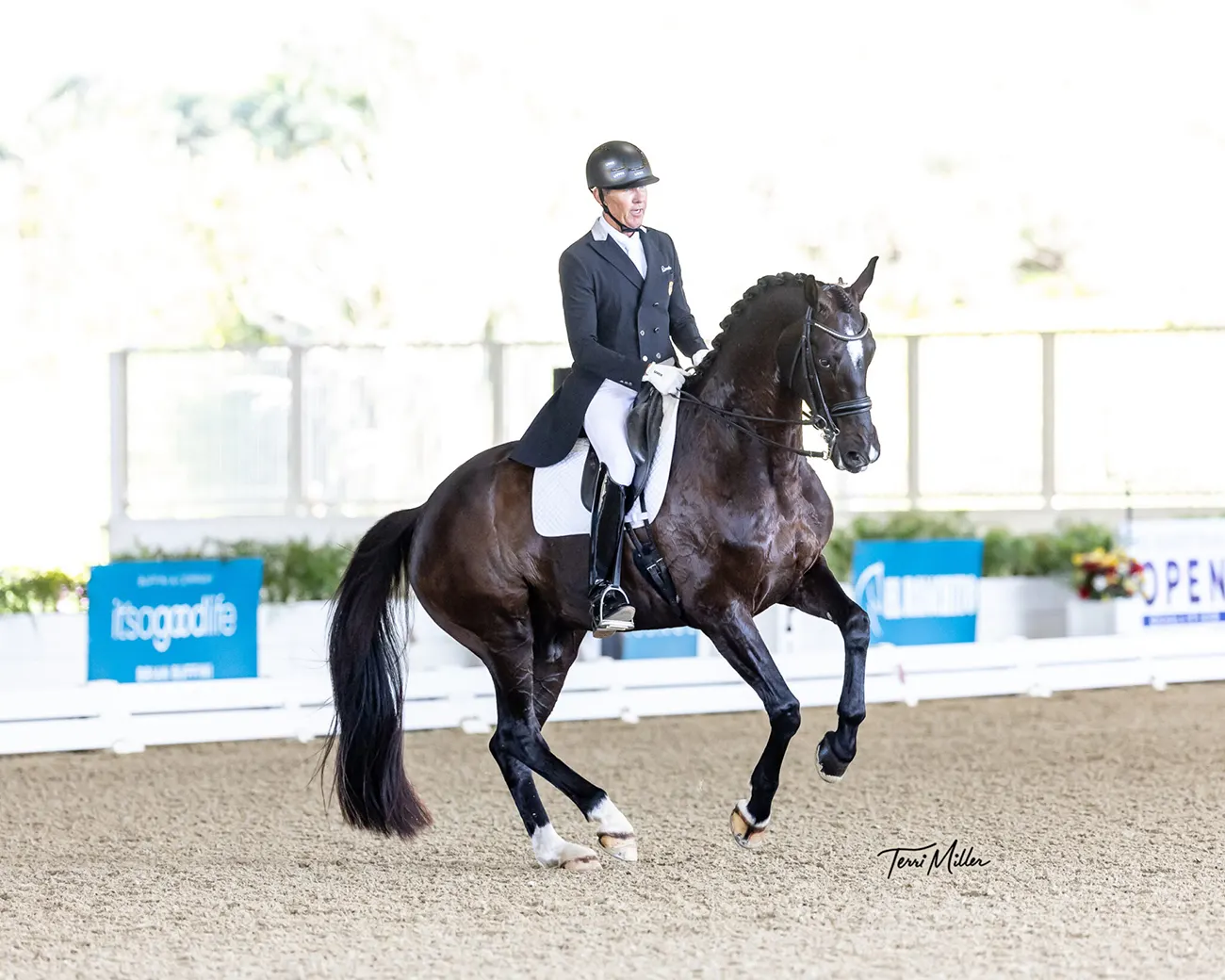
Seidel, alongside Olivia LaGoy-Weltz, was appointed as a U.S. Equestrian Federation dressage assistant pathway coach last month. He will support the coaching efforts of Chef d’Equipe Christine Traurig and USEF Dressage High Performance & Pathway Development Advisor George Williams, as the entire team works to identify and prepare riders for the podium at the 2028 Los Angeles Olympics and beyond.
Meanwhile, the Cardiff, California-based professional has not abandoned his own competitive ambitions. He intends to stay a familiar face in competitions on both coasts. Of his string of horses in training, two are currently competing at the Grand Prix level: Jack (Johnson—Dimensa, Dimension), a 13-year-old Rhinelander gelding, and Equirelle (Florett AS—Orchidee T, Donnerhall), a 16-year-old Dutch Warmblood mare. Louise Leatherdale owns both horses.
We recently caught up with Seidel to learn about this next step in his career, his horses, and what he does in the fleeting moments he’s away from them.
How are you feeling about taking on a new role as a USEF dressage pathway coach?
I’m excited about it. You know, I’m still competing myself a little bit. So I didn’t really think I was going to try to get into this role so quickly, but it just all worked out well. And I still can ride and compete myself a little bit, which is great because I ride some beautiful horses owned by Louise Leatherdale. I’m super excited about helping, especially with having Christine [Traurig] in the program as well, because I’m good friends with Christine and the whole crew.
Christine is pretty much the main person, so I’m more in charge of developing people coming up to the Grand Prix level, including the under-25 Grand Prix riders, which are the kids coming out of the [FEI] Young Riders. They’re just starting their careers, which makes it a great, great division. I love working with those kids.
Why did you decide to take the job now?
Right now, we’re gearing up toward the Los Angeles Olympics in 2028 and really trying to scout and make sure we’re getting a strong field coming up to the Grand Prix that’ll be ready when the time comes. And I think that it takes a lot of work, and it can’t be done by one person. I wanted to help.
Tell us about your current string.
I have two main horses right now, but the newest one is named Jack. I’ve had him for probably two or three years now. I’ve shown him a little bit at the Grand Prix the last couple of seasons but not that much. I feel like it’s taken me a long time to get to know him and figure him out. But I feel like I’ve finally gotten to that point where we click. Hopefully this coming season, we can be a little more competitive in the Grand Prix.
And then my longtime partner is a mare named Equirelle. She’s older, as she’s 16. But because she had a tendon injury a while back, she’s been off for a year. She’s coming back into work now, and she’s doing quite well. I think she should be ready to be competitive this year and be in full work at the Grand Prix. I also have a couple of young horses going in the Prix St. George right now. But they’re still coming up.
You were injured not too long ago yourself.
Yeah, unfortunately, I had to have a couple of back surgeries recently, which threw me back a little bit. It wasn’t a horse injury at all; I just started having sciatic pain. I had a really good friend who is a very famous back surgeon; his name is Dr. [Robert] Bray, and he took me on. The problem ended up being a cyst in my lower back. It had to come out and be operated on, because it pushed into the nerve and caused a lot of sciatic pain.
There were some complications with the cyst, too, as it got a little infected. So there was a little bit back and forth, medically. We had to go in twice again and clean it out and stuff. It’s been going on for eight months, off and on. But I’ve ridden in between procedures, so it’s not like I’ve been off the horse the whole time or anything. Even when I competed in that time, the pain really was not too bad.
Now that you’re fully back in business, how will you balance your competitive goals with your responsibilities as an assistant pathway development coach?
That’s why we have multiple pathway coaches. Let’s say I’m at a competition, and a student’s ride times interfere with my rides. Then, someone else on the team—Christina, Olivia or George, probably—would step in and help a little bit. But most of the competitors I will be helping with also have their own coaches with them at these competitions. So it’s probably not going to be too big of a problem to coordinate everything and make it work.
I think everything has its plus and minus. Of course, since I want to compete, it takes away a little bit, time-wise, because it can interfere with the show. But I also think that if you’re competing yourself, and you’re going down the centerline yourself, you stay sharp yourself. You know what someone is going through, going down the centerline. Not that other people can’t do that or don’t have that; the other coaches have all shown and competed themselves. But I think sometimes if you yourself are right in the middle of it at that second, your heart is a little more in it right now. And you know a little bit more how it feels in the moment.
What are your plans for the upcoming winter season?
I’ve gone to Wellington [Florida] a few times, but I haven’t been in the last couple of years. I’m not quite sure whether I’ll go this year. I’m in the process of talking to Louise, who owns the horses, and she has a ranch in Wellington, so I think this coming season, I might like to go there again to compete.
I’d like to go because I think the horses are in a different place now. They are actually competitive now. Being down there, where they can show because there are more shows there, would be good. And the horses need to show more in Florida, because you have a little bit of a better atmosphere there, in the way of spectators. Then the horses will get more used to the crowd. You don’t have that as much here in California, and [there are] just more shows in general. Also, because Louise has a farm there, it’s easier for me to travel there. I don’t have to make a lot of arrangements. It’s pretty easy to pick up the horses and go there. All of those kinds of things.
When you’re not at the barn, what do you get up to?
I surf. Mostly because I live close to the ocean. I come home, grab my stuff, and just go down the beach and get in the water. But unfortunately, I haven’t gone in a while, because of the problems I’ve had with my back. I’m doing better now, so I will start back up pretty soon. And just generally staying active, working out a little bit on the side, and cooking dinners—those are all a big part of what I do outside of the barn. I have a very, very blessed life.
The post Guenter Seidel Has A New Job But Same Dreams appeared first on The Chronicle of the Horse.
]]>The post Alessandra Volpi Jumps Onto The World Stage With A Pair Of Mares appeared first on The Chronicle of the Horse.
]]>It’s hard to believe Alessandra Volpi just turned 25 when you look at her international show jumping record. After a young rider career that included two FEI North American Youth Championships experiences, she graduated to the senior level with a bang in 2022, making her first five-star Nations Cup team and her first FEI World Cup Finals appearance that year, both aboard the talented mare Berlinda.
Now, after spending the past year training in Germany and Florida with Marcus and Meredith Beerbaum, Volpi is back at the top again, this time with a pair of mares—Gipsy Love and Candy Luck Z, both owned by Cedar Fox LLC.
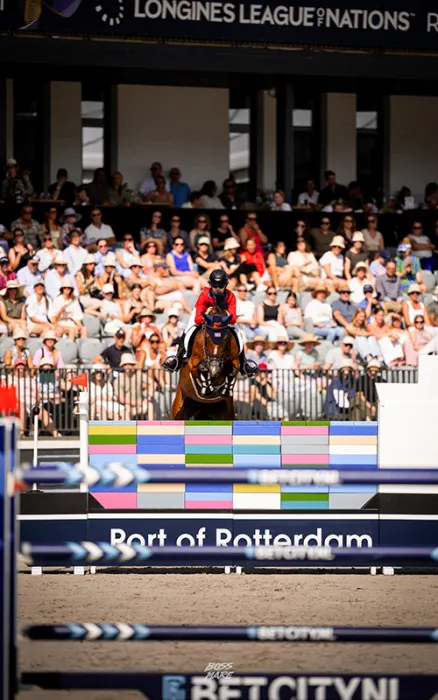
After an impressive appearance earlier this year with “Gipsy,” an 11-year-old Slovakian Warmblood (Guidam Sohn—Cholula L.A.T., L’Esprit), at the Longines FEI World Cup Finals (Switzerland), where they finished third in the second round of competition before withdrawing with a minor injury, Volpi has been competing on the European circuit with both mares and her string of younger horses. Last week, she was part of the U.S. team that finished fifth in the Longines League Of Nations Rotterdam (the Netherlands), along with Aaron Vale and Paris Olympians Karl Cook and Laura Kraut.

Volpi was born in California but spent a few early years in London. She fell in love with horses on pony rides in Hyde Park before her family moved back to the San Francisco Bay Area. She trained with Max Amaya and then Harley Brown before the COVID-19 pandemic hit. Then, while school was fully online, she decided to chase her dreams to the Florida winter circuit.
She graduated in 2022 from Stanford University (California), where she majored in science, technology and society, and minored in civil environmental engineering, but returned to horses full time after college.
We caught up with her after Rotterdam to learn more about her love of mares, what she learned from the Beerbaums, and what’s next for her.
Tell me about your team experience at Rotterdam with Gipsy Love. It was your first time there?
After the World Cup Final this year, which went well, I really wanted the chance to jump on a team, and [Chef d’Equipe Robert Ridland] suggested to us that I jump this one, which I think was a really good fit for my horse. It is obviously an important Nations Cup for the U.S. because we needed to qualify for the [Longines League of Nations Final, taking place in October in Barcelona]. It’s both intimidating and exciting to have that pressure on you, but I always find being on teams with the more experienced athletes and horses to be inspiring.
I guess you can see it as a lot of pressure, but I think you can choose to see yourself as, like, this is proof of all the work: I’m here on this level now with these people. I’m jumping on a team with them for a reason. It’s really exciting. It’s really fun, and it’s also an honor to learn from them, watch them and get a chance to do it myself.
It was my first time at Rotterdam. I think when I go into a Nations Cup week, the team class is always my focus. My main goal was to do my best try and jump clear rounds for the team.
I jumped two three-star [Nations Cups] in the past month and a half, as preparation to jump on that team, and both of those I would categorize as rocky experiences. I’m working with my two best horses [Gipsy and Candy Luck Z] now; one is 11, one is 10, and so they’re a bit newer to the level. I haven’t had them all that long—both of them about a year and a half—so it was a lot of learning. We had a few bumps in the road. I was nervous, but I was excited. And to be honest, I think sometimes I do my best performances under pressure.
We managed to jump clear in the first round, which was super exciting, and it let the team move on to the second round, where we had two down, but my horse still jumped really well. I think we have a lot of things to work on back at the barn for our next team appearance. But I was super happy with her, and it was a challenging class.
Tell me about your partnership with Gipsy.
I got her at the end of the last Florida season. She was bred in the Czech Republic, which is quite unusual, and Christian Kukuk [the 2024 Paris Olympics individual gold medalist from Germany] saw her as a 6-year-old and bought her along with Ludger Beerbaum. When she was 8, she was sold to another American, Anna Dryden, who rides in Ludger’s program. Marcus always had eyes on the horse. I was looking for a potential grand prix horse, and Anna was willing to sell her at that moment in time. I think we got lucky with her, and Marcus always saw the potential in her, and she’s turning into a really amazing partner.
“When we make a mistake, I think, ‘How can I understand her better?’ not, ‘How can I make her better?’ “
I always say she’s a very special horse. I don’t think we understood each other very well at the beginning of our relationship; she’s very sensitive, and you need to really work with her in the way that she wants to be ridden. You have to agree with her—she’s a mare—so it doesn’t feel like I’m telling her what to do. It’s me and her working together always and trying to bring the best out of each other. It’s listening to her. And I feel like when we make a mistake, I think, “How can I understand her better?” not, “How can I make her better?”
You had an incredible start to the FEI World Cup Final this year in Switzerland, finishing third during the second round and sitting seventh before the final round, but then you withdrew. Tell me what happened and what you learned from the experience?
That was an amazing experience. I actually didn’t think I was qualified to go. I hadn’t had incredible success in the qualifiers, and somehow I managed to have enough points to qualify through the Western League. Lizzie Chesson [USEF managing director of show jumping] came up to me toward the end of the Florida season and was like, “Any chance you want to go to World Cup Finals?”
At that point, Gipsy and I were starting to kind of understand each other more and perform more in the big grand prix [classes] in Florida. I talked to Marcus, and we decided to give it a shot.
I had no expectations. I’ve jumped this horse one time indoors. We tried to prepare the best we could, of course, but you never know. A championship is a completely new, different environment, even from jumping a five-star grand prix. I kind of went in just focused on doing our best and growing as a partnership from the week.
We were clear the first day, and I was over the moon, and then had a double-clear in the jump-off class, which, I think there were only six clear rounds that day. It was very special feeling. And it was just one of those moments where you’re like, oh my gosh, all this hard work finally comes together and shows you that you’re doing it right.
I had to withdraw from the final because she had overreached and just wasn’t fit to compete in the final round. She was totally fine body soundness-wise, just couldn’t compete on that foot. She was back to being all good in a week’s time. A lot of people were like, “Oh, how sad and unfortunate,” and, “What a bad ending to this week.’ ” And I was like, “Are you kidding? I came here with no expectations. My horse jumped three clear rounds in this championship!”
I was so happy, and it gave me a lot more confidence in myself and her and our partnership. So that was really an amazing week for us.
What’s it been like training with the Beerbaums over the past year?
I think [Marcus] is incredibly proven in his training. I mean, if you look at the roster of, especially American women, that have come through his program and had a lot of success, it’s pretty incredible, which is why I kind of sought him out in the first place.
Part of what I appreciate so much about him is that he gives me a lot of confidence in trusting my own instinct. Like, if I think that I should try something or do something, he’s like, “Alright, give it a shot.” And that’s, in my opinion, the best way to learn.
I think he also puts a lot of emphasis on flat work, and the work at home that goes in—you’re not changing everything at the show. If you look at Meredith and the work he did with her, you know, it’s a very different type of horse or riding style than you would maybe expect from a traditional German-style instruction. It’s traditional theories applied to a more modern style.
You’ve got more mares than geldings or stallions in your string right now. Why do you think you connect with mares?
Actually, it’s pretty bad! Like, now, if I’m looking at a horse to buy or try or whatever, I’m [jokingly disappointed] it’s a gelding, which is not how I should act! [Laughs.] And I’m trying to get rid of that prejudice, but I am a big fan of mares.
I think that when they want to fight for you, they really fight for you. Not to say geldings don’t or stallions don’t—I also have a really talented stallion—but Berlinda was my first, most amazing mare, and I always just tend to have a good relationship with them.
What are your plans for the future? Do you want to do the horses full time?
I never say never to anything. Every time there’s a kid that’s like, ‘I don’t know if I want to go to college,’ I tell them, ‘Definitely go to college,’ because you never know. College was the most amazing experience. I did like the academic work and the internships that I had through school.
Right now, the horses are my passion, and luckily, I have the support to pursue that at least for the undetermined future. But I can definitely see myself also working with my education.
We just bought a farm in North Salem [New York] in an effort to get a home base, because I was just floating a little bit [between Florida and the Beerbaums’ German base].
I’ve been working hard to build a younger team of horses that I can bring through the development phases into grand prix horses. I think that process really works for me. A lot of them I have are 7, 8, 9, so that way, when we get to the grand prix age of 10, 11, 12, 13, whatever, you know them so well, and they’re more tailored to your program and your riding. I enjoy that process a lot, so that’s how I try to build and keep the team going.
My goal for the next couple years is to try and get as much team experience as I can. It’s a whole different feeling jumping for the team than it is for yourself. I’m trying to learn by doing and just put myself out there and be OK to make mistakes. I’m focused a little bit less on hard and fast results and more on just building this year. Not to say I don’t enjoy good results, but I try not to make it my main focus. I don’t think I’ve always felt that way, but I’m learning that that is the better way to be, at least for myself.
The post Alessandra Volpi Jumps Onto The World Stage With A Pair Of Mares appeared first on The Chronicle of the Horse.
]]>The post Cosby Green’s Investment In Education Pays Off At Luhmühlen appeared first on The Chronicle of the Horse.
]]>In that time, she made her five-star debut with Copper Beach at Pau (France), where they were 16th, and last year they contested the “Big B’s” of Badminton and Burghley (England) before that horse’s retirement this year at 19. This year, Green headed to Longines Luhmühlen CCI5*-L (Germany), June 12-15, for the first time, bringing with her two horses she’s brought up to advanced.
She finished fourth with Highly Suspicious, a 15-year-old Irish Sport Horse by Russel owned by her parents, Edie and Clay Green, in their second attempt at the level. They traveled back to the U.S. last year to contest the Mars Maryland 5 Star at Fair Hill, where they led the dressage on Day 1, but were eliminated cross-country. This spring they were 13th at the Bicton International CCI4*-S (England), where they were part of a young U.S. team that finished second in the FEI Eventing Nations Cup. At Luhmühlen “Puff” added just 0.4 show jumping time penalties to their dressage score of 34.6 and were one of four pairs to make time on cross-country.
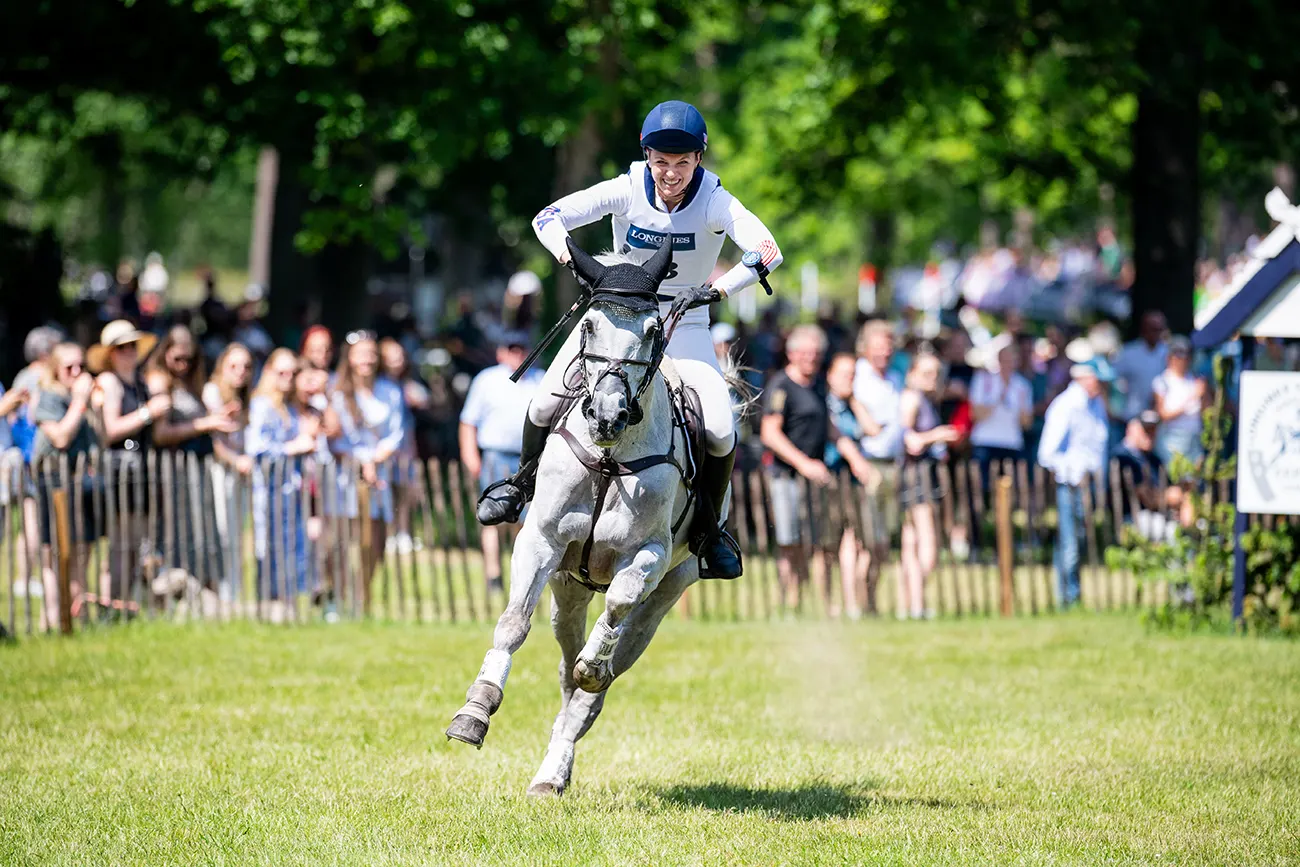
It was a five-star debut for Jos UFO De Quidam, a 17-year-old Argentine Warmblood (Lobby Des Fortes—Remonta Guinea). “UFO” was brought up to three-star by Heather Morris before she gave Green the ride in 2022. In 2023, the pair finished 25th at Boekelo CCIO4*-L (the Netherlands), where they were the top-placed rookie pair. At Luhmühlen, UFO was just over the time on cross-country and added a rail and time in show jumping finish eighth on a score of 44.2.
“It’s amazing when it pays off and comes together, and when the team is proud and everyone’s happy and pleased. That’s what makes me the happiest, as well as when the horses are happy and enjoy themselves,” she said.
We caught up with Green to hear about her European plans and the experience at Luhmühlen.
You originally only planned on staying in England for a couple years, what made you decide to stay abroad longer?
It was always my plan that I’d come home after a year or two. I feel like I’m still not done yet, and I wanted to be more competitive, have bigger dreams and goals, and I feel like the best place to do that would be in England, just in the sense of horse quality and support system and the lifestyle. It seems like the obvious answer of how to make my dreams come true. Hopefully I’m here to stay for a good while.
What have you been working on this season?
This season’s been an interesting one. There’s been a lot of growth in it. I have really been starting to ride a lot more horses and growing my string and establishing myself as a professional over here. I’ve done lots of competing, all different levels, all different types of horses. That’s something that I’ve been working on, just being able to diversify myself as an athlete, competing everywhere, all types.
Then on another note, I’ve just kind of been focusing on getting the horses to peak when I need them to peak. And then thinking about the older horses’ goals, and then the younger horses’ goals, and just quietly producing the younger ones. … I’m just trying to be very methodical this season and this year [in regard to] “This one needs to go here and not there,” and just trying to have a better idea of what it takes to get to the top levels and trying to spread that out accordingly.
What made you decide now’s the right time to take these horses to a five-star, and what made you choose Luhmühlen?
Puff obviously tried his debut at Maryland. I really thought he was ready and prepared for that, but to be honest, he felt not himself a couple of the days of the competition. I still have no idea what happened or what went wrong necessarily, because he was on such good form, other than he just felt not himself. Whether that was the travel or not, I’m still not sure to this day, but ever since then, he’s been on incredible form. He’s come out this year feeling amazing. So just kind of in response to that, I thought Luhmühlen would be a good pick for him, because they say it’s not as big in dimension, which is true, but it definitely had its own different kind of difficulties to the other five-stars. I knew that he would feel, hopefully, nice and confident around there, which he definitely did. If anything, he was a little bit too keen, but we’ll take that.
Then for UFO, I’ve always thought that kind of track would really suit him, because he’s tiny and he’s so easy to turn and so quick on cross-country, that I thought he would just really, really kind of thrive in that twisty type of track, and he really did.
How do you feel they went this week?
I was really just so proud of both of them as a whole. To have both of them go so well and come through so well and perform, as I had always dreamed or had hoped, was amazing. I think the only thing that I could really have tidied up on Puff’s performance was his couple of flying changes. He is so solid and so incredible at those, so I was pretty devastated to have messed up a couple of those, just because that kept him from a really top, top performance.
But otherwise, I just couldn’t fault him for a single thing. I thought it was the best he’s ever gone. He was with me and tried his best the whole entire time. That’s been a really long kind of partnership, and one that’s had ups and downs, so it was really nice to feel it—especially in the jumping phases—really come together.
UFO was out on injury last year, so we had to really think about how we were going to get him to Luhmühlen. It had to be a little bit light on runs, but we had a great fitness plan. For him to have come through it so well is amazing. To have done the cross-country so full of running was also incredible. The dressage with him, he’s limited in his ability, just from his conformation and his movement, he wouldn’t be so flashy, and his changes are really not confirmed. It’s a little bit harder because he’s older with those, but we do what we can, and he put down a solid effort. I don’t think he could have done too much better.
Cross-country, he was the perfect horse for me to go run around that track on for the first time. He was so good to me and so confident and absolutely flew around it. The show jumping I thought he was trying his guts out. He had that one unfortunate pole, but he really tried his best to not touch anything and had a nice, smooth round and a really good, tidy performance for our first five-star attempt.
Your first five-star horse, Copper Beach, had lots of experience with Buck Davidson. How does it feel to have brought these horses up to the level and finish in the top 10?
It makes me super proud and super happy and relieved to know that the system works. It’s just really comforting to have horses that I know so well. “Sean” was always a little bit what Buck had him to be and wanted him to be. And these ones I could make a bit more myself. It’s just super special. And I felt like I’m able to add the things I learned from Copper Beach as well and pass it along to them. I learned how to deal with the pressure of five-star and the expectation, and I was able to pass that knowledge along to them.
What did you learn about yourself this weekend?
I learned that I can do it—basically that it’s possible. Sometimes as an athlete, you get one horse around and you think, “OK, maybe that was a fluke, or that was lucky.” But to have both of them perform so well, and very similarly, I think that really gives me confidence that I am able to do the level, and they’re ready, and I can put in a solid performance. … It’s just nice to know that I can have multiple horses at the five-star level.
The post Cosby Green’s Investment In Education Pays Off At Luhmühlen appeared first on The Chronicle of the Horse.
]]>The post Tori Colvin Talks Derby Wins, Homebreds And Future Goals appeared first on The Chronicle of the Horse.
]]>Tori Colvin made a name for herself as a junior, winning just about every championship title in the hunters, jumpers, and equitation rings, often against professionals and many multiple times over. After such a prolific junior career, Colvin went out on her own and has been a fixture in the professional divisions ever since.
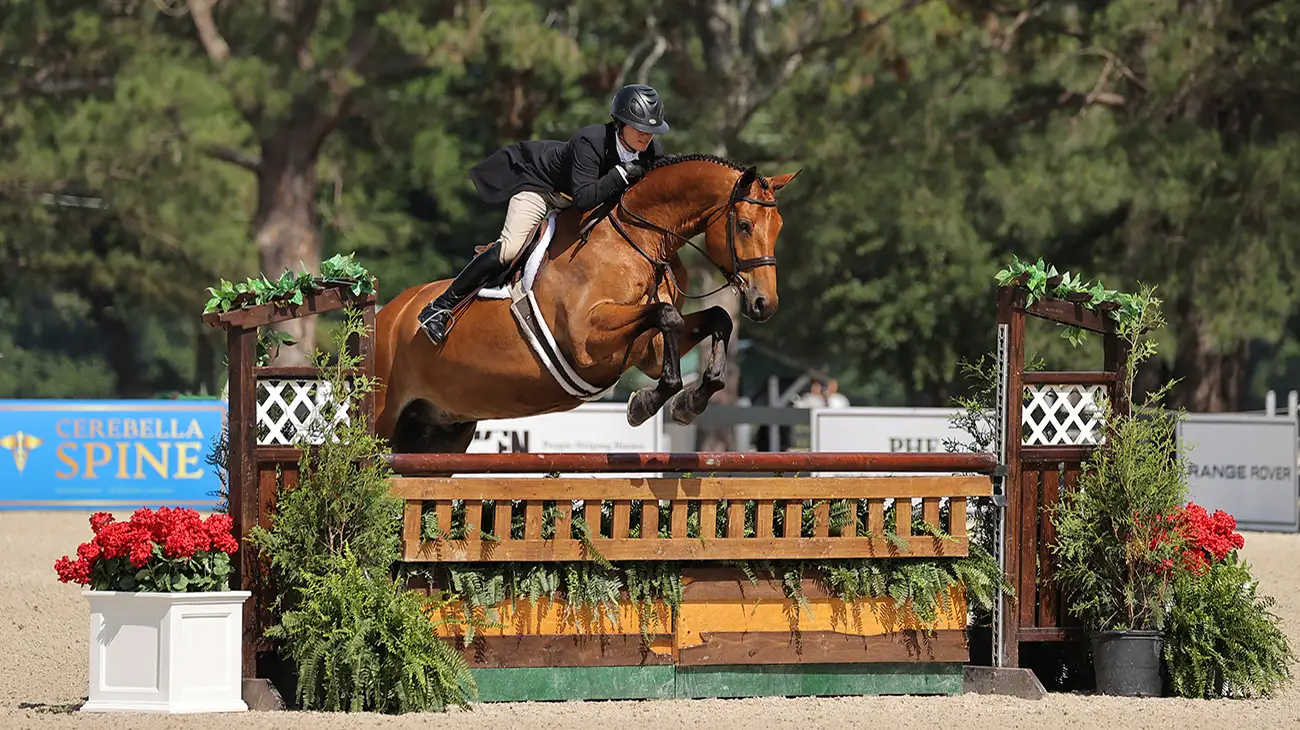
A three-time winner of the USHJA International Hunter Derby Championship (Kentucky), Colvin continues to rack up wins in the derby ring. On May 9, she and Castellrock LLC’s Dicoblue PS topped the $25,000 USHJA International Hunter Derby at the Aiken Charity Horse Show II in Aiken, South Carolina.
We caught up with Colvin, 27, who’s based in Loxahatchee, Florida, to learn more about “Blue,” an 11-year-old Oldenburg gelding (Diarado’s Boy—Chactine, Chacco-Blue), her current business and her up-and-coming homebreds.
Why did you choose the Aiken Charity Horse Show as a target for Blue?
We’ve been going to that show the last five or six years now, and it’s a very good first away show from the [winter] season. It’s a nice facility, has a lot of grass, but it’s not massive, so a lot of the horses really like it. This horse particularly, we’re aiming towards the derbies and [the USHJA International Hunter Derby Championship]. The previous week they had the [$25,000 Mahoney-Miller Hunter Classic], and he was second in that, so we kind of targeted those bigger classes with him there.
We hadn’t done a derby in a couple months, so I didn’t know how he would do, but he was really, really good. He seems to like that horse show. Last year he was second in that derby, so he came back and won, which was nice. He feels very comfortable and happy there.
What do you think makes him a good derby horse?
He doesn’t care about anything. He doesn’t spook. He’s very level-headed. We don’t even longe him. He’s a very good soul. He’s very handy as well. I think all those kind of make him into a derby horse. He’s beautiful to look at but still has the scope to be able to jump the big jumps with not basically using any effort but still making it look like he’s jumping really well.
Sadly, he is for sale, and there’s a couple people looking at him right now. So, I’m not sure we’ll have him in the barn too much longer, even though I would love to be able to show him at derby finals.
What’s his personality like?
Very sweet. Loves cuddles. He’s in your face. He’s a little spoiled, but that’s OK. He’ll ask anybody for treats. He’s a very sweet guy, and he just likes to be cuddled. He’s overall just genuinely, very, very sweet.
I wanted to talk to you a little bit about where you’re at in your career and your business. What types of horses do you have in your barn right now?
Basically, a little bit of everything. I have a couple 7-year-old jumpers who are, knock on wood, I think very nice. And then we have some sale horses as well. I have a lot of babies. We [Colvin and her mother, Brigid Colvin] bred a couple. I have a lot of 4-year-olds that are coming up right now, hunters and jumpers, and then some client horses. Right now, we have 16 horses in the barn, and during [the Winter Equestrian Festival (Florida)] we had 25.
The oldest one that I’ve bred is named Naminko (Cornet Obolensky—Wamkina, Fedor). He’s a 6-year-old jumper, out of my old junior jumper Wamkina. He jumps exceptionally well. He could almost be a hunter or a jumper. He seems like he’s going to be really talented. And then I have a couple baby hunters that are 4, which I haven’t shown yet, that are coming up right now. And then we have about like 10 foals in Kentucky right now. My mom gets excited [about bloodlines], so she likes to have a lot of babies. I have to tell her to slow down!
We’ve just bred one by Mumbai [formerly ridden by 2024 Paris Olympic champion Christian Kukuk]. We’re testing out the waters of all the breedings. We have a couple Chacco-Blues, Cornet Obolenskys, and we’re kind of feeling out which one seems to make the best temperament and the best talent. There’s a couple of them that are in Virginia, getting backed and figuring out their lives right now.
What do you like about doing the young horses?
I like it because it’s very fun to see them come along. Like my 6-year-old I have, I’ve seen him since he was a foal and born in Kentucky, and then he was being backed in Virginia, and then he came here, and he was still quite green when he came here. But I started in the 0.90 [-meter classes], and now we’ve made it up to the 1.20s, and it’s pretty cool. And hopefully next year will be in the 1.30s, and hopefully he’ll just keep going bigger and bigger. It’s cool to watch them grow.
Has there been anything that’s surprised you about being a professional in the hunter/jumper industry?
It wasn’t as much of a shock as I feel like maybe for some, because when I was a junior I was already showing in the professional divisions when I was with Scott [Stewart]. Yes, when I went off and on my own, it was a little different. But then I kind of went right into riding for the Ingrams at that time, so it wasn’t as much of a dramatic change. I kind of just kept doing the same thing. It’s a little different [now] because it’s solely my barn, but it’s kind of just all transitioned into each other slowly.
What have you taken away from some of the programs and trainers you’ve worked with to your own business?
A little bit of everything. For the equitation, especially, I rode mostly with Andre [Dignelli] and Heritage [Farm], but I rode a little bit with Missy Clark and then with Scott, and so I had a little bit of everybody, which I feel like helps a lot, because everybody’s a little bit different. You learn a different thing from everybody.
What part of your job is the most fulfilling?
The babies, watching them grow. Watching Izzy [Isabelle Castellanos], the one student that I have right now, watching her grow and learn new things and succeed. I started her when she was on the small ponies, and then she just did the [WEF Equitation Championship]. That’s fulfilling for me.
Do you have any big goals for 2025 for yourself?
It’s a little difficult because we have a lot of young horses. We were planning to go to Devon [Pennsylvania], and we had three or four going, and then one is possibly getting sold, and then the other one is maybe getting sold. So, I don’t know if we’ll go there. And then my jumpers are just 7, so they can do enough, but they’re still young, so I don’t want to push them too much. So right now, we’re in a little bit of a waiting game.
We’re definitely doing derby finals and indoors. Izzy is going to do all the finals, so that’ll be fun and exciting. But we don’t really have too much of a plan.
What about goals for your career?
The biggest thing would just be to keep having more jumpers and trying to produce grand prix horses.
I’ve had one here and there, and then some young horses, but I haven’t had enough yet. You need a good string. I’m hoping to build that string, and then hopefully they’ll be able to jump the bigger stuff. When I was a junior I had a couple really, really nice horses. My main nice horse was Cafino, and I was able to show him at a World Cup [qualifier] and stuff like that. That would be my dream [to get back to that level].
The post Tori Colvin Talks Derby Wins, Homebreds And Future Goals appeared first on The Chronicle of the Horse.
]]>The post Ph.D Student Katie Dinan Shines At World Cup Final With US-Bred Mare appeared first on The Chronicle of the Horse.
]]>“Bridie,” an 11-year-old Belgian Warmblood (Verdi TN—Casa Blanca La Silla, Cassini I) bred in the U.S. by Lisa Lourie and owned by Grant Road Partners LLC, came up through Lourie’s young horse training program at Spy Coast Farm. Once she had a solid base, Irish Olympian Shane Sweetnam started riding her in bigger classes. After a lifetime under Lourie’s ownership, Dinan purchased Bridie as a coming 10-year-old, and the pair was able to step right onto the international stage.
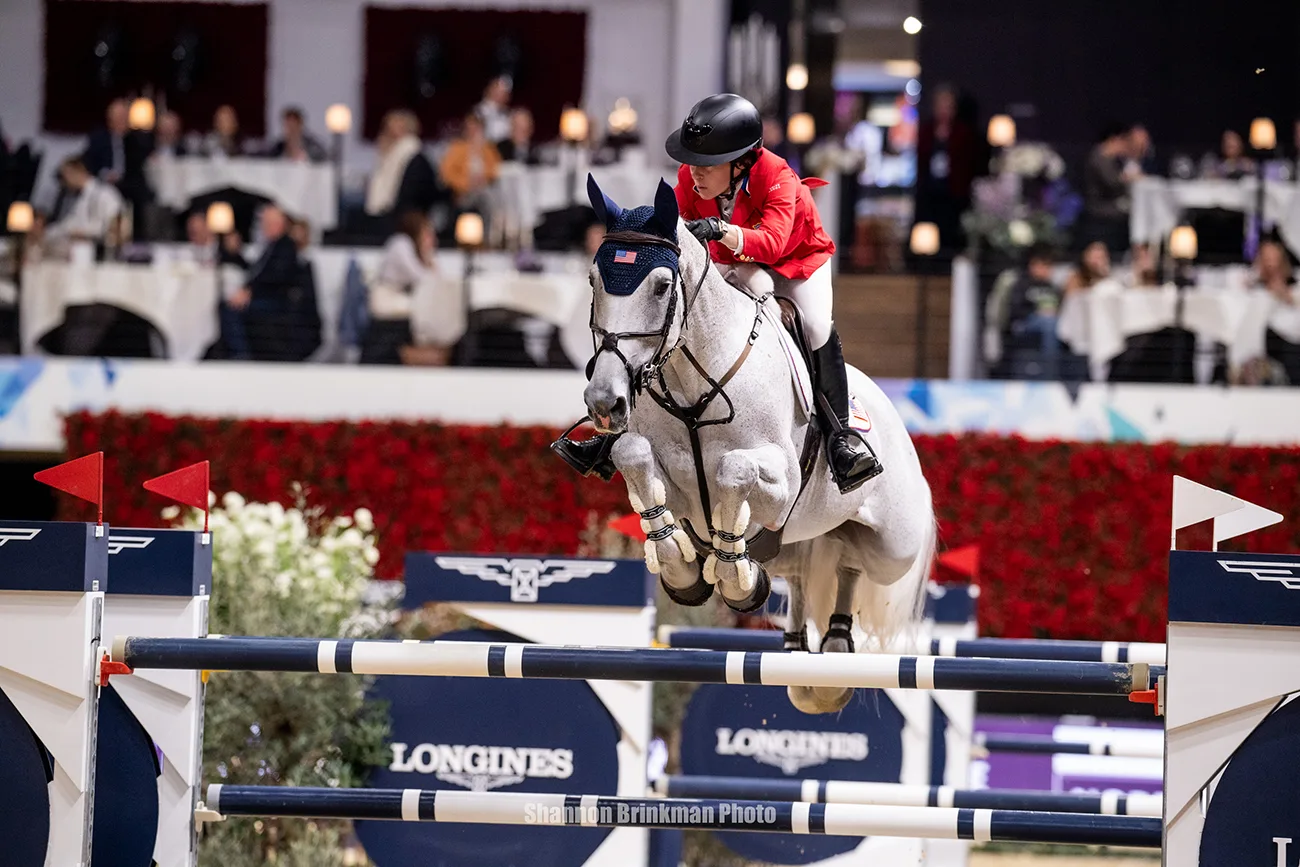
“She has so much power and ability; she has so much scope,” Dinan said. “She physically is such a great jumper, and at the same time, she’s super intelligent. She understands the sport; she understands that she should clear the jumps. She has quite a competitive nature herself, and she really wants to do the job really well and takes herself very seriously. Especially this past week—what she put into it, it just took my breath away how hard she tries to do the right thing. To have a horse that’s both so brave, but also so smart at the jumps is such an amazing combination.”
Dinan, 31, already had five World Cup Final appearances under her belt, so she had ample experience to draw from, paired with a little extra good luck in the form of memes of retired top mounts Brego R’N B and Nougat Du Vallet wishing her luck, courtesy of her mom.
Bridie showed she was ready for the intense three days of jumping, culminating with a pair of clear rounds on the final day of competition. They were one of just three pairs to jump clean and the only ones not to have a time penalty that day, boosting them to eighth overall and making them the highest-placed U.S. finishers.
“It was definitely a very exciting week,” said Dinan. “I am still pinching myself a bit. Sunday was definitely a really big day for me.”
We caught up with Dinan to talk about Bridie, their World Cup experience and Dinan’s research endeavors.
Tell me a bit about Out Of The Blue SCF. She seems like a cool horse.
She has a really fun story. She was bred by Lisa Lourie at Spy Coast Farm, so she’s an American-bred horse, which is not something you see that often in show jumping. There are more and more people, especially Spy Coast, trying to breed in America. That was something really cool to be part of, especially representing the U.S. at these competitions, to have a horse that was bred in the States.
She has really good breeding. She is by Verdi TN, the stallion from Maikel van der Vleuten that had so much success. And on her mother’s side, she’s out of a mare named Casa Blanca, who was by Cassini I and Tin Rocco, and her mother has unbelievable results as a broodmare. She is the mother of Rebeca LS, [who was] ridden by Edward Levy and Brianne Goutal-Marteau in big grand prix, jumped 1.60-/1.65-meter classes, and Bridie’s younger sister by one year [Paso Doble SCF] is now ridden by Nayel Nassar, and is also jumping 1.60-meter grand prix. So, the fact that the same mother had three babies that have all jumped 1.60 meters is pretty remarkable.
We got her at the end of her 9-year-old year, and I started showing her last January. … The more I know her, the more in awe of her I am. She’s just an unbelievably fantastic horse, and I am pinching myself that I am lucky enough to be her rider and that we have her in the stable. She has so much blood and really wants to go and has so much just, like, forward energy and is always looking to the next thing. She’s the kind of horse that you could go galloping outside and she could canter for hours and hours. She just seems to have endless reserves.
What drew you to her in the first place?
I have to give my coach, Beat Mändli, who I’ve worked with for over 10 years now, credit for that. He had seen her with Shane that summer jumping some big classes, and he really liked her. I think he saw in her that she was a mare with a lot of blood, and that really pulled you to the front and wanted to go, and he thought it would be a really good combination for me. And I wasn’t sure. Shane is such a good rider, and I’m always hesitant to make any assumptions [that] a horse will be a good fit for me or not based on their prior results, but he had a really good feeling. …
She’s definitely a bit different than horses I’ve had in the past. She’s the first mare I really competed at this level. And she’s a big horse. She’s got a very big stride. She has a lot of blood. You don’t know until you go in the ring with them a few times, right? So I trusted Beat, and his judgment, and he had such a good feeling.
I also have a huge respect for Shane Sweetnam. I know him well, and I knew the horse had a really good upbringing, and that he had done a really good job producing her. I felt really good that we were getting a horse that had had such a positive experience and been asked the right questions at the right time.
What made this was a good year to make a bid to go to World Cup?
I think the World Cup Final is always a really big deal and something that is great to aim for. It’s been a priority of mine for many years. It’s a great championship, and it’s the only championship we have this year. … Also, for me, I have an 11-year-old horse that I’ve had for just over a year, and the experience of jumping this championship together I hoped would make us stronger, and we would learn in the experience.
Bridie just blew me away, and how she kept on jumping and got stronger and better as the week got on. One of the toss-ups was that I did not jump for the last few weeks in Florida in preparation for the World Cup. And for sure, I wondered if I was making the right decision. And I kind of jokingly said that I would know after the fact if I made the right decision; hindsight is always 20-20, but looking back, I’m obviously so happy I went.
You two hit the ground running last year and made the short list for the Paris Olympic Games. How do you feel like your partnership has grown over the last 15 months?
We accomplished a lot and had a few really good rounds early on in our partnership, towards the end of [the 2024 Winter Equestrian Festival (Florida)], and we were put on the short list, which was a real vote of confidence from our chef d’equipe and selection committee. I think we grew stronger because of that, and I was really honored by that and wanted to rise to that occasion. And then we had the opportunity to go to Aachen [Germany] last summer, which is the dream of any rider, and I think that experience made us stronger as a combination.
I really feel that we’ve been learning each other and growing together ever since, culminating this past winter at WEF. She was clear in our last five-star grand prix we jumped, and I felt like that was one of our best rounds we’ve had together.
We’re getting more and more in sync in the rounds and trusting each other more and more. It’s a huge team effort, and my coach, Beat, knows the horse better and better. Lou Beudin has been taking care of my horses now for almost eight years and has been taking care of Bridie since we got her. And she’s had really the same program now for 15 months and is getting more and more comfortable in our program. We’ve just gotten all stronger together as a team.
You were the only person to go clear in both rounds on the last day of World Cup, which is a big accomplishment. Can you talk about how it felt to pull that off?
I can’t really believe it. I was really motivated to have a strong finish on Sunday. I felt like my horse was really on form, and I wanted to deliver for her, because she was there for me, and I knew she was ready to do it. I thought [the first round] walked very big, but it was riding pretty well. There were many good rounds.
“You live for that moment of exhilaration when you’ve done it, and we did it together. The connection we had, I felt like so in sync with her, and I think that’s what made it like such a special moment for me.”
I didn’t actually watch anybody before I went, because I went 12th. I walked my course; I made my plan, and I wanted to just stick to that and focus on my warm-up. When I went in the ring, she gave me such a good feeling. The first two lines, I took a little bit of a deep breath, and just was like, “OK, just follow the plan; she’s right there.” The more we went the more confident the two of us got because she was giving me such a good feeling. After going clear the first round, I was so thrilled, but I was like, “OK, I can be happy for a minute, but now I need to just refocus, because the next round is in an hour.”
The second round was very big, and also a long enough course, so it was like a whole new event. The day is not over. It was really, for me, a test of focus, and for my horse, a test of endurance and fitness from the week. I felt like she was just peaking then, and all I had to do was not mess her up, which is a great position to be in as a rider, because she was like, “I’ve got it, Katie, just buckle up.” But I also so badly didn’t want to let her down, because I knew that she was there to do it. The whole team I had behind me—Beat and Lou, who put so much into this, and my parents and my fiancé also came for the weekend—I felt really supported.
She warmed up great, and then I felt like she was jumping so well in the second round. I thought [the course] was tough because the last two lines were like so interconnected. … It was really about execution, and my horse made that easy for me because she was just simply spectacular. When we crossed the finish timers, I had an overwhelming sense of joy and relief, because it’s what you dream of and what you work hard for through ups and downs, and you live for that moment of exhilaration when you’ve done it, and we did it together. The connection we had, I felt like so in sync with her, and I think that’s what made it like such a special moment for me.
Are you still a doctoral candidate?
I am a third year Ph.D student at Rockefeller University, which is a research institute in New York City, I am working in the lab of a guy named Mike Young, who won the Nobel Prize in 2017 for discovering basically the molecular mechanisms for circadian rhythms of our body’s clock. The lab does all their work with fruit flies, and I am studying sleep and sleep deprivation in fruit flies to try to better understand the genetics and epigenetics of why we’re so affected by sleep deprivation.
I’m really interested in sleep and different like sleep cycles. I also sometimes wonder how the sleep patterns of different types of animals have evolved, and it’s given me a new perspective on some of my horses’ behavior, [on an] evolutionary biology level. They have made new rules about how you need to have the stable areas at shows dark at night and things like that. And I think that’s really good, because the more we know about sleep, the more important we realize it is. Everything from a fruit fly to a dog to a horse to a person has this internal molecular clock in them that’s operating on a 24-hour cycle. It affects our not just our sleep, but our eating patterns, our mood, our energy, and that’s something that I think about in myself and in my horses.
The post Ph.D Student Katie Dinan Shines At World Cup Final With US-Bred Mare appeared first on The Chronicle of the Horse.
]]>The post Marcus Orlob And Jane Are ‘Settling’ For Success appeared first on The Chronicle of the Horse.
]]>Orlob and Jane (Desperado—Zandra, Metall) continued their positive momentum into the final week on March 27, where the pair earned their third straight victory of the three-month AGDF season in the CDI4* Grand Prix and Grand Prix Special. In the Grand Prix, they finished strong on a 70.63%, nudging out Kasey Perry-Glass on Heartbeat WP with 68.02%, and Katherine Bateson-Chandler and Haute Couture took third with a 67.95%. Orlob and Jane went on to earn a winning 70% in the Special.

Orlob and Jane’s run at the 2024 Paris Olympics was cut short when the pair was eliminated just moments into their test for a speck of blood, presumably from when Jane spooked and stepped on herself entering the arena. Now, the German-born rider is happy to be finding a groove with Jane as the 2025 season gets underway.
“When she settles, she puts everything into a great performance,” he said.
We caught up with Orlob while the dust of AGDF was still settling, and talked to him about how he’s working to bring out the best in his Olympic partner, both physically and mentally.
During AGDF, with all those consecutive weeks of competing, how do you stay sane?
I have to say, the last weekend was really tough because I really got sick. I had a bad cold; I had a fever, and I was coughing. But Wellington is so convenient now—better than driving all the way up to TerraNova [in Myakka City] or Ocala—and, of course, we had two horses entered. So I said, “I have to push myself through.” Thank god for my amazing team, really, and for the grooms. The horse literally was ready and I just jumped on. I did a minimal warm-up and survived.
I was happy that it was over, but on the other hand, I think it’s good that you have a CDI almost every weekend here, because this really gives you the chance to get into a routine of competing. I had Jane; I had JJ Glory Day [Grand Galaxy Win—JJ Dolche Gabbanna, Deemster]; then I had my groom, Allison Nemeth, the U25 rider, in there; and also Alice [Tarjan] competed in the 6-year-old class. So it was a busy weekend, but a good one.
You were just talking about the routine of competing every weekend for a number of weeks. How does Jane do with that kind of consistency?
I think she’s doing good. Now, looking back, maybe I should have started like a week earlier. But it is so hard; I talked to Alice, her owner, because I didn’t want to do too much, because now we have Europe on the schedule coming up. I think this is really the hard line as a rider, trainer, owner: What is the right amount of competitions? But I think Jane benefits from being in a regular show program.
What made the last few weeks so successful? What clicked for you and for Jane?
You know, we are training hard at home. I would say, what was a really big help was that [U.S. Dressage Team Chef d’Equipe] Christine Traurig came over a couple times, and we had conversations about what she thinks is necessary and what I think is, and we kind of met in the middle to work together on a training plan. I think it’s really working.
Now, again, it’s time to change the training. But I think, for the test, Jane is in great shape. Now it’s just the other part: I need to travel again with her and get her to different rings to get her more desensitized and comfortable again in the show ring.
What are you and Christine working on together? What does that program look like?
Just overall, more throughness to have Jane really supple. Christine was really focusing on this, and just overall, a touch more engagement in everything. That is the main thing.
When did you first meet Jane, and what was your impression of her?
I first met her when she was a 3-year-old. I met her in quarantine, because Alice called me and said, “Hey, I have this new mare, but she’s really spooky and hot, so you ride her in quarantine, and then after quarantine, I will deal with her.”
I remember, I said, “Wow, my god!” I mean, first of all, she’s beautiful. She was very, very sweet on the ground. And Alice was completely right. In quarantine, they also have jumps so we had to share the ring with the jumpers. She was literally so afraid of every jump, but already there she was moving so big and powerful. I was like, wow, that horse will be amazing at some point.
Hats off to Alice, she did all the training. Lucky me that it was a little too much power for her, because then I got to ride her.
I’ve heard you describe Jane as a “puppy”? What’s her personality like on the ground?
Last year, when I started competing, we had no time. It was literally one show after another show to qualify for the Olympic shortlist. And then when I flew with her on the plane together to Germany, that was my first time that I flew with the horse, and I had to take care of her. When I went into the stall with her, she was literally so sweet. She just put her head on my shoulders and licked my face. It was then I discovered what a sweet animal she actually is.

Then, because I had no groom over in Germany, I did basically everything: the turnout, the grooming, the mucking of the stall. I did everything myself. That was great, because I had nothing else to do—I had literally this one horse—so I got to know her really well, and I spoiled her.
Since then, I think we’ve got a good connection. When she hears my voice the second I go to the barn, she kicks the door and wants my attention. Honestly, on the ground, you would never think that she’s so powerful and can be spooky and reactive. On the ground, it’s like the opposite.
What has it been like to help Jane develop over these eight years working with her?
I would say it’s been very interesting. She really learned everything super quick. For a long time, Alice tried to find the better half of her. We worked with different bridles and all this, until she got to the conclusion, “I think you need to take over.” Because Alice is a peanut, right?
But overall, the journey was very easy. Alice tried to compete her once as a young horse and there she was spooky. If we knew that we would go this route, I think we should have taken her more out. But Alice said, I will deal with this later when she’s grown up.
It sounds like that fieriness is a part of her power and her strength when it comes to show time.
Exactly. That’s the thing where I think at some point hopefully we can take it to our advantage, because that’s the beauty about her. You never need to really motivate her to go, you know? I mean, that horse is unbelievable.
I always say to my other competitors, “Oh my god, she’s so powerful!” I can pause at the end of the Grand Prix and start the test all over again. She’s just like a workhorse, and I think she likes doing it, because you never have to use your legs, really, or a strong seat because she just goes.
What were some of the highlights of your winning test last weekend?
My highlight was, honestly, I was happy with her that even after the spookiness [in the Grand Prix Special], I could finish the test. After the spookiness, she actually allowed me to ride her and again, and she settled.
I was happy that I could turn it around and even when I had a mistake and with the spookiness, that she was totally with me and I could show again the quality that horse has.
I 100% believe in this horse, and I hope at one point in time, she will relax more and more in the ring, and then I can actually ride with more brilliance and with more ease of movement to really show the quality. I think that’s the sad thing, I couldn’t even really show what she actually can do. Last year [at the Kronberg CDI (Germany)], when we were there, that was a pretty good round where she was really focused and with me and then we got a 75% [in the Grand Prix Special]. I think this is easy for her to achieve again.
Can you tell us a bit about JJ Glory Day?
He just turned 9. He is a really good stallion, I would say. He’s also very sweet on the ground, very willing and easy to ride. I’ve been riding him since he was a 4 year old. I did a little bit of the young horse classes with him in Chicago [at the US Dressage Festival of Champions]. He’s almost ready for the Grand Prix CDI—not quite yet, so I just want to spend a little bit of time with him on the national level.
I hope that if training and everything goes well, to maybe compete him next season in Florida in the CDIs. I’m excited for this horse, too, because he’s similar to Jane, but not spooky. He’s a very good quality; likes to work. He’s a very honest horse, fun to ride, and also very motivated. I think he’s just a bit young still, and just a bit on the greener side where he needs a little more strength and time to get the movements polished.
He’s started shining a little bit more on competition days. At home, he’s great, but then you go to a show and he has a little bit of extra fire in a good way, where he starts showing off a little bit like a macho man.
What have you been doing outside of horses these days?
I like to take my Jack Russell, Emma, to the dog beach. That’s very relaxing. Most of the time, I leave my phone in the car, and at that time I’m not available. People always text and call, so this is time I’m not available. If I have some extra energy and time, I take my motorcycle out, usually on Sundays, and drive a little bit around and grab some ice cream and go back home.
The post Marcus Orlob And Jane Are ‘Settling’ For Success appeared first on The Chronicle of the Horse.
]]>The post Kent Farrington Is On A Hot Streak appeared first on The Chronicle of the Horse.
]]>“Somehow I’ve ended up with a lot of mares,” said Farrington, 44. “I don’t know if that’s coincidence or not, but I think they’re great, and I get along with them too. Mares typically have a lot of personality; if you can guide that in the right direction, you can have an incredible horse.”
In particular, Greya, an 11-year-old Oldenburg (Colestus—Contessa 126, Contender) owned by Kent Farrington LLC, has been on a roll, winning back-to-back five-star feature grand prix classes at the Winter Equestrian Festival in Farrington’s hometown of Wellington, Florida. Those wins came on the heels of a Longines FEI World Cup Qualifier victory at the Desert Circuit (California) with Toulayna. The two mares were his partners for last year’s Longines FEI World Cup Final (Saudi Arabia), where Farrington placed fourth.
We caught up with Farrington to hear about his strategies for keeping his horses at the top of their game, his thoughts on barely missing out on the 2024 Paris Olympic Games, and why he’ll be staying home from this year’s Longines FEI World Cup Final in Basel, Switzerland.

You and Greya just scored multiple five-star wins. Talk about her character. What makes her such a winner?
She’s the modern show jumper. She’s super careful. She’s very fast, and she has a great desire to want to compete. I think those things combined make her a great sport horse today.
You’ve brought Greya up through the levels since she was a young horse. What’s that process been like with her?
That’s what I enjoy the most. I find that really rewarding. I bought her as a 5-year-old, and I left her in Europe for a year. Then I took over at the end of her 6-year-old year and really started putting in the rounds when she was 7 and just built her up slowly. She was always extremely careful, so I took my time in producing the horse.
You had such a disappointment when Greya suffered from allergies at the Paris Olympic Games and you weren’t able to compete. Is she a difficult horse to manage in general, or was that a fluke?
No, she’s not. It was sort of a one-off. I don’t know what it was. I don’t know if it was the air conditioning in the tent, or she just wasn’t feeling great there. I don’t know exactly; it was just bad timing.
But what’s good timing or bad timing is always hard to say. Would the Olympics have been a little bit early for her? Maybe. That was sort of a tall order, let’s say. With her experience she would have been one of the youngest horses competing at the Olympics, so I don’t want to say she couldn’t have competed well, I think she would have, but it still would have been a big ask. That’s just the fact of the matter.
When I didn’t feel that the horse was in top condition there, I’m not going to risk a horse like her for an event. We always say it, but it’s true: You put the horses first, and that’s always going to be the way to go.
When did you know with Greya that she would be a five-star horse?
I don’t think you actually know until you do it. Until then it’s just speculation, so I’d say when I jumped a couple five-stars, and I felt like she was doing it well, then you think, maybe this horse can do it. I think until then you don’t really know.
How old are most of the horses you’re looking to buy?
I try and get them when they’re younger, because I think then you have more time, and I’m using it to my advantage. When they’re younger, I get to know them better, so I can build more of a rapport with the horse. I know everything about them, and I’ve gotten them into my system of riding and training earlier.
Farrington’s Major 2025 Wins To Date
- $117,000 UF Health Grand Prix Qualifier CSI4* at World Equestrian Center—Ocala 3 (Florida) on Jan. 16—Orafina
- $200,000 UF Health Grand Prix CSI4* at World Equestrian Center—Ocala 3 on Jan. 18—Toulayna
- $340,000 Longines FEI Jumping World Cup Thermal at Desert Circuit 4 (California) on Feb. 1—Toulayna
- $385,000 Fidelity Investments Grand Prix CSI5* at Winter Equestrian Festival 5 (Florida) on Feb. 8—Greya
- $500,000 Lugano Grand Prix CSI5* at Winter Equestrian Festival 7 on Feb. 22—Greya
- $62,500 Hermès 1.50-Meter Classic CSI5* at Winter Equestrian Festival 7 on Feb. 23—Grass De Mars
- $117,000 Mars Equestrian Grand Prix Qualifier CSI4* at World Equestrian Center—Ocala 9 on Feb. 27—Grass De Mars
- $200,000 Mars Equestrian Grand Prix CSI4* at World Equestrian Center—Ocala 9 on March 1—Toulayna
I’d want to start riding them myself when they’re probably 7. The reality of high-level sport is that I’m pretty busy doing the sport, so I keep my eye on the young horses, and I ride them sometimes. But when they’re younger than 7, it’s not the best allocation of my time when I’m also trying to do the highest level of sport. I’m very mindful of that, and I like to take my time with the horses that I ride every day.
I’m not a guy who rides a million horses a day. I want to put my time and focus into my job, and so I’d say 7 is when I start to put more time into them personally.
Who’s helping you ride these days?
I have [young horses] with different riders in Europe, and at home I have Claudio Baroni, who’s been with me for years, and João Carvalho, who’s also been with me now a couple years.
It’s fantastic that you have a program where you can connect with a talented young horse and then keep them developing until you’re ready to take over.
That’s the dream. I like the process. I like riding young horses and seeing them develop, and I have quite a few young horses.
That’s my passion. I’m passionate about the sport, and I’m passionate about horses, and I’ve been doing that for a while. It’s fun to see it pay off with the nice team of horses that I have today.
It’s getting increasingly competitive to buy talented horses. What is your strategy for keeping horses in your pipeline?
They say it’s hard to find [a good young horse]. I think there are always opportunities to find good horses. It just might not be in the package that you want it to be.
Ideally I’d love to have the horse when it’s 7, but lots of times I have to buy them when they’re 5, because otherwise they won’t be available. But I have an open mind. Sometimes I buy them when they’re 9, but they don’t have experience yet, so they have the experience or training level of a 7-year-old.
I think it’s more having an open mind to opportunity, and that’s probably the best way to make sure you have horses in your group.
What qualities do you look for in a young horse?
When you’re a younger rider, the best thing you can do is get as much experience as possible riding every type of horse. I think when you’re a more experienced rider, what you want is to accentuate your riding strengths. So I’m looking for horses that maybe suit me better, or I suit the horses better. Therein lies an opportunity. If I can ride a horse that maybe everybody else can’t ride, then that means that there’s a bigger market [for me].
I’m not that big of a rider, so I can ride smaller horse. I’m comfortable riding a horse that’s extremely careful, so that’s another one of my strengths. One of my weaknesses or something I wouldn’t be as inclined to buy would be a big, physically strong or cold type of horse—not that I couldn’t do it, I think I could, but it wouldn’t be my strength. I think there are many riders that would look for that horse that would probably be stronger in the market than me.
Talk about how you design a schedule for each of your horses for the year.
I think the horses sort of tell you. You can’t look that far in advance. You have a rough idea of what you’d like to do but you adapt as you go. Does the horse feel too tired after an event to do another one? Or did you go to that event and didn’t end up jumping as much as you originally thought, so maybe you can pick up an extra? In these things I try to really be fluid and adapt to the situation.
You’ve been traveling all over the country to compete this winter. Are you going to continue to travel a lot or stay in Wellington for the rest of circuit?
Wellington is my home. I like to base out of Wellington and treat the Winter Equestrian Festival like separate shows [rather than a circuit]. I don’t think it’s the best to go in the same ring over and over again; I don’t find that productive training, or realistic for what I do the rest of the year.
Even when I’m in Wellington, I try to make sure the same horses aren’t going every single week. I’ll show there as much as the schedule suits. No horse will show so many weeks in a row.
Without a quadrennial championship this year, what are your priorities?
I want to keep doing the best sport, going to the best shows, and trying to do the sport at the highest level.
Are you thinking about attending the Longines FEI World Cup Final in April?
No, this year I don’t think that will suit me as I have a heavy outdoor schedule leading up to there. To go right on the heels of Wellington, the week after the [$750,000 Rolex US Equestrian Open Grand Prix], to go from that much outdoor showing to an indoor immediately after, I don’t think I’m in a position where I’d be confident enough to contend for a win.
Are you looking at the Rolex Grand Slam this year?
I like those shows. I think those are some of the best shows in the world, so if the horses are in form I’d love to go.
This article originally appeared in the March 2025 issue of The Chronicle of the Horse. You can subscribe and get online access to a digital version and then enjoy a year of The Chronicle of the Horse. If you’re just following COTH online, you’re missing so much great unique content. Each print issue of the Chronicle is full of in-depth competition news, fascinating features, probing looks at issues within the sports of hunter/jumper, eventing and dressage, and stunning photography.
The post Kent Farrington Is On A Hot Streak appeared first on The Chronicle of the Horse.
]]>The post New Mom Caroline Pamukcu Proves She’s Back On Top At Bouckaert Farm appeared first on The Chronicle of the Horse.
]]>The couple welcomed daughter Blake Pamukcu, who shares a name with Caroline’s Paris Olympic mount HSH Blake, on Jan. 29.
“I’ve always wanted to have a family, and I’ve always been super close with my family,” Caroline said. “It feels like it’s meant to be. I guess it’s the best way I can put it, it just feels so natural to transition, and I’m beyond lucky—I can’t tell you—my husband has stepped up incredibly. He’s doing so much for me.”

The couple and their families got to know their new addition for a week in their northern base of Springtown, Pennsylvania, before migrating south to Ocala, Florida, where Caroline’s horses spend the winter.
From there Caroline wasted no time getting back in the tack, hopping on a horse for the first time a week after giving birth. While she backed off her competition schedule last fall, only showing three youngsters in the Dutta Corp. USEA Young Event Horse East Coast Championships (Maryland), she didn’t give up riding completely, saddling up for easy rides and doing a trot set here and there.
Her upper-level mounts, who all had their shoes pulled for two months, resumed walking hills and trot sets in December. Sharon White, whom Caroline has been training with for about a year, jumped the horses twice around baby Blake’s arrival.
Caroline did her first event post-pregnancy at Three Lakes Winter II (Florida) Feb. 22-23 to gauge how her horses were feeling before heading to Bouckaert Equestrian Horse Trials International, held March 6-9 in Fairburn, Georgia, where she rode six horses in the Fédération Equestre Internationale divisions, taking the win in the four-star short with HSH Double Sixteen, a 10-year-old Irish Thoroughbred (Robin Des Pres—Azaria, Fruits Of Love) owned by the Double Sixteen Partnership, and finishing fifth in the same division with HSH Tolan King.
“I worked so hard my whole career, like with the sales business, and all that was leading towards getting a good group of owners and good group of horses, and I finally got there,” she said. “And I don’t want to lose it, right? I’m so easily replaceable. There’s a million other me’s, so I just don’t want to lose everything I worked toward, so I kept going as long as I physically could. And then hopefully, this weekend gave everyone kind of a sigh of relief that they don’t have to lose faith in me, and we can keep going.”
We caught up with Caroline to hear about life with a baby, her four-star win, and find out what she’s looking to next.
Tell me a little bit about how you felt “Six” did throughout the weekend.
I love him. I call him my little Jack Russell. I absolutely adore Six. He has so much personality. It’s hilarious. I always have high hopes for him. Him and my Tolan King horse, I describe them as the underdogs. Six is full Thoroughbred. He’s like 15.2-15.3 [hands]—he’s petite; he’s plain bay, extremely unassuming, like you would walk into a barn, and you wouldn’t pick either of them out, right? They’re not tall and beautiful or flashy looking.
He’s pretty good mover, not a superstar, and he’s a good jumper with the biggest step. You wouldn’t think of him as a world champion, but the thing about him is, he’s a good Thoroughbred; he has a heart of gold, and we’ve got a super, super partnership. I trust him, and then he trusts me a 110%; that’s a cool thing. So when I tell him, “All right, buddy, I’m gonna ask you to take a big step here,” he’ll give me everything he can, and if I make a mistake, he won’t hold a grudge against me. He’s a phenomenal athlete.
He competed some in Ireland with Leila Barker, before you got him in 2022. What’s your history with him?
When I was living in England, I did some training with Andrew Nicholson as well, and I definitely learned a lot about his philosophy, how important it is have blood horses. I’ve always been a big fan of blood horses, and [I called my business partner Kelly Hutchinson and said] “We need to find a really blood horse.” And she said, “Oh, I have one for you, but it’s 100% blood.”
I remember trying him, and when I first got on him and was walking around in the arena, I looked at Kelly and the owner, Leila Barker, who produced him and did an amazing job with him, and I said to Kelly “I have to have him.” It was just one of the things, I don’t know, I fell in love with him. For such a little guy, he had such a presence about him.
It’s been six weeks since Blake was born. How have you been able to step back so quickly?
I stayed really fit. I’ve always been going to the gym and all that. So I did that all through my pregnancy and kept riding. The last few weeks of my pregnancy I took easy, but I still was doing a ton of walking and a ton of stuff on the ground. The week before she was born, all the horses were moving from Pennsylvania to Florida, so we were doing stuff in the barn. I stayed super active, that’s the biggest thing.
I started riding week after she was born, and then I went straight, a hundred percent back into it. But I feel like I’m cheating a little bit: When I have big jump days at home, I get everyone to warm my horses up first, and then I just do the jumping bit. And then dressage days, I get my team to help trot horses first and warm them up for me. So I’m not riding for the straight 12 hours like I normally could; I might be doing eight hours instead.
Perhaps the most important question, has Blake met Blake?
Of course! The first day I arrived to Ocala, that’s the first thing we went and did, was visit horse Blake.
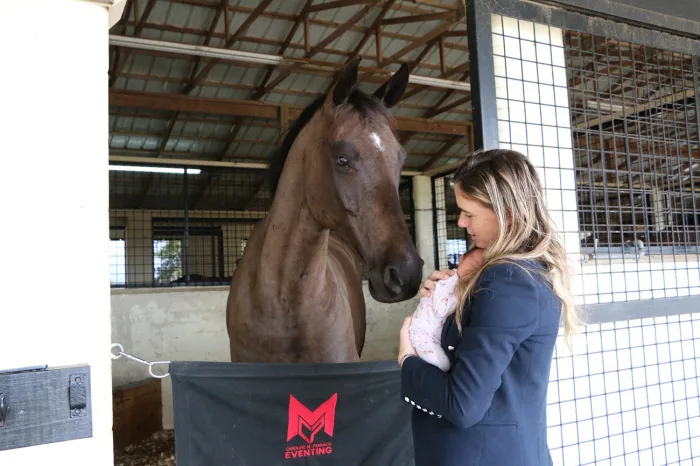
Is your daughter traveling to shows with you?
She’s coming to every show. I’ve always had a camper, so it’s easy. It’s just home away from home.
She loves sleeping when the camper’s driving, then as soon as the camper’s stopped moving, she is awake. She’s a camper baby. She really likes the noise. It’s pretty funny.
You’re right back on the road to Carolina International (North Carolina) this week.
We’ll go every single weekend through June, if I make the European tour. We’ll see; I just have to prove to the team at the moment that I’m still on form with my horses after the baby. It is a big ask, like with my owners it’s a big ask to keep investing into someone with something so life-changing. So hopefully I can just keep working hard and be proving that I can still do this even with the baby.
Are there any other big goals for this year?
I’m really hoping to do European tour, because they’re targeting Bicton (England) and Luhmühlen (Germany), so I was hoping to take a few horses to those. And then if I make that, I’ll bring horse Blake over as well, and then do CHIO Aachen (Germany) with him. So those would be my big targets for the spring.
I just love being a part of Nations Cups. I think it’s so important for our country to keep supporting these Nations Cups and this European tour. That’s how I got my team experience, and that made the transition to ride at the Pan Ams and the Olympics so much easier than if I never did a Nations Cup. So the best way forward for my horses, and for me, is to keep practicing at those and being competitive on the world stage, so that when [the 2028 Los Angeles Olympics] comes around, hopefully we’ve checked all of our boxes.
The post New Mom Caroline Pamukcu Proves She’s Back On Top At Bouckaert Farm appeared first on The Chronicle of the Horse.
]]>