The post Double Olympic Gold Medalist Laura Collett Shares Her Eventing Wisdom In US Clinic appeared first on The Chronicle of the Horse.
]]>At only 35 years old, Collett’s riding resume is one that many riders can only dream of. After overcoming a traumatic rotational fall in 2013 that left her with permanent vision loss in one eye, the eventer has won two Olympic team gold medals for Great Britain team at the 2021 Tokyo Olympics and the 2024 Paris Olympics, where she was also the individual bronze medalist aboard her longtime partner London 52. Collett was also a member of the gold-medal-winning team at the 2023 FEI Eventing European Championships in Haras du Pin, France, and her multiple five-star wins with London 52 include setting a record low score at Badminton (England) in 2022.

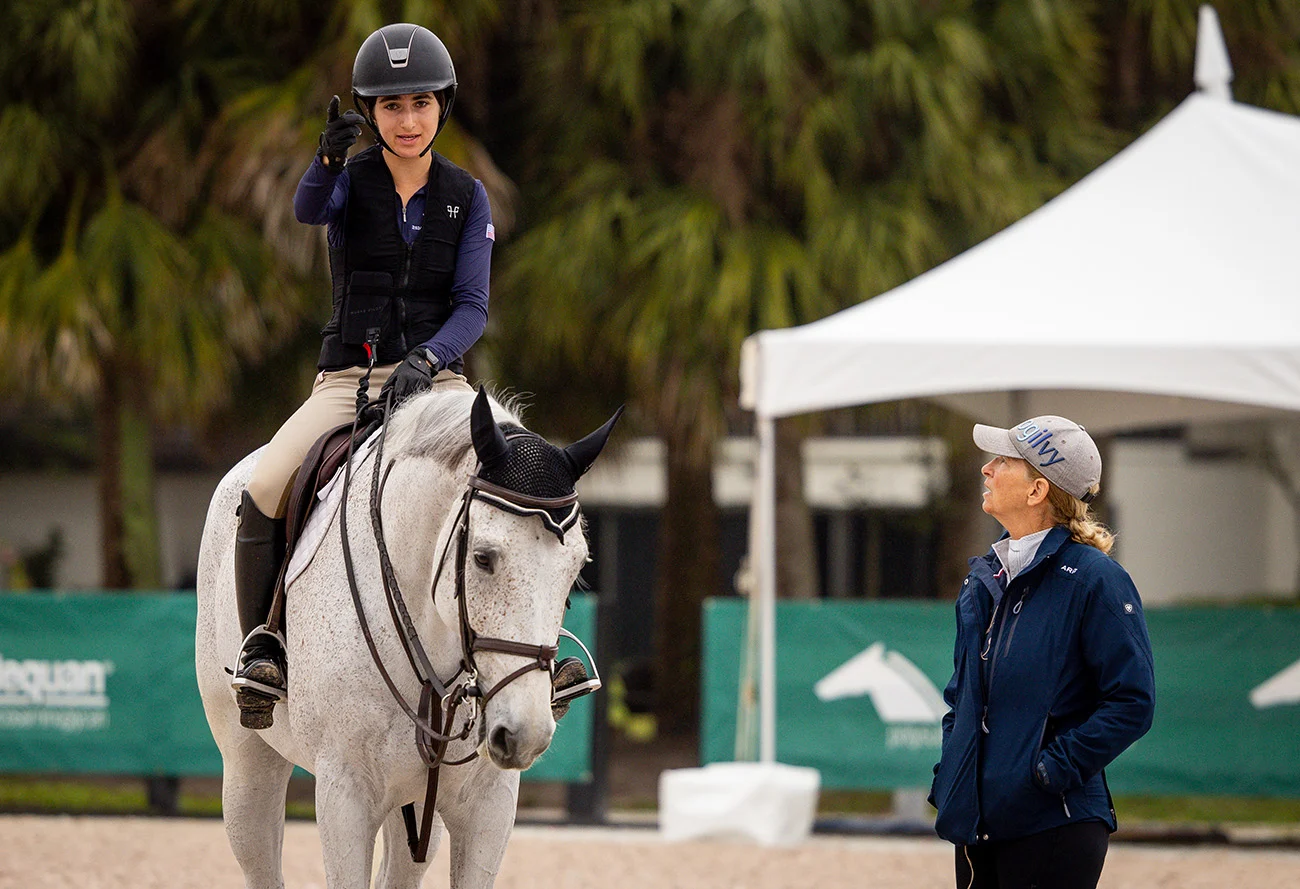
Collett’s four-day clinic in Aiken was comprised of several individual lessons and seven riding groups at varying levels ranging from beginner novice to advanced. On the first day of cross-country instruction, Collett began each group session by discussing the three main concepts a rider needs to know on the cross-country course.
“The first thing is that you have to be aware of your balance and your horse’s balance,” she told the riders. “They should be up in your hand, not hanging on you and pulling you down. You don’t want [their balance] or your balance to be downhill on the cross-country field; that’s asking for a problem. The second thing is to have the correct canter for the type of jump you are jumping. If you’re cantering to a combination or a skinny vertical, you would need to bring the canter back to you in order to have control—that’s a gear change. And then for a brush jump, you would just nicely balance up to it. The third thing is knowing the line. You as the rider know where you’re supposed to go [on course]: Make sure you pick your line, and then that your horses stay on your line. If you start letting them drift off the line at a wider fence, you could have a run-out. Everything else just falls into place from there.”
Although the warm-ups and courses varied in each session to tailor to each group’s level, Collett consistently focused on the rider’s position and how it directly affected their horses. When the students began cantering over a small Trakehner log fence to warm up, Collett had the riders practice balancing their horse’s canter up to the fence. She also explained why position is important for a rider when they oscillate between a balanced and forward canter.
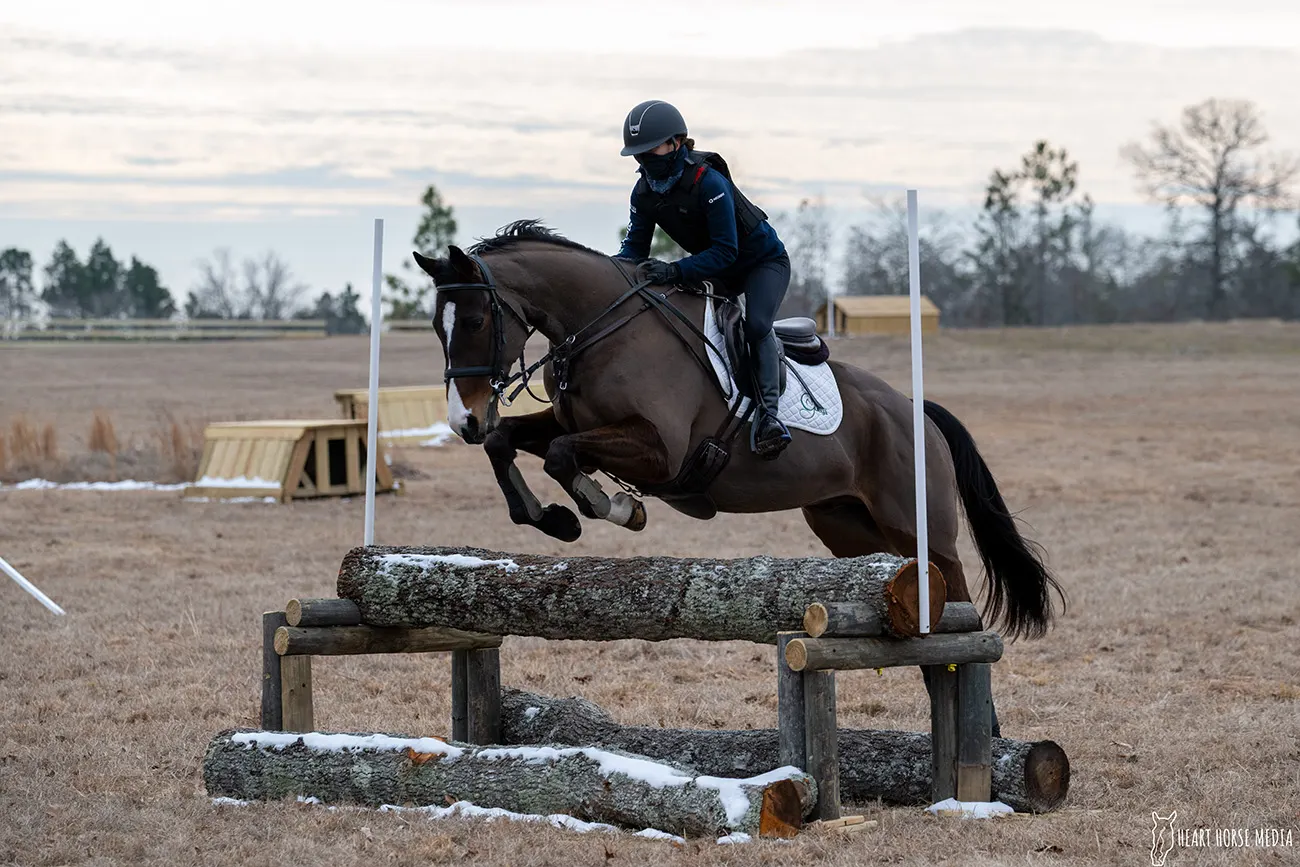
“A balanced canter means you bring your body up to shorten the horse’s step,” she said. “You sit up straight and away from the horse’s neck. A forward canter means that you’re up in your cross-country position and you go forward with pace. But you don’t want a forward canter or position for the entire cross-country round because then the horse just stays in one canter, and that doesn’t help you adjust throughout the course. You need to be able to cultivate both.”
The riders practiced these concepts over the first couple of single fences, and when several of the riders put in too many strides too close to the base of the fence, Collett gently corrected them. She emphasized the importance of balancing the horse to the fence through the turn and then following their motion with the rider’s arms to the fence so that the last few strides did not become a pulling match.
“Get the proper balance early so then you can allow [the horse] to be soft in your hand,” she said. “Balance and then ride up to the fence—don’t keep pulling the entire time. Then you feel like they’re taking you [to the fence] instead of you just pulling to shorten their step.”

Collett had the groups put a broken line together: They were to jump a small rolltop fence bending down to a small table fence.
“Make sure your eyes are looking, so you’re telling your horse where to go,” she said. “Jump your rolltop a little left of center, eyes looking, turning your shoulder so you’re not just pulling. Get a balanced canter in this line to give yourself enough room to get to the table.”
Many of the riders completed the line with minimal mistakes, and Collett moved her focus to two single brush jumps with guiderails, one set to be jumped up the hill and the other down the hill in a figure-8 pattern. She stressed the importance of the riders creating a balanced canter. When one rider leaned up his horse’s neck and knocked the second jump down, Collett gently reminded him of the importance of his position.
“You’re following with your upper body too much, sit up,” she instructed. “You can’t support your horse by throwing your upper body at him. Your approach was good but don’t try to get the jump by leaning forward; sit up and support [to the base].”
One of the exercises Collett put together was having the riders start right-lead up over the skinny brush, right turn down the hill over the other skinny brush, left turn halfway around and then down over an “S” line: a hanging log to a rolltop, and then four or five stride strides back over the skinny brush jump again to finish out the course. When several of the riders became concerned about counting strides in the “S” line, Collett reassured them.

“I want you to worry more about the canter and the balance in that line rather than [doing] the correct number of strides,” she said. “Don’t wait for their stride to get long and strung out before you balance with your body [when shortening in the “S” line]. Balance yourself the whole time.”
Collett also had the upper-level riders tackle a more technical 3’9” corner fence to practice their accuracy. She had the riders jump a smaller table and then do a left-turn down to the corner fence. She emphasized the importance of jumping a corner directly in the middle. “If you don’t jump it straight, the horses won’t be able to tell how wide it is,” she said. “You open yourself up to a potential run-out if you don’t jump it straight.”
During the more advanced groups, Collett took the riders across the length of the cross-country field, stringing different lines together and creating different courses. One of the exercises was to jump a rolltop down a hill, then do a left turn back on the small trakehner log fence (in the opposite direction from how they had warmed up), and then bending left up the hill over a narrow table fence. One rider, who had a greener horse, was doing well until her horse stopped at the table.
“When [the fence] is narrower, keep him together so he understands,” Collett said. “Don’t open up the canter. Keep him more connected between your leg and hand.”
When the horse stopped again, Collett had the rider bring the horse back to the table to stand in front of it. Then she had the rider go back and jump the rolltop fence again to give her horse confidence before coming back to jump the table.
“Good, steady back to it, shoulders up.” On the third try, the horse made a huge effort over the table and cantered away. “Well done! That was great riding.”
The particular horse-and-rider pair continued to gain confidence as they tackled different lines, questions and exercises together. Much of that was due to Collett’s encouragement; she did not become flustered when any of the riders or horses made mistakes. The majority of Collett’s business is developing young eventing prospects and bringing them up through the ranks, so she knows first-hand how important building a green horse’s confidence is and how much patience it requires. When riders made mistakes, Collett never rushed them; she allowed them to take their time and figure things out.

After each rider completed their lines or courses, Collett would ask for their assessment of how it felt. Collett’s love for the sport of eventing, and her all-around positive attitude, were evident in her teaching style. When any horse-and-rider pair successfully rode through a small mistake or miscommunication, Collett’s face would break into a smile, and she was the first to cheer them on.
“Well done!” Collett would repeat over and over. “Give him big pats, big pats! That was an excellent correction.”
The post Double Olympic Gold Medalist Laura Collett Shares Her Eventing Wisdom In US Clinic appeared first on The Chronicle of the Horse.
]]>The post Presenters Laud Improvements On Day 2 Of FEI-Level Trainers Conference appeared first on The Chronicle of the Horse.
]]>This report in about Day 2 of the 2025 Adequan/USDF FEI-Level Trainers Conference. Click here to read the Day 1 report.
German dressage team coach Monica Theodorescu and U.S. dressage team chef d’quipe Christine Traurig remarked on the positive changes they saw among the horses and riders they coached on the second and final day of this week’s 2025 Adequan/USDF FEI-Level Trainers Conference, as the participants built upon the lessons they learned on the first day of the event, held Monday and Tuesday at High Meadow Farm in Loxahatchee, Florida. The clinicians were true to their references to “Transition Tuesday” and spent much of the second day focused on that topic.
Sometimes Less Is More
Theodorescu praised Kate Shoemaker for her warm-up with her 9-year-old Hanoverian mare Vianne (Kastel’s Vitalis—Raureif, Ramiro’s Bube). Shoemaker, a Grade IV para-dressage rider, attended the trainers conference in advance of this weekend’s CPEDI3* at Adequan Global Dressage Festival 3 (Florida), which is her first international para-dressage competition with Vianne since the pair won individual bronze at the Paris Paralympic Games.
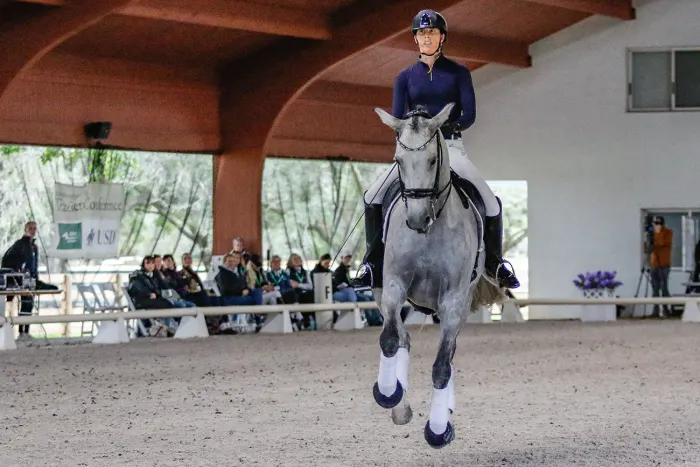
The German team coach said that, for her, a warm-up with the degree of balance, relaxation and engagement the pair displayed would be sufficient for a training day. When a horse is well-schooled, it is not always necessary to work on the movements for the next competition; simply letting the horse work in a productive and calm way is enough, she told the spectators. That sentiment also carried over to warm-up at shows.
“The work has to be done at home, not at the competition,” she said. “Make it easy and the least exhausting possible. The horse gets mentally tired, too.”
As Shoemaker put her horse through her paces, she was cautioned to not hurry when they worked on a turn on the haunches to supple the horse.
Later in the lesson, Shoemaker and Vianne—who compete in open dressage classes as well as para-dressage and recently won a Prix St. Georges class—tackled one-tempis. Theodorescu told her to just keep going as they did a series of them. The result was 17 one-tempi changes to the delight of the audience. Soon after, the presenter called the lesson early as it was successful, and Vianne didn’t need to be schooled any longer.
Your Ring Finger Is The Thermometer
Chris Hickey and Saskatoon OMF, a 7-year-old Hanoverian gelding (San Amour I—Dolce Nera, Don Frederico) owned by Cecilia Stewart, was more supple, relaxed and improved from the previous day, Traurig noted as their ride began. She talked to Hickey about the importance of the rider taking responsibility for the aids and constantly assessing their efficacy: If a horse first responds by stiffening in your hand, you may need to soften your hand, she said. She spoke about hand position and how the fist holding the reins can massage them, as if squeezing out a sponge. If the horse doesn’t respond, she suggested softly adding some wrist action to gently turn up the volume.
“The thermometer in your horse’s mouth is your ring finger,” she said, meaning that the softness of the horses’ mouth can be checked with just a twinge of the finger.
It was the same with leg aids: A rider should be able to soften the leg aid without the horse’s way of going changing. If it does change, the rider may add a little more leg to give a gentle reminder. She reminded Hickey that, for the half-halt to work properly, the horse must be unconditionally in front of the leg.
“A downward transition is not a backward transition; you are gathering the hind legs under,” she noted.
As “Saskatoon” responded to Hickey’s aids, Traurig told him to make a fuss over the horse and praise him. She shared that she always had a soft spot for Saskatoon and frequently asks his owner if she can take him home, but Stewart always declines.
“It’s a treasure as a trainer to find a horse with talent and a good attitude,” she mused.
Downward Is Still Forward
Neve Myburgh started her second lesson with Theodorescu by warming up her 8-year-old German Sport Horse mare Firiet (Franklin—Evita, Ehrentanz I) on the weaker side, and the trainer quickly noticed she was already improved from taking shorter steps in the canter on that side the day before.
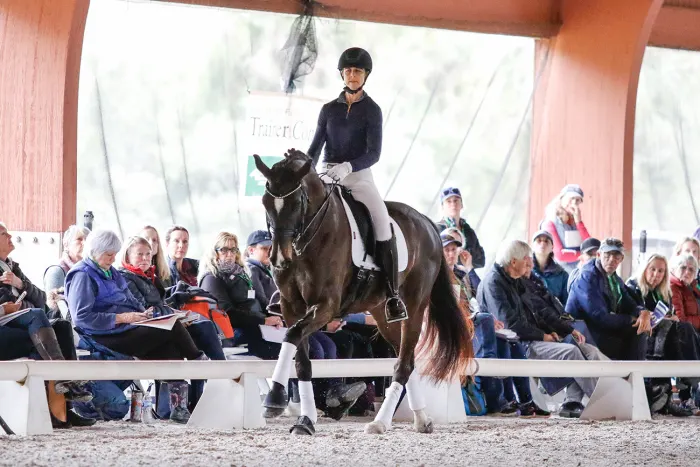
In the Transition Tuesday theme, Theodorescu reminded Myburgh that even downward transitions are forward transitions into the changing gait, asking her to use soft contact and her seat, instead of pulling on the reins, to make the transition.
Firiet demonstrated a willingness to improve, especially in the counter-canter, as her stride in the medium canter became more uphill and her inside hind leg came more forward from Monday’s lesson. To work into the flying changes, Myburgh was directed to half-pass from the center line, then after the short side she went across the diagonal in the medium canter. Theodorescu said that when the rider felt that today was the day for a flying change, then she should go for it but if the single changes were not secure, she could not move onto four-tempis or three-tempis.
The Straight And Narrow
Geometry was at the forefront when Heather Bender and Keisha B, her own 10-year-old Dutch Warmblood mare (Geniaal—Fiona B, Apache) entered the arena. As they warmed up, Traurig reminded Bender to be very precise in her geometry and aids, and not to hurry. As the lesson continued and they worked toward canter pirouettes, Bender was encouraged to feel how the inside bend of the horse is available, even on straight lines. The inside leg to outside rein connection was in full action during the haunches-in and as the rider worked on downward transitions.
Bender was directed to ride shoulder-fore in the canter and then to make a 20-meter circle where they worked on tempo transitions to “change gears” within the gait and to prepare for more collection. Traurig wanted to see the horse asking “what’s next”—rather than slowing down—when Bender shortened her reins to collect.

Moving into lead changes, Traurig talked about the importance of the horse’s legs staying on a straight line in the change so that the hind legs stay on the line in preparation for the pirouettes. Straightness continued to be a theme as the lesson continued.
To Each Horse A Different Warm-Up
JJ Tate and Denali, Cackie Vroom’s 11-year-old Hanoverian gelding (Don Noblesse—Shakira, Scolari), worked with Traurig and, because the gelding had gotten a bit tired during the previous day’s lesson, the presenter allowed Tate to warm-him up at her own pace while taking into account his needs. They went through the walk and Tate incorporated lots of leg yields in the gait. They did a turn on the forehand at X and continued into a half-pass to supple the horse. As they continued the warm-up with lots of suppling and bending, the gelding became lighter and softer to the aids.
The pair also worked toward pirouettes, with Traurig instructing Tate to establish her bending aids in a manner in which she could feel the adjustability of the canter forward and back. It was Transition Tuesday for Tate as well, Traurig said, talking about how the downwardness of going “back” within the gait enables the upward transition of going “forward” in the pirouette. As the rider was finding the perfect time to start the movement of the pirouette, Traurig advised her not to allow Denali to bait her into thinking “not yet, not yet, not yet.”
Traurig also cautioned Tate to make sure aids from the outside leg didn’t allow the gelding’s haunches to fall out of the pirouette, yet she still needed to give him some room to move while turning him from her outside leg.

Q&A: What About A Fussy Horse?
During one of the conference’s question-and-answer sessions, a participant asked how to deal with a very green mare who is resistant to the contact and how to teach her in an effective and positive way.
Traurig advised eliminating any causes of discomfort before moving on to soft training techniques. First and foremost, she recommended having the mare’s teeth and mouth checked for any signs of discomfort. Similarly, she said, check the bit fit before proceeding. Modern horses are sensitive and their mouths are much narrower than in the past, so addressing the thickness of the bit is important.
“I can tell you, for example, that I still have my bit box from years ago, and when I looked at the old snaffles I used to use, they were a whole lot wider than then I use now,” she said.
The rider also has to take responsibility and accountability on how they ride to the contact and honestly assess whether they have a smooth, soft feeling in the contact: Do their hands get unsteady? Do they move too much so the horse gets fussy? Have they correctly taught the horse to understand contact? Exercises like longeing in sidereins can help teach a horse to seek the bit, but the rider should first assess themselves and the role they are playing in their horse’s understanding of—and potential aversion to—contact.
The post Presenters Laud Improvements On Day 2 Of FEI-Level Trainers Conference appeared first on The Chronicle of the Horse.
]]>The post Theodorescu, Traurig Share Their Dressage Training Toolboxes At FEI-Level Trainers Conference appeared first on The Chronicle of the Horse.
]]>Transitions, serpentines and counter-canter were the tools of the trade for the first day of this week’s two-day Adequan/USDF FEI-Level Trainers Conference. German dressage team coach Monica Theodorescu and U.S. dressage team Chef d’Equipe Christine Traurig put eight horses and riders through their paces at Mary Ann McPhail’s High Meadow Farm in Loxahatchee, Florida.
Ironing Out The Transitions
Hannah Irons, the first to go aboard Ein Traum, a 5-year-old Westphalian gelding (Escamillo—Supersusi, Sandro Hit) owned by Irons Sporthorses LLC, told Traurig on Monday that her youngster needed confidence. The trainer had the pair work on suppleness and lots—and lots—of transitions. “Today is Transition Monday, and tomorrow might be Transition Tuesday,” Traurig quipped.
After warming up, Irons used serpentines to get the gelding to bend and accept the aids as they rode from trot to walk and then back to trot on the centerline to encourage bending in the upward and downward transitions. Irons piloted her horse on a 20-meter circle and then decreased the size of the circle to help him understand the driving aids, and that the inside aids are used to flex and direct while the outside aids position the shoulders. Traurig told her that getting the horse to go on the bit must not feel like he is hanging on her rein; instead, it should be a very supple feeling in her hand as she took care to ride him softly bent and in the same tempo.
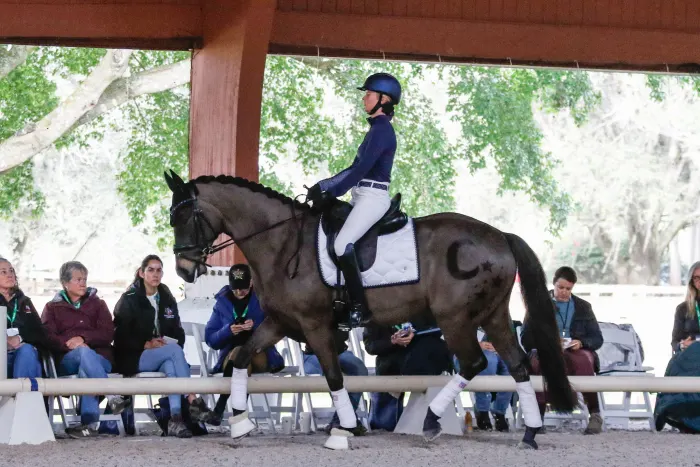
The lesson was quietly positive, and Traurig was full of praise. She cautioned Irons to stay disciplined in her equitation and relax her shoulders, because she and her horse were encouraging each other’s bad habits. The trainer often repeated that the rider should use the reins to flex, then soften, then flex, then soften and to gently use her fingers. Traurig instructed Irons to take heed to something Olympic German rider Frederic “Freddie” Wandres (who was in the audience) says about talking a walk break during training: “It’s a working walk, not a talking walk. “
Mining The Counter-Canter
Neve Myburgh and Firiet were next up, riding under Theodorescu, and the German trainer’s watchful eye quickly noticed the horse had a slightly shorter stride in the canter to the right than to the left. Thus began the work in counter-canter with Myburgh’s own 8-year-old German Sport Horse (Franklin—Evita, Ehrentanz I) mare. The trainer talked about the benefits of using counter-canter to obtain better collection and self-carriage, using the pair to demonstrate.
Theodorescu cautioned the rider to be careful with her position, noting that many riders tend to lean too much to the inside, causing the horse to struggle with the rhythm as they try to stay “in the middle of the rider.”
The pair also was instructed to ride serpentines (more serpentines!) at the canter with lead changes at X in a successful effort to get Firiet more equal in her canter strides. Then, they did serpentines without changing leads, staying in counter-canter to build strength and better balance.
Theodorescu did some serious name dropping when she mentioned that all the cool kids (think Ingrid Klimke, Isabell Werth and Frederic Wandres) ride the counter-canter. Every. Single. Day.
Saskatoon Impressed With Transitions
Chris Hickey and Saskatoon OMF were next into the arena with Traurig, who has known the 7-year-old Hanoverian gelding (San Amour I—Dolce Nera, Don Frederico) owned by Cecilia Stewart since he was 3. The gelding was an easy-going youngster until he was taken off property to a show and, according to Traurig, he was “quite impressed.”
She asked Hickey and “Saskatoon” to ride down the quarterline and then leg-yield to the rail to get the horse moving forward in rhythm and to get him more supple and confident. Once again, transitions and riding from back to front helped increase connection and help the horse work on self-carriage. She told Hickey to feel the inside snaffle rein so the poll didn’t get too stiff, and to use the corners and the short sides of the arena to supple the gelding and prepare for the long side.
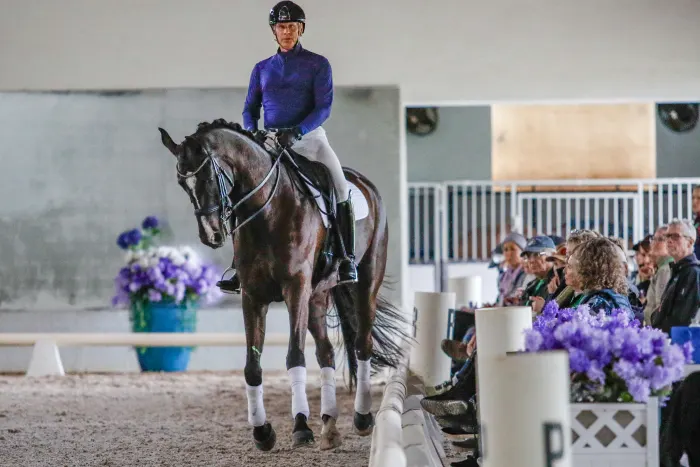
They did lots of transitions in the trot (it was “Transition Monday,” after all!) and worked from shoulder-in to haunches-in. They did half-pass, taking care not to make it too steep while training the horse, and then continued in shoulder-in down the next long side. They continued in haunches-on after the corner, then another half-pass to finish—or shoulder-in or shoulder-fore, Hickey could choose.
The corners were used to reframe and reorganize the horse and to remind him that a downward transition is “forward thinking” made the lesson come full circle. Lots of praise and “attaboys” (mostly for Saskatoon) were forth-coming.
I Spy With My Little Eye
Theodorescu employed counter-canter again with her next pair, Amy Bradley and her own colorful 8-year-old Oldenburg gelding I Spy (Asgard’s Ibiza—Bella Rose). Their warm-up included transitions and lots of half-halts. The pair did four-loop serpentines with walk-trot transitions at the centerlines. They also worked on an exercise at the trot in which they did a shoulder-in on the long side and, when “Spy” would lose the balance and the rhythm, Bradley would do a 10-meter circle and then return to shoulder-in. They continued with good energy in the hind legs and then transitioned to the walk at the corner. Then, they did a half-circle to another half-circle in the opposite direction to change rein while keeping the rhythm.
When it was time for the canter, Spy tried a series of evasions to get out of the counter-canter but to no avail. Finally, they were directed to canter then take the short diagonal with a flying change to the centerline. They finished up with walk/trot/halt/trot transitions, making sure the horse stayed balanced on all four legs in the halt.
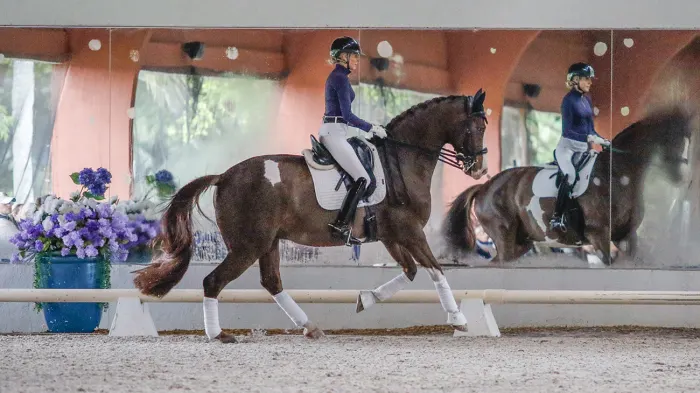
Gold Medal Perfection
The most decorated rider participating in the clinic rode with Theodorescu. Paris Paralympic Games individual bronze medalist Kate Shoemaker aboard her Paris partner Vianne could be, Theodorescu told spectators, borderline boring for her to critique because “everything is very good.” Shoemaker and her 9-year-old Hanoverian mare (Kastel’s Vitalis—Raureif, Ramiro’s Bube) were praised for the rider being focused on the horse and the horse being focused on the rider.
The comments were minor, and Shoemaker handily made the suggested improvements. When they were turning onto the long side to half-pass, the trainer reminded Shoemaker to think of shoulder-in first. And when they did canter half-passes, Theodorescu coached them into more collection. She asked Shoemaker to establish a bigger passage—check. She suggested Shoemaker create a more forward-thinking piaffe—check. The only negative she had to say about Vianne is that she is steady but could take a bit more contact.
“It’s all there,” Theodorescu said. And it was.
It’s Not an Easy Job
Olivia LaGoy-Weltz and Fade To Black, Mary Ann McPhail’s 10-year-old Hanoverian (Fantastic—Saphira, St. Moritz I) mare were the final riders with Theodorescu. As LaGoy-Weltz began her warm-up, the trainer remarked that there are different ways to get to Rome, and riders must get to know their horses in order to do an effective warm-up tailored to each horse’s needs.
“You have to focus on different solutions to make it easy for each horse,” she said. “Start the warm-up with patience and feeling to get the horse in harmony, lightness and suppleness.”
She remarked during LaGoy-Weltz’s warm-up that Fade To Black’s acceptance of the contact improved with every lap of the arena, improving her self-carriage with it.
After the warm-up, it was all about balance day and, as the pair did a series of three-tempis and two-tempis and one-tempis, Theodorescu suggested LaGoy-Weltz keep the shoulder more to the right to improve her balance. “Make it easy for the horse and there’s no discussion,” she said.
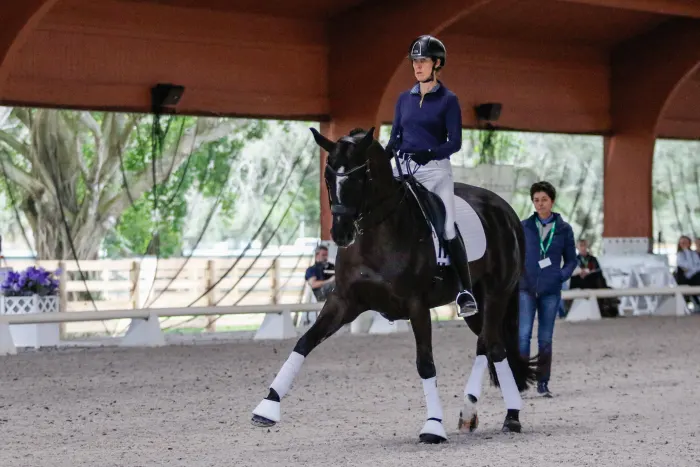
In the lateral work, she asked the pair to do a 10-meter circle with more collection to the shoulder-in. As they did, the mare began to get more tense, so Theodorescu coached LaGoy-Weltz to keep her supple on both sides to strengthen the mare’s back.
“She doesn’t want to do anything wrong,” Theodorescu said of the horse and then praised LaGoy-Weltz. “It’s not an easy job, but it’s a good job.”
Click here for a report on Day 2 of the Adequan/USDF FEI-Level Trainers Conference.
The post Theodorescu, Traurig Share Their Dressage Training Toolboxes At FEI-Level Trainers Conference appeared first on The Chronicle of the Horse.
]]>The post 2025 Horsemastership Clinic: Ward On Effective Warm-Up And Setting Up For Success appeared first on The Chronicle of the Horse.
]]>The final day of the 2025 USEF Horsemastership Training Series, held Jan. 2-5 in Wellington, Florida, began with McLain Ward gathering riders in the middle of the ring, not to outline a jumping course but to scrutinize tack choices, specifically bridles and bits.
“I feel that people, in general, are getting a little gimmicky with some of their tack, like it’s some kind of magical advancer where a lot of times working a horse in a little bit of a better way or being a little more patient or having better contact with the horse gives you the results you want,” Ward said. “This doesn’t mean that in my own riding, I’m not open-minded to trying something different if I’m really struggling with a horse’s mouth, but I always gravitate toward being more conservative when it comes to tack.”

Ward then shifted the discussion to the importance of flatwork, particularly in the schooling area before a class. He explained that the warm-up should focus on loosening up the horse in a relaxed and methodical way. Riders should prioritize rhythm, suppleness and responsiveness rather than attempting to teach new skills or demanding an excessive amount.
“I see people all the time trying to show something or prove something in the warm-up. That’s not the point of the warm-up,” Ward said. “The extra preparation should be done before you arrive at the show, and when you arrive at the show, what you have is what you should work with.”
The riders began schooling over a 2’6’’ crossrail oxer set a bit off the rail. Ward used the exercise as an opportunity to discuss his approach to warm-up fences before entering the ring. He explained how he typically schools eight to 12 jumps depending on the horse. The main goal is for the horse to enter the ring feeling confident, relaxed and attentive without being overworked or overwhelmed.
He talked about the importance of tailoring the warm-up to each horse, using a scale from 1 to 10 to determine the amount of seat, contact and leg required. This approach can allow riders to make precise adjustments based on their horse’s needs, ensuring effective communication and minimal effort.
“Have enough rhythm because it’s an oxer, but I want this jump to just get in your way,” Ward said.
The course featured a variety of technical elements that required strategy and adaptability. One line was similar to the three-part cavaletti exercise from the previous day with Beezie Madden. To start, all jumps were set at approximately 1 meter, providing a manageable height for riders to establish their rhythm before progressing to more complex elements. Each jump was equipped with ground lines on either side, allowing them to be approached from any direction.
At one end of the ring, a triple combination was set in a standard one-stride to two strides. The first and last jumps in the combination were verticals, while the middle was a square oxer.
Another significant element was a diagonal three-part line, which riders could approach in multiple ways, depending on the horse’s stride length. This line could be ridden in four strides to five strides, four strides to six strides or even four strides to seven strides. The first and last parts on the line were square oxers, while the middle jump was a vertical with a plank on it.
Additionally, the course included a single diagonal oxer and a water jump set at approximately 2’6’’, with guide rails on either side.
The first course began with riders approaching the crossrail oxer off the right lead. From there, they continued on a circle, setting themselves up for the single diagonal oxer. The riders then made a left turn and jumped only the middle vertical of the three-part line. Next, they made a turn before the oxer at the end of the line, rolling back onto the same diagonal oxer. They then executed the same left turn back onto the middle vertical.
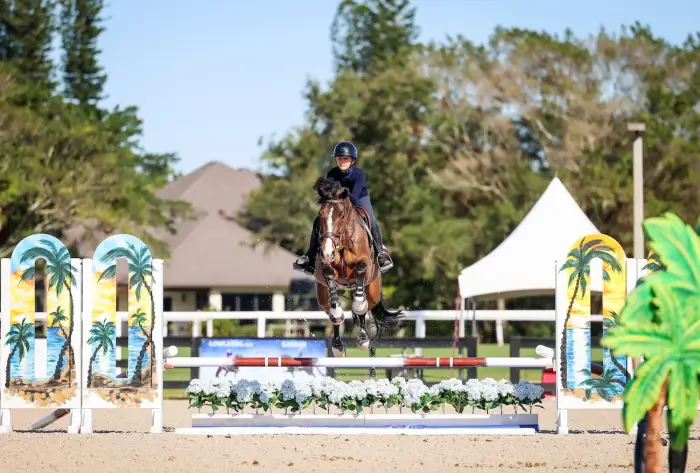
Maggie Jacobs, riding her mare Fury, was one of the first to tackle the course. Her horse is known for shaking her head when she feels pressure with no release and tends to step sideways and get crooked if she feels too much pressure on the reins.
“Start by following this mare with enough rhythm that you have something to balance off of,” Ward said. “Don’t start by giving her little bumps in the mouth because she is already kind of jigging.”
Ward instructed Jacobs to focus on staying with her mare at the jump, emphasizing the importance of getting up to the fence and then sitting back again on the landing. He explained that getting behind the mare would result in having to chase her up to the jump, making it harder to maintain control when she landed. He additionally suggested adding a second rein to the gag bit to enhance communication and steady control over the mare’s mouth.
For Olivia Sweetnam, Ward stood far in front of the plank vertical, raising his hand in the air to give her a focal point. This allowed Sweetnam to keep her eyes raised and focused ahead, rather than looking down at the jump and peering through her visor.
“If you think at this stage in my career that I’m not at home picking a focal point, dropping my stirrups and thinking about simple details in my riding every day, then you’re wrong,” Ward said. “I work on those basic things because doing those simple things diligently leads to good habits, which are the key to success.”

For the second course, the height of the jumps was increased to 1.30-1.45 meters, except for the water jump and the crossrail oxer, both which remained at 2’6″ The ground lines were also adjusted, widening as the jumps increased in height. The main focus of the course was the three-part line, and Ward instructed them to complete the line twice in the same direction, to achieve a flowing four strides to a steady six strides.
Some riders struggled to get their horses back in time after landing the second jump, making it difficult to fit in the six strides. Ward addressed the issue by advising riders to use all six strides to shorten, “taking a foot every stride” with balance, hands and contact. He also reminded them to make sure they had enough pace in the first four strides so they wouldn’t need to chase their horses to complete the line smoothly.
The final course introduced the water jump. Ward reminded the riders that if they didn’t feel their horse was in the right place, they could circle and reset because the whole point of the exercise was to train their horse. He also said that once the water jump is executed correctly, there’s no reason to jump it again because you don’t want the horse to become unimpressed by it.
As Jacobs worked with the added rein, Ward said, “Sit down, slow down, be patient and let things develop. Do less. Imagine in your mind these are crossrails. Your horse is a little mouthy and you’re getting caught up in it. Follow the horse a bit, trust your eye and go with it.”
Ward explained that the change wouldn’t make a difference overnight and emphasized the importance of Jacobs keeping her hands steady and light, with a constant give and take.
“I would play with a couple of different things myself,” Ward said. “I like a double twist because it sits nicely in the horse’s mouth, and I would tape the sides with some latex because obviously, you would never want to cut their mouths. I would either do a figure eight [noseband] if she’s crossing her jaw, which she doesn’t look like she’s doing much, so I would just go to a regular noseband and a nice full cheek to help keep her straight.”
Ward pointed out that regardless of the height of the jumps or the complexity of the course, a rider’s ability to maintain proper rhythm, balance and control comes from strong flatwork.
“I want to give my horse the training and tests they’re going to see and experience in the ring in a modified version at home,” Ward said. “I want my horse to succeed.”
ClipMyHorse.tv premium members can watch all the USEF Horsemastership sessions via USEF Network.
For coverage of the first two days, flatwork with Anne Kursinski and gymnastics with Beezie Madden, click here.
The post 2025 Horsemastership Clinic: Ward On Effective Warm-Up And Setting Up For Success appeared first on The Chronicle of the Horse.
]]>The post 2025 Horsemastership Clinic: Madden Develops Adjustability Through Gymnastics appeared first on The Chronicle of the Horse.
]]>Beezie Madden started her gymnastics session Saturday—Day 2 of the USEF 2025 Horsemastership Training Series, held Jan. 2-5 in Wellington, Florida—with a fundamental lesson: the importance of properly mounting your horse.
“I like to keep my outside rein a little tighter than the inside because I have control if he wants to go in any direction,” the four-time Olympian said as she mounted her 8-year-old gelding Micky-Cara. “I put my foot in the stirrup and keep it by the girth. I want my right hand up by the pommel so I don’t have to move it to get on. A lot of people put their hand on the back of the cantle or in the middle, but it’s best to put it on the pommel.”
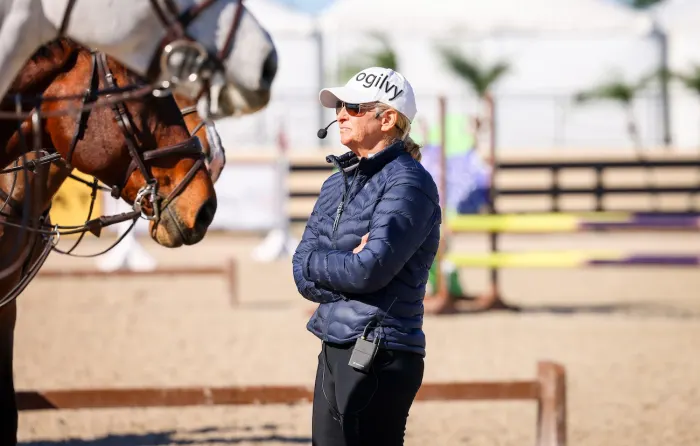
Madden began her warm-up by addressing the importance of an effective position and a relaxed body.
“Position is not because I want to look pretty, but because I want to be effective and be able to communicate with the horse in the most effective way with the least amount of distractions for him,” Madden said.
Continuing her focus on effective communication, Madden demonstrated how to find the correct leg position. She shifted into her two-point position, beginning to bounce gently to lower her leg smoothly around the horse’s side. As she settled into the front of her saddle, she kept her lower leg steady, maintaining a secure yet relaxed contact.
The gymnastics course was designed to develop rhythm, balance and precision in both horse and rider.
The riders began with three cavaletti placed on the center line, set 60′ apart. Riders approached the exercise in various ways, adjusting the stride length each time to challenge their timing and control.
On one long side, a line was set at 74′, intended to be ridden in a quiet six strides or a forward five. Both jumps were square oxers with no ground rails and could be jumped in either direction, with one featuring a liverpool underneath.

On the opposite long side, a line of four jumps was set at 34’6” inches between each element, designed to be ridden in two strides.
At the end of the ring was a bending line of three jumps, each at a height of 18“. This exercise was designed to be ridden as a normal one-stride to one-stride. It helped riders focus on controlling their horses while encouraging them to think about landing on the correct lead.
Before warming up, Madden had the riders demonstrate their two-point position at the walk and trot to ensure their legs were properly underneath them. Madden summoned Avery Griffin for a demonstration of the two-point position. Madden pulled Griffin’s leg forward toward the horse’s head, causing Griffin to lose her balance and fall out of position, demonstrating how crucial it is for the rider’s leg to stay directly underneath them to maintain balance and stability.
Once the riders warmed up their horses, they began the first exercise, jumping the three cavaletti. They started by riding the line in a forward four strides to four strides. Then, they adjusted to five strides to five strides, followed by five strides to four strides, and then four strides to five strides. The exercise continued with six strides to four strides and finally, four strides to six strides.

“I’ve never been the most talented rider, but I work hard at making my horses adjustable,” Madden said modestly. “If I don’t see it eight or nine strides out like you like to see it, I have to be able to adjust my horse three, four and five strides out, and it’s the same in the lines. By the end of this, I can do three and five, even in that shorter distance, with all my horses. The horses have to be adjustable, and they have to be there for you when you call on them. Horses make you look like good riders when they’re adjustable.”
The riders moved on to jumping the bending line in the corner of the ring. They cantered into the line, completing the sequence, then transitioned down to a trot before picking up the canter again. They then rolled back to a vertical set on the diagonal, then continued to the corner jumps, ridden in the opposite direction. The exercise was repeated with another transition from trot to canter, followed by a rollback to a square oxer set on the opposite diagonal. To finish, the riders jumped the corner jumps once again, focusing on maintaining fluidity and control throughout the course.
“Ask with a little pressure, release with a little light contact,” Madden said of the downward transitions. “If they get a little release, they’re going to be quicker to do it right. If they know you’re going to keep pulling, they’re going to fight you. Carry the hands and then make it a soft hand. It can just be finger contact.”
The next exercise focused on the liverpool line. The first time around, Madden had the riders focus solely on jumping the liverpool to help the horses become comfortable with the obstacle. To make the exercise more approachable, she lowered rails of the oxer to make an “X.” Madden encouraged the riders to ride forward, making sure they were helping their horses approach with confidence.
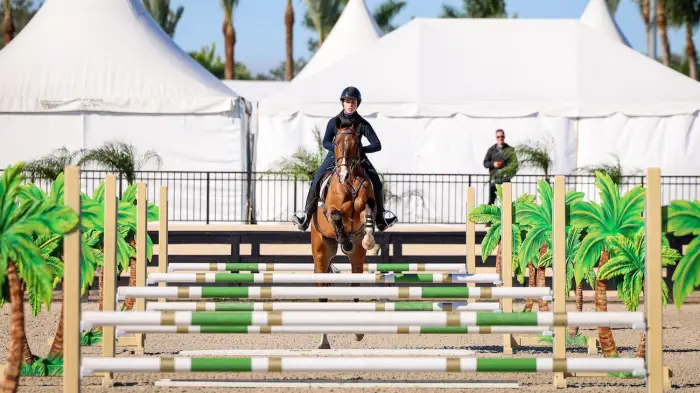
Madden then had the riders tackle the whole line in a forward five strides. After each jump, Madden instructed the riders to transition to walk before approaching the corner, where she emphasized the importance of “pressure and release.” She explained that applying pressure with subtle cues and immediately releasing when the horse responded correctly helped reinforce desired behavior while maintaining softness and connection throughout the ride.
Madden then had the riders do the same exercise in a quiet six strides, encouraging the horses to gather themselves and power over the oxer out of the line.
The first time trying the six-stride off the left lead, Taylor Cawley and her horse Quatro Van Dorperheide knocked the back rail of the liverpool.
“Do it again, and we’ll see if he learned from that. He might want to help you a little more there,” Madden said. “We’re not looking to have horses hit the fences, but if they hit the fences because they didn’t listen, then maybe that’s a learning experience for them.”
The next attempt went more smoothly, as Cawley’s horse wasn’t running through her hands as much, and the transitions to the trot had helped him stay more balanced and focused. He was also more careful over the liverpool, showing improved attention.
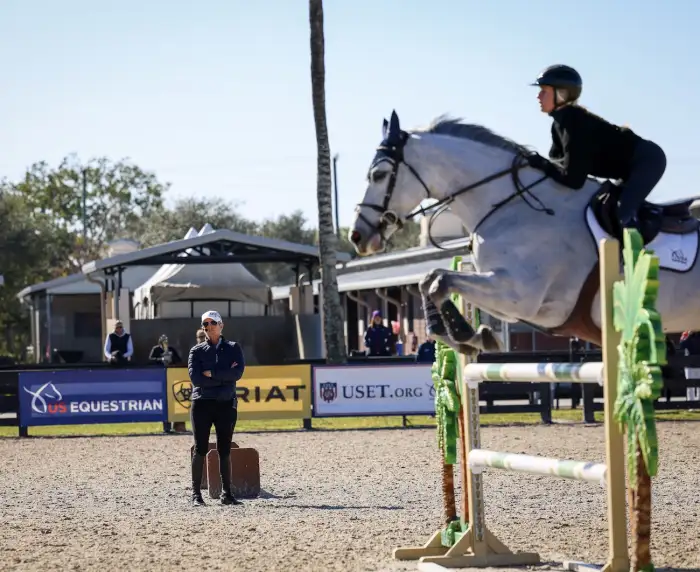
The last exercise, focusing on the four-part line, was quite successful. The main goal of the exercise was to avoid micromanaging and allow the horses to focus on doing the work themselves. Madden encouraged the riders to trust their horses’ ability to handle the line and maintain a natural rhythm. She reminded them to give the horses space to think while still maintaining balance and control.
“A lot of times we get very mechanical in our riding, like shoulder-in, which is right indirect rein and right leg, but it’s also feeling what the horse is doing, and if he’s doing it, then release a little and say, ‘Yes, that’s the right thing,’ ” Madden said. “The same thing with going back to the trot or the walk. You want to be prompt, but you want to do it with connection and balance.”
ClipMyHorse.tv premium members can watch all the USEF Horsemastership sessions via USEF Network.
The three-day USEF Horsemastership Training Series also included a Friday flatwork session taught by Anne Kursinski and will conclude with a jumping session taught by McLain Ward on Sunday.
The post 2025 Horsemastership Clinic: Madden Develops Adjustability Through Gymnastics appeared first on The Chronicle of the Horse.
]]>The post 2025 Horsemastership Series: Kursinski Emphasizes The Importance Of Releasing Pressure appeared first on The Chronicle of the Horse.
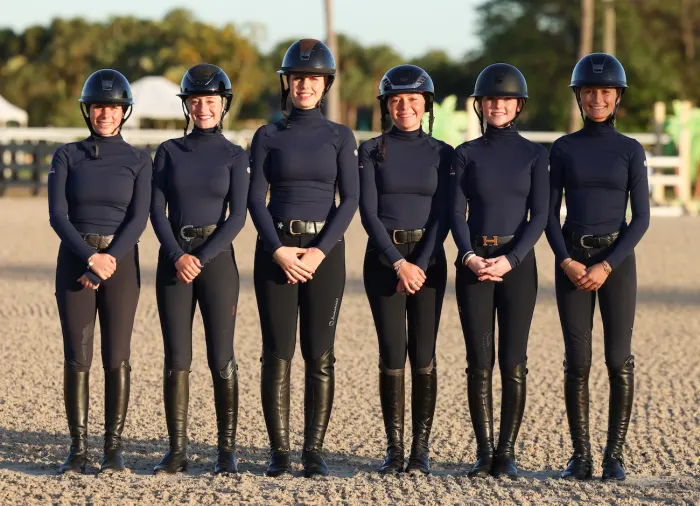
]]>When six of the country’s most successful young equestrians entered the arena for the first mounted day of the 2025 USEF Horsemastership Training Series, held Jan. 2-5 at the Adequan Global Dressage Festival show grounds in Wellington, Florida, five-time Olympian Anne Kursinski began by emphasizing the importance of understanding their horses’ mechanics.
“Many of the top five-star riders have trained with dressage trainers and other international top riders, not just the U.S. riders, to understand the mechanics of their horses,” Kursinski said. “How they move, how to influence them, how to improve their balance, their lightness, strengthening the hind end, and how your position influences the horse.”
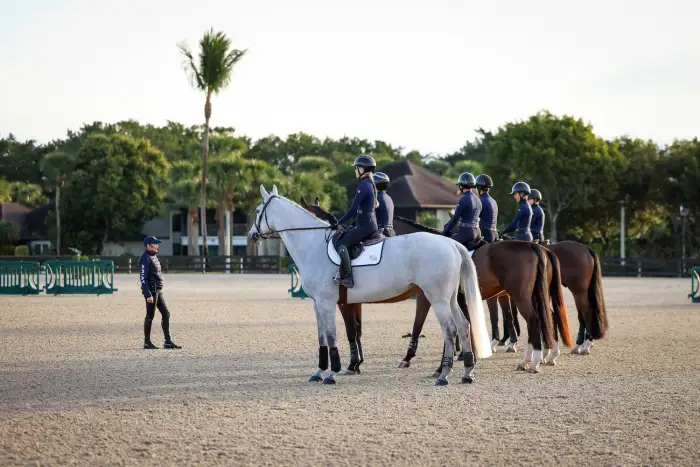
As the riders began warming up their horses, a mix of their own mounts and borrowed ones provided for the clinic, Kursinski directed them to work on 10-meter circles and half turns, simple but effective exercises designed to get the horses moving off the riders’ legs and into a steady rhythm. Throughout the warm-up, Kursinski stressed the importance of a “give and take” approach.
“It’s OK to glance down at their head and neck to see what they’re doing but don’t stare at their head and neck,” Kursinski said. “When you do a circle, keep the same rhythm with a little [inside] bend and [inside] leg at the girth as your seat touches the saddle. Close that inside leg, put those hands together and then back out on the track.”
Kursinski then introduced a turn on the forehand, a key exercise to deepen the riders’ understanding of lateral movement and engage the horse’s hindquarters. The riders were instructed to drop their stirrups, which required them to focus more on their seat and core to maintain control.

“We want the horse thinking forward and stepping into your hand in the turn,” Kursinski said.
When one rider’s horse began backing up with her head raised, resisting the movement and losing the connection, Kursinski stepped in with a solution.
“Walk to the fence line and put her up against the gate a little bit,” Kursinski said. “The first thing I’d do if I had a stick in my hand is put it in my [outside] hand because the question is from your [outside] leg, and if anything, you’re going to think about keeping her head on the fence while deepening your seat. Think forward from your [outside] leg with your body back.”
Kursinski moved on to the next exercise: a shoulder-in. She instructed the riders to keep their horses’ hind feet close to the rail, using the fence line or another marker as a reference point. Each rider took turns demonstrating the shoulder-in at both trot and canter, focusing on maintaining the proper alignment and lightness in their aids. Kursinski moved between them, offering corrections and praise as she emphasized the importance of a steady, forward connection.
Once everyone had gone through the exercise, Kursinski called riders to the center of the ring to tie a knot in the reins. This was meant to encourage the riders to keep their hands together, improving stability and control.
“Give and take. Invite the horse to relax a bit,” Kursinski said. “There’s a rhythm, there’s a tempo, there’s a heartbeat, there’s an elasticity.”
When Taylor Cawley began giving and taking, her horse gave her a softer feel.

“When you gave, he gave. He softened his topline,” Kursinski said. “Pressure creates pressure. There’s timing, there’s rhythm, there’s giving and taking.”
Kursinski also took a moment to discuss her approach to training, particularly when it comes to the use of draw reins. She made it clear that she doesn’t use them in their own riding and doesn’t believe they’re necessary to develop a horse’s true connection.
“I never had a trainer that wanted me to ride in draw reins. None of my mentors ever rode with draw reins,” Kursinski said. “I know loads of people use them today, but I could get a horse round, get his head up, get his head down, but without draw reins, leg to hands. Maybe a stronger bit occasionally but just getting a connection.”
As the clinic continued, Avery Griffin’s horse began to show resistance to her aids, particularly with responding to her leg and getting round. Despite Griffin’s best efforts, the horse wasn’t fully engaging and was losing the desired connection.
Kursinski mounted Griffin’s borrowed horse, immediately noticing the lack of response to her leg. She applied a firm yet gentle aid with her leg to ask for forward movement, starting with stepping off the leg and using a shoulder-in to help him engage his hindquarters and shift his weight.

Once the horse began to understand the cue, she allowed him a moment of release. As he began to raise his head and resist slightly, Kursinski added pressure and release, guiding the horse into the correct frame without forcing the movement.
The rider tells the horse what they do or don’t want by adding or removing pressure, Kursinski said. “If they’re not doing it correctly, then add a bit more pressure. I get stronger in my leg if they don’t answer the leg, or my seat is a little deeper. The reins are a little stronger, so you’ve got to feel that when you’re riding, you’re telling the horses through increasing your aids and decreasing your aids what you’d like them to do.”
Kursinski then asked Griffin, “What did you see?”
“He comes into the bit more and uses his hind end because you’re moving him off the leg,” Griffin responded.
At the close of Day 1, Kursinski asked the riders to share what they had learned.
“I think a lot of the exercises we did highlight a lot of mistakes that can come out because you have to put everything together,” Clara Propp said. “Like [Kursinski] said, he’s not a young horse, and he’s pretty well-rounded on the flat, so the mistakes that were made come from my miscommunication. I think with the knot in my rein, it really helped block the sides, but I think that’s something I’m going to carry on at home because I think it’s a good tool to get your hands together.”

The riders recognized that making small adjustments to their posture, aids and connection with their horses could have a profound impact on their performance.
“The top riders are so invisible that you can’t see what they’re doing,” Kursinski said. “That’s what you’re looking for.”
ClipMyHorse.TV premium members can watch all the USEF Horsemastership sessions via USEF Network.
Check back tomorrow to read coverage of Day 2’s gymnastics session with Beezie Madden.
The post 2025 Horsemastership Series: Kursinski Emphasizes The Importance Of Releasing Pressure appeared first on The Chronicle of the Horse.
]]>The post Clinic Report: Eventer Monica Spencer Is All About The Set-Up appeared first on The Chronicle of the Horse.
]]>While teaching a previous clinic in Florida, she explained, she encouraged riders to “set up” before a cross-country question. The riders would sit taller, but she wasn’t always seeing them properly prepare their horses for the obstacles when she asked them to. Finally, she realized that because of her New Zealand accent, everyone thought that she was asking them to “sit up.”
“So now I say, ‘check in,’ ‘change gears,’ ‘down shift,’ ‘sink in,’ ” all in the spirit of making sure that every pair she coaches has the best possible approach to the task at hand. That means there should be a conscious decision on the riders’ part to prepare their horse for what’s ahead with a well-timed, well-executed half-halt to make sure that the horse registers and is in an appropriate balance for the next question.
Fresh off her seventh-place finish at the Defender Kentucky CCI5*-L with her Thoroughbred, Artist, the Paris Olympic hopeful gave a two-day clinic at Copper Meadows Equestrian in Ramona, California. There were plenty of opportunities for Spencer to workshop her coaching vocabulary as she guided seven groups of riders, ranging from introductory to four-star level, over show jumping and cross-country exercises.

Throughout the weekend, she kept the exercises simple and her instructions consistent, with the goal of improving rideability and confidence by helping riders better adjust their horses in between asks so that they were prepared to fully commit to the next question.
“I only really ever say about five things,” she said. “Check in, hold the line, support with leg, hands forward, and commit.”
On the first day, which focused on jumping in the arena, she set four fences in a figure-8-like pattern: two fences, an oxer to a vertical, were set fives strides apart straight down the outside line and, on the other side of the arena, two verticals were set opposite to those, each angled across the diagonal. Riders first jumped straight down the five-stride, oxer-to-vertical outside line, then came around the short end and headed across the diagonal, jumping a vertical and riding a bending line to the oxer in the opposite direction. They then finished a figure-8 by jumping the other angled vertical on the diagonal, and bending to the vertical on the outside line. They completed the exercise by coming through the short end and jumping one angled fence to the other, with an inside bend between the two.
Spencer was less concerned about the number of strides each pair got in between the fences, and more about riding with a tangible half-halt to set up, especially in the bending lines. She had the riders do the pattern on a continuous loop as she gave them adjustments until she was satisfied with their comprehension of the lesson on rideability. Next, they tested their skills over a short course consisting of the figure-8 and an additional outside line (vertical, oxer, vertical) set at five strides apart.
“The repetition helps the horses to learn and the rider and the horse to become more confident as a partnership,” she said.
For the upper-level groups, Spencer placed take-off and landing rails on either side of the verticals in the additional line to change the striding into a shorter six strides, emphasizing the ability to ride the half-halt and change the horses’ shape over the oxer.
Spencer reminded riders at every level to ride straight and plan their lines to find the center of the fences, especially when navigating the bending lines. As part of the checking-in process between the jumps, she also recommended that riders focus on the fences as they approached.
“I know that we’re taught to always look straight ahead,” she said, “But that’s more about keeping your head up. You should still be looking at the fence with your eyes.”
On day two, Spencer had the groups apply the same conscious riding principles across the country.

“In the warm-up, keep it simple but make sure that your horse is responding to your aids: Can you go forward, can you go back, do they follow your hand?” she said. “You should also ask some questions that are going to be asked of you on course. Ride straight lines and be disciplined. Make good turns, change directions.”
Then, she had each group warm up their horse as they would for cross-country at a horse trial, giving them pointers after they had completed warm-ups on their own. Again, Spencer was looking for a palpable down shift out of the gallop about 5-6 strides out from the fence so that the horse could get a good look at the obstacle, then the rider to “commit” with a giving hand and consistent pace to the jump.
When practicing obstacles on course, Spencer kept mostly to her playbook of key phrases, watching closely for how each rider timed their change of gears and implemented a straight-on approach. Those on greener horses were rewarded for “getting it done,” but discipline was expected of all participants.
Spencer also took time to address noticeable teaching moments. When a horse was getting backed off at a certain question, she had the rider “check in” and down shift earlier in the approaching line so that they could then pilot their partner more positively forward toward the bogey. When a pair was having trouble holding a straight line, she had them aim toward a different point when they set up, which resulted in a straighter execution.
Several riders were preparing for upcoming shows, so once she had assessed the partnerships, Spencer coached them over questions a level up from the one they entered.
On moving up the levels, Spencer said riders should have confidence at the current level, be training more difficult elements regularly and confidently, and have a knowledgeable coach.
“Make sure that you’re feeling really established at the level that you are competing at, and that you’re training at least at the level above,” she said. “Then you can have the conversation with your coach to determine whether you and your horse are ready to move up.”
Taren Hoffos, whose family owns Copper Meadows, and as a four-star competitor was the most advanced rider in the clinic, got plenty of mileage out of her rides with Spencer.
“Monica’s lessons were all about applying the fundamentals of riding in order to create a process for horse and rider to follow in show jumping and cross-country riding,” she said. “She stressed keeping it simple and clear for the horse, valuing consistency and predictability. Her input was super helpful: I was able to identify holes in my training that I look forward to working on and correcting.”
At the end of the clinic, both horses and riders walked away more confident, relaxed, and ready for what’s next, as Spencer intended.
The post Clinic Report: Eventer Monica Spencer Is All About The Set-Up appeared first on The Chronicle of the Horse.
]]>The post Schut-Kery, Rothenberger Focus On The Basics To Polish FEI-Level Performance appeared first on The Chronicle of the Horse.
]]>The 2024 Adequan/USDF FEI-Level Trainers Conference was led this year by a team of German-born athletes sharing the essence of the training system promoted by the German Equestrian Federation.
Some 300 attendees watched as moderator Lilo Fore and clinicians Sabine Schut-Kery and Sven Rothenberger coached riders through a series of lessons designed to provide continuing education for upper-level trainers and riders alike during the clinic, held Jan. 15-16 at Mary Anne and Walter McPhail’s High Meadow Farm in Loxahatchee, Florida.
The clinicians talked about how the best dressage trainers and riders apply “the basics” to develop their horses through the FEI levels of dressage and maintain them at that level. The basics they focused on were the fundamental elements and priorities of training, from rhythm to relaxation and suppleness, contact, impulsion, straightness and collection. Trainers who follow the German system rely upon these basic elements in the general education of green sport horses and then refine and apply them in subsequent specialized training.

Details, Details
Schut-Kery, who earned her Bereiter license in Germany before becoming an American citizen and riding on the silver-medal winning Tokyo Olympic team, focused intently on every detail from the moment a rider entered the arena. For example, on the first day of her lesson with Bonnie Canter, who rode her own Vitali, an 8-year-old Hanoverian gelding with whom she won the fourth level adult amateur championship at the 2023 U.S. Dressage Finals, Schut-Kery offered to trim the rider’s saddle pad. She wanted more direct contact between Canter’s calves and the sides of her horse.
“It’s a small detail, but an important one,” she said.
She tweaked Canter’s position so she could more effectively keep her horse in front of her aids. “Rider position is about much more than equitation,” Schut-Kery said. “It affects how a rider applies their aids to communicate with their horse.”
She coached Canter to bring her shoulder blades closer together and “ride with a longer leg,” while demonstrating how to bring her knees further back and press her heels down without making her leg stiff. Schut-Kery explained that this leg position is helpful when a rider applies pressure near the girth at the start of each stride in a forward-directing, sideways-directing or engaging aid.
She had Canter work on using her leg in the correct position while riding every corner in steady rhythm, developing more jump in each canter stride, and increasing thoroughness in the canter to improve collection.
“When you collect, he gets a little less forward-thinking. He cannot be hesitant to go forward,” said Schut-Kery.
So she reminded Canter that after she applied her leg aids, she needed to maintain her balance, allow her seat to follow the “swinging” movement of her horse’s back, and ride with elasticity in her elbows to “keep the front door open.” The auditors saw improvements in the activity, engagement and freedom of movement of Vitali’s shoulders. He took longer, more powerful strides, and his topline became more supple as the muscles contracted and relaxed in his back behind the saddle.
Next, Schut-Kery coached Canter as she practiced half-turns on the haunches at the walk to improve collection. When she wanted Vitali to be more attentive, she told Canter, “Think a little. Focus that he reacts better to the aids. Be disciplined. The minute that you feel that you have to use larger aids, think that he must react to small aids.”
However, she noted, a horse may seem inattentive to the aids but react slowly because of stiffness. It’s important for a rider to have a good understanding of their horse and adjust their expectations accordingly.
‘Let Him Participate’
The second day with Canter, Schut-Kery wanted to see a quicker rhythm and “not too slow, not-floaty gaits.” She asked Canter to canter Vitali in shallow loops along the long sides of the arena with bending to make Vitali’s ribcage more supple, which improved his flying changes.
At the trot, she observed, “His neck carriage is OK but upright … it looks less supple and short with respect to the rest of his body.”
So she coached Canter to balance her leg and rein aids to slightly lower Vitali’s neck while keeping his poll the highest point and his face in front of the vertical so that “the base of the neck is a little softer and more connected with the rest of his body.” Vitali’s back became more supple, and Canter could use her leg aids to ride him more toward the bit.
Next, she had Canter work on “constructive stretching” at the trot to improve Vitali’s contact with the bit. She asked the rider to repeatedly, slightly and briefly release some tension in the reins without moving her hands forward to maintain contact and the poll as the highest point. Vitali responded by opening the angle of his throatlatch and stretching his neck into better contact with the bit.
“Let him explore a bit while maintaining rhythm and keeping his hind legs under his body,” Schut-Kery said. “Put a limit on how much he can stretch in a working frame.”
Vitali developed more swing in his back and a more “forward feeling” at the base of his neck.
Schut-Kery told Canter that when Vitali no longer has support from her hands, she can sit up taller and close her legs. Closing her legs should tell Vitali to engage and “move [his] hind legs more under [his] body.”
“His response to your aids provides information that you can use to train him,” Schut-Kery said. “This stretching exercise is a tool you can use in your warm-up. Riding a horse more over his back can increase the volume of his strides, decrease his tension and engage him more. His energy flows more through his body.”
Schut-Kery talked about riding as a conversation in which both parties must participate to build a strong rapport, not just the rider dictating to the horse.
“Be a conductor in the rhythm, guiding and mentoring your horse based on their temperament,” she said. “Gain your horse’s confidence by letting him know that you won’t put him in a threatening situation where he will have to worry. Have a relationship with your horse, and then you can motivate him. If you want to produce a horse that is motivated and a thinking horse, let him participate a little. If the horse has good character traits, then the horse can participate in the relationship.”
Relaxation First
German-born Dutch Olympian and dressage judge Sven Rothenberger began his session with Endel Ots and Lion King, an 8-year-old Belgian Warmblood he owns with Caroline Hoerdum, by addressing the gelding’s tension in an unfamiliar covered arena surrounded by auditors.
While Ots rode at a walk, Rothenberger encouraged him to use each corner to bend Lion King, ride some shoulder-in, and then let him relax.
“Give your horse enough time for relaxation,” he said. “Try a little leg-yield or shoulder-in at the walk. Don’t try to force a horse to relax.”
Then he had Ots trot and canter on a 20-meter circle. “You need this basic work. I can see the horse is still tense because he does not finish each canter stride,” said Rothenberger. “He is ‘running,’ even in the free walk. Slow him down with your seat, not the reins. … Sit a little deeper.”
After this patient work, Lion King relaxed, and his gaits and attentiveness improved.
“Now this is a frame you should show him in,” Rothenberger said approvingly. Lion King’s throatlatch was more open, his rhythm was steadier, he was more engaged, and he had greater freedom of shoulder. There was better “back-to-front” contact from his hind quarters through his topline to the bit.
Next, they did some work to develop more activity and jump in each stride at the canter. When they practiced half-pass at the canter, and Lion King lost some of his activity, Rothenberger coached Ots to change from half-pass to shoulder-in and to balance his leg and rein aids to allow Lion King to canter with more activity.
On the second day, Lion King came into the arena and was much more relaxed and attentive from the start. When they began trotting, the clinician told Ots to carefully use his legs to ask his horse for a little more activity without more speed while riding on curved lines.
Ots and Lion King practiced collected canter, voltes and half-pirouettes.
“We have to help our horses so exercises are easier and more fluid,” Rothenberger said. “Horses feel it when they do something good—the rider gives them a good feeling.”
Lion King seemed to agree, as he stretched his topline in free walk on long reins and looked pleased with himself.
Basics And Exercises
Rothenberger also coached professional Jessica Jo “J.J.” Tate on her own Romeo, a 12-year-old Oldenberg gelding.
The first day, they worked on flying changes. To prepare, Rothenberger asked Tate to add more jump to each canter stride by developing more control with the outside rein as she warmed up. Rothenberger explained the importance of warming up a horse until he canters with thoroughness, a supple back and in front of the rider’s aids before asking for flying changes.
Next, the clinician asked Tate to improve jump in the canter by riding half-passes and using her outside leg to support Romeo and prevent him from bracing against the bit.
Then he asked her to ride half-pirouettes while looking and riding more uphill with steadier contact from her hands to the bit.
“Everything you do, prepare well,” Rothenberger said.
This also applied to practicing half-steps toward developing piaffe. After Romeo did some good half-steps, he ended the session.
“You always have to find the point where you say, ‘It’s enough,’ ” Rothenberger said. “Then say thank you to your horse, when you could have done more but you didn’t.”
The Importance Of Positivity
On the second day, Romeo was anticipating and offered flying changes before Tate applied her aids. Rothenberger had them canter on circles and serpentines until the horse waited and accepted her aids.
Rothenberger noted it is important to reward a horse with a pat immediately after he responds correctly to the rider’s aids—after a correct change, for example—instead of waiting until he completes an exercise or figure that includes a flying change. This helps the horse understand what the rider intends to reward.
He asked Tate to canter Romeo in spirals to encourage him to pay attention to his rider, carry more weight on his hind quarters, articulate his joints and develop better self-carriage.
Rothenberger described self-carriage as the horse is on the rider’s aids with light, consistent contact, and the rider can give the reins at any time without the horse changing their rhythm or tempo.
He had Tate ride Romeo in more canter spirals while she maintained Romeo’s rhythm, tempo and correct contact to the bit. He then advanced the exercise by having Tate ride out of the spiral, onto the track and into extended canter on the long side.
“Now her horse is steadier than yesterday, and she can ride him straighter,” Rothenberger noted.
In the next exercise, Tate rode Romeo in a half-pass in walk and then rode a transition to canter on the same half-pass. “This exercise helps the horse jump in each canter stride,” Rothenberger said. “The rider can focus on improving bend and flexion.”
As Tate gave Romeo a break at free walk, the gelding strolled confidently around the arena, stretching his topline and calmly looking at the auditors.
Rothenberger summed up the positive approach to dressage training discussed by the clinicians:
“Anyone can be a successful rider, whether they are short, tall, or more or less athletic,” he said, “The thing is to do something positive each day to build the relationship with your horse.”
The post Schut-Kery, Rothenberger Focus On The Basics To Polish FEI-Level Performance appeared first on The Chronicle of the Horse.
]]>The post 2024 Horsemastership Clinic: Nations Cup Practice With Beezie Madden appeared first on The Chronicle of the Horse.
]]>The final day of the 2024 USEF Horsemastership Training Series in Wellington, Florida, concluded Sunday with the 11 participating young riders putting their newly honed skills to the test in two Nations Cup-style rounds over a 1.25- to 1.30-meter course. The ring was divided into a show ring and a schooling ring, which consisted of three warm-up jumps, several helpers to set fences, and a liverpool to use if the riders felt their horses needed to school one. And while the courses were the focal point of the day, Olympic show jumper Beezie Madden, who led the clinic, dedicated much of her attention to ensuring the riders were thoughtful about their warm-up process, and how it could change in a two-round format between rounds one and two.
That morning, the young riders had a chance to walk the track and choose their lines over the 12-effort course, which included a rollback between Fences 1 and 2; a four-stride line from a liverpool oxer to a one-stride combination between Fences 3 and 4B; an open water at Fence 6 set on a direct seven or bending eight strides from the previous jump; a triple at 9ABC; and a six-stride line from an oxer at 10 to a liverpool vertical at 11.
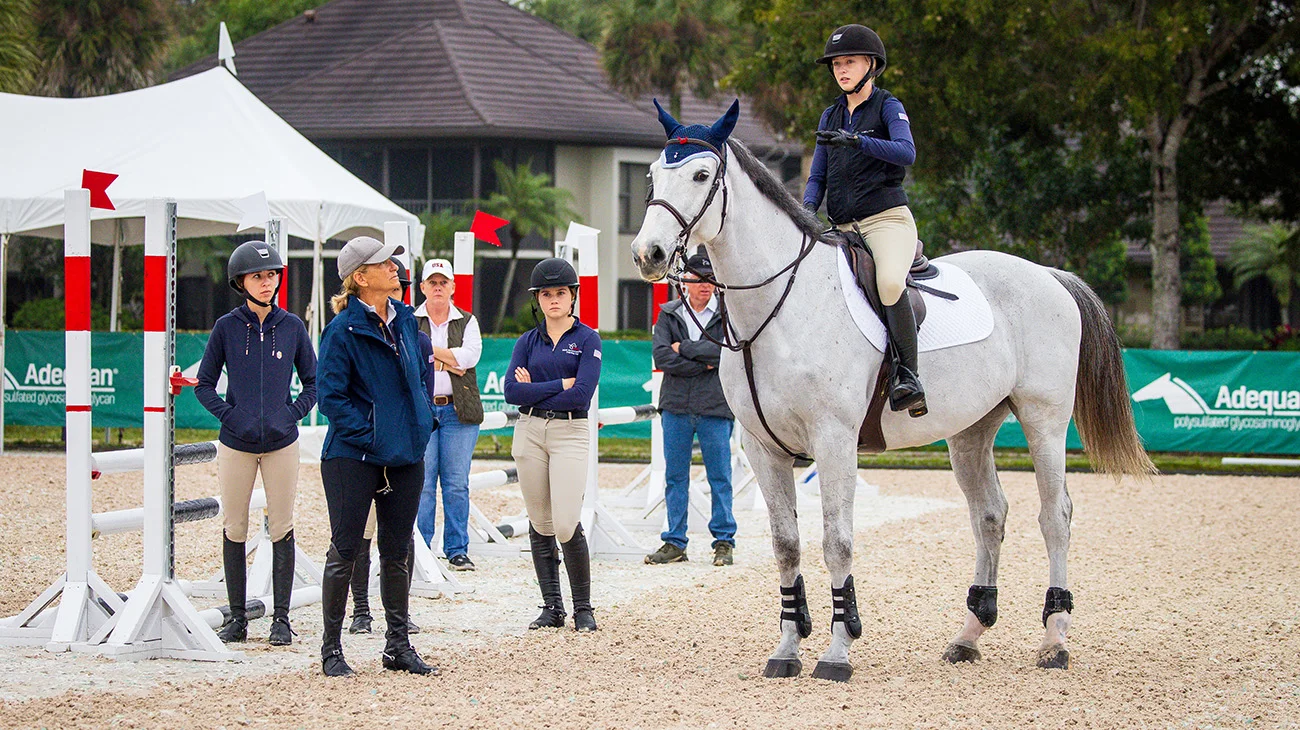
Before the riders, who were divided into groups of three, began jumping their warm-up fences, Madden wanted to hear each person’s plan for riding the course. She then walked them through the warm-up process in the schooling ring.

“Be prompt with your warm-up; don’t take too much time on it,” she said.
To riders who picked up the canter and sat the first several strides, Madden offered a small correction: “Start with a light seat at the canter and let the horses warm up first before you get into any serious work.”
When the first group—Carlee McCutcheon, Amira Kettaneh and Luke Jensen—started jumping schooling fences, Madden told the three to find deeper, closer distances.
“Keep cantering forward through the turn as you approach the fence; let the jump come to you,” she said. “It’s about getting your horse rideable out here. Rhythm through the turn, and then the horse has to wait to a normal or short distance. Put the horse in your hand and then release in the air. Schooling them after the fence helps their rideability to the warm-up fence. The size of the jump is insignificant; the rideability is what you’re working on out here.”
As Jensen finished his warm-up, Madden asked him to come back and jump a ramped oxer as his final fence before heading in. “This horse gets a little hung up over the jump, so we’re going to raise his sights and jump a ramped oxer,” Madden said. “Take him right in the air because he wants to go left.”
Madden’s advice worked, and after jumping the fence and taking a moment to collect his thoughts, Jensen headed into the ring.
Finding Each Round’s Teachable Moments
Jensen opted for the direct seven strides to the open water, then had rails at Fences 10 and 11.
“I thought, for going first, it was a good ride,” Madden said after Jensen’s round. “I would have liked to have seen more right opening rein through the triple to stay straighter. Next time through, anticipate that more. The last line got a little rushed; he’s got that left drift, so you’re that much closer to the front rail with him. Take some time to let him get straight; don’t rush.”
When McCutcheon went into the ring for her first round, she rode most of the course very accurately but also ran into problems from Fences 10 to 11, adding a stride in the line.
“Excellent job in the beginning, but keep your poise throughout your ride and look for where you are,” Madden said. “Ride what you see and feel, more than riding textbook. You’ve done years and years of riding the plan and sticking to it with the equitation—now you’ve got to show us that you’re riding what you have out there.”
Hunter Champey rode the clear first round but clocked in 0.63 seconds over the time allowed.
“I loved the way you rode to the fences, but after the jumps, you were just coasting,” Madden said. “Your horse took you left over one of the jumps, and you didn’t correct her afterward. That’s where you got slowed down. She also peeked up the line from Fences 3 to 4AB. When you’re riding a spookier jump, sit more, support her, and push her from your seat and leg. But, I thought you rode the last line the best of everyone so far.”
“Ride what you see and feel, more than riding textbook. You’ve done years and years of riding the plan and sticking to it with the equitation—now you’ve got to show us that you’re riding what you have out there.”
Beezie Madden
Second Round Changes
Although Madden had a very hands-on approach in the schooling ring for round one, she allowed the riders to warm up more on their own to prepare for the second round.
“When I warm up for the second round of a Nations Cup, I try to keep it as short as possible,” Madden said. “It’s like warming up for a jump-off: Don’t jump a bazillion jumps. Maybe you have a hot horse, and you want to do some low jumps—that’s great. But don’t do a lot of big jumps.”
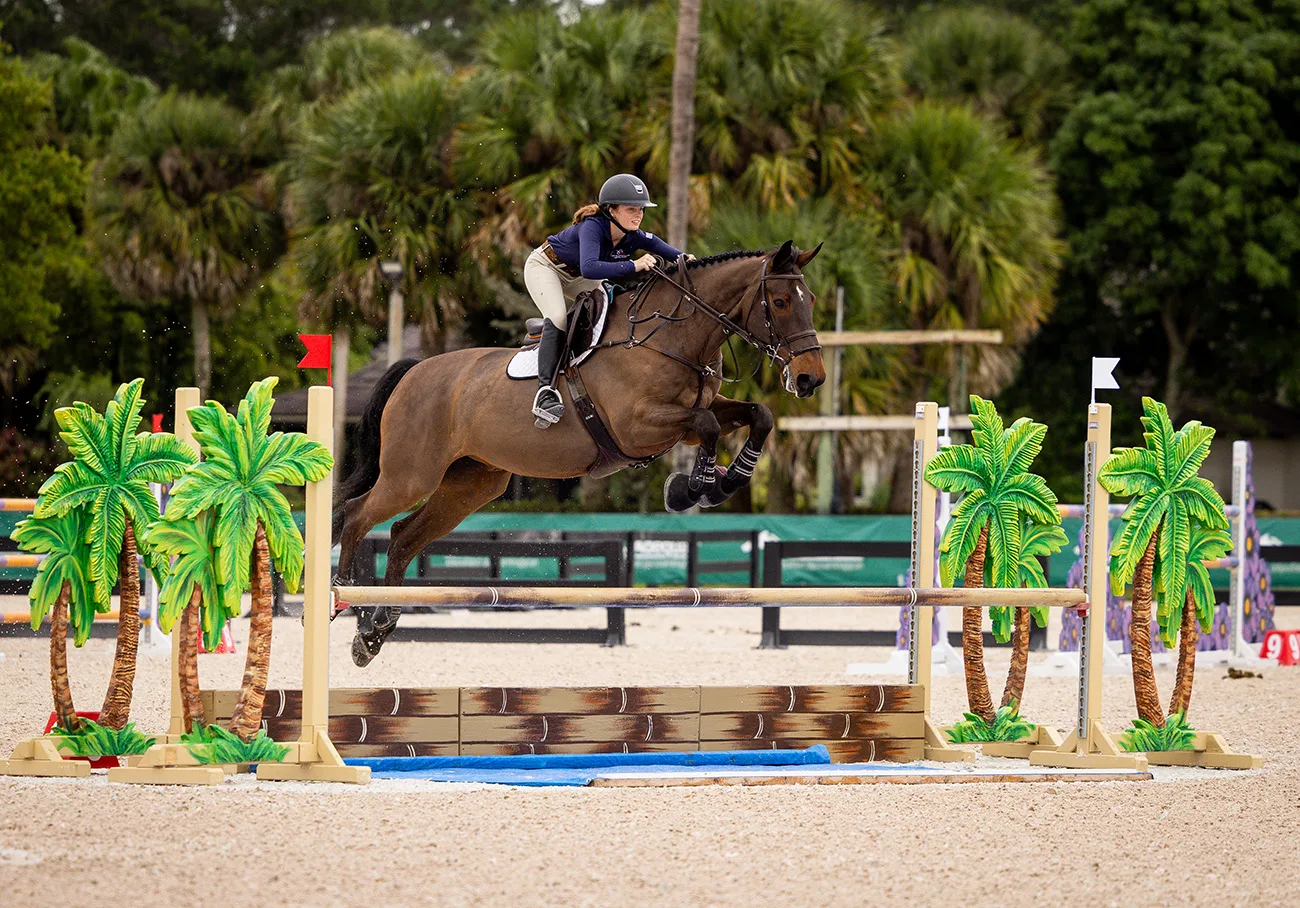
The riders had two helpers in the schooling ring to set the jumps for them. Madden chimed in if she felt a rider was overlooking something that needed improvement. She met the riders at the in-gate to go over their plans before they headed in. Jensen’s second round was much improved—he was clear until he had a front rail at the final oxer.
“I thought that was a beautiful ride until the last line,” Madden said. “You set it up much better and half-halted through the turn to it. You got there slowing down in the six, but then you leaned up the neck and then the rail came down.”
Although McCutcheon did the longer bending eight strides to the open water, Madden wasn’t fazed by it. McCutcheon finished with a clear round 3 seconds under the time allowed. “That was much better,” Madden said. “You made what you had work.”
Avery Glynn had a smooth, clear first round and came back the second round with the intentions of another clear.
Watch Glynn’s first round, courtesy of USEF Network:
“So Avery is sticking to the same plan she had for the first round,” Madden explained to the group. “She’s not making things complicated.”
Glynn was on her way to another clear round but had a rub at fence 9B and 9C down. She finished on a score of 4 faults.
“Again, what a good ride,” Madden said. “You executed it beautifully. One criticism: I was thinking at the double [Fences 4AB], you’ve got to open your hip angle up a little bit. You’re so soft, which is great, but you were up his neck a little bit at the double. There are times you can’t be too soft. Opening your hip angle does not mean driving; it means staying out of the horse’s way.”
Dealing With Refusals
Camilla Jerng, riding a borrowed horse, had problems with him stopping in the ring, but Madden used them as teachable moments for not just Jerng but the entire class.
As Jerng cantered her first warm-up jump in the schooling ring, Madden’s experienced eye recognized issues ahead, and she encouraged the rider to get her horse in front of the leg.
“Push him through the turn,” Madden said. “He’s behind you; come up to the fence. If you don’t correct them in the schooling ring, it’s going to come out more in the show ring.”
In the ring, the horse took issue with the liverpool at Fence 3.
“Stick,” Madden yelled from the in-gate, when he stopped the first time, “in front of your leg, come on!”
After he stopped again, Madden and several of the unmounted riders came out to put the line down four holes.
“OK, here’s what I want you to do before you go back to this line,” Madden instructed Jerng: “Cluck, stick and gallop forward on a straight line. Both reins in one hand and tap him with the stick.”
The horse then jumped 3 but stopped at 4A.
“Cluck, stick, gallop again,” Madden said as she and the other riders flanked the sides of the jump. “Just come back to the double here.” Jerng’s horse jumped through the line, and Madden had her halt on a straight line after it. She then completed the rest of the course without further problems.
“Stopping is not an option,” Madden said to Jerng after she exited the ring. “This is a borrowed horse—you don’t know him, and you didn’t expect that. But he was nappy in the schooling ring; that’s why I wanted you to get him in front of your leg. You’ve got to get him thinking forward, and that you’re the boss.”
When Jerng returned to the schooling ring for her second round, Madden had her leg her horse, cluck and tap him with the stick to get him in front of her leg from the beginning and had her jump the schooling liverpool.
Back in the ring, Jerng rode positively to the liverpool at Fence 3, but the horse stopped again, and she fell off. As she ran her stirrups up, Madden and a small group of unmounted riders came out to fix the jump and help Jerng get back on. Madden and Jensen flanked either side of Fence 3 to encourage Jerng’s horse to jump it, and Madden instructed her to come right back at it. He stopped again, and Jerng tapped him with her stick before trying a third time.
On the next approach, her horse spun to the left away from the jump. “Turn him right and go forward to the fence,” Madden said. As Jerng went toward the fence, Madden clapped her hands behind the horse, and he jumped Fence 3. “OK, good, keep going and finish the course!” Madden called out.
Jerng rode the bending eight strides to the open water jump and finished well.
“I thought the rest of the course was very good. You got it done,” Madden said. “It’s hard to get on someone else’s horse and do this.”
For many other riders, the second rounds brought scores of 4 faults, but Madden reminded them not to be too discouraged by their performance; a 4-fault score could still help their team win a medal during a Nations Cup class.
“Everyone wants to go clear, but 4 faults is not a bad score,” she said. “You can still be on the podium with that, so don’t give up.”
Read coverage of the first two days of the clinic here. Video of each day’s sessions is available to premium members at USEF Network powered by ClipMyHorse.TV.
The post 2024 Horsemastership Clinic: Nations Cup Practice With Beezie Madden appeared first on The Chronicle of the Horse.
]]>The post 2024 Horsemastership Clinic: Katie Prudent Uses Gymnastics To Build Thinking Riders appeared first on The Chronicle of the Horse.
]]>Standing in the midst of her gymnastics course, show jumping legend Katie Prudent put her hand up to her purple visor to block out the sun as she squinted up at six young riders trotting around her. Her floral shirt blew in the warm breeze, and she took a deep breath before she spoke.
“You are the first person of the day to feel your horse,” she began, “and it’s your job to say, ‘You know, the first 10 steps didn’t feel right on his left hind.’ If you know a horse better than others, you may know it’s stiff for the first few minutes and needs time to warm up. That’s your job as the rider. You have to be the first ones to let people know there is a possible upcoming problem.”
Unlike in previous years, gymnastics day in the USEF Horsemastership Clinic did not start with a demonstration ride over the course. Prudent went right to work with the 11 young riders, who were split into the same two groups as they were the day before for flatwork with Anne Kursinski. Prudent began by taking both groups through a warm-up of walk, trot and canter with a few leg yields and flying changes.
When Prudent asked the riders to execute a left leg yield, some of the horses did not move off easily their riders’ legs. They were the same riders who struggled with leg yields during the flat session.
“If your horse does not like doing an exercise, that does not mean you don’t do it,” Prudent said. “That means you need to do it more. Don’t ever forget this, guys: You will never be stronger than your horse. You have to figure out how to make them listen through feeling.”
Before they moved to jumping, she asked the riders to shorten their stirrups a hole while still mounted—a simple task with an unexpected consequence. One could see the surprise on Prudent’s face as she surveyed the first group and none of them were safely shortening their stirrups. She immediately turned her attention to Kursinski, who was standing along the rail. “How to properly shorten one’s stirrups needs to be addressed at some point,” she said. “That’s an hour lesson I don’t have time for right now. We need to do that for the future, Anne.”
The gymnastics course Prudent and the riders had set consisted of four parallel lines across the entirety of the ring with an open water jump placed directly in the middle, to be jumped toward the barns:
• The first bounce line had four plain green-and-tan striped verticals (with one ground line at each—the intent was for it to be jumped in one direction) with one trot rail set 9’ before the first vertical and another set 9’ after landing from the last vertical.
• Directly next to the bounce line sat three plain black-and-white striped verticals set 21’ feet apart to make a “1-to-1” stride between each of the fences) with two rails and two ground lines so they could be jumped in either direction.
• An open water jump sat next to the 1-to-1 line with a rail over the open water.
• Next to the water on the far side were a line of two purple-and-orange square oxers with no ground lines and floral standards, set 38’ apart on a forward two-stride line.
• At the far side of the ring stood the final line of one-strides: a plain black-and-white colored line consisting of a canter rail, a short 16’ one-stride to a very small vertical, 22’ to an oxer, 24’ to another vertical, and a long 26’ one-stride to an oxer. This line was set to be jumped both ways with no ground lines.
• Separately, a small blue-and-orange skinny panel jump with no standards sat just along the rail closest to the in-gate.

“At your riding level, you need to be able to do anything I tell you,” Prudent said. “These are all great exercises for that.”
Prudent had the young riders begin over the low trot-in, canter-out bounce line toward the in-gate, with each bounce set as half of an “X”. Several of the horses backed off their first times through the line and stuck a bit off the ground.
“How do you get a horse to go forward?” Prudent asked the group, waiting patiently for a response. She received four answers: leg, seat, cluck and driving aids. “But what should your hands be doing? Nothing! If you feel your horse backing off to the bounces, put your hands forward up his neck. That’s something we don’t teach enough of today—release!”
After everyone had gone, Prudent asked the unmounted riders to raise the four bounce fences to 2’9” verticals and had the riders come back through the exercise again.
“I like a bounce for a horse that might be a little slow in the front—you know, to get out of the way, they’ve got to be quick,” Prudent said. “Your job is to hold your position all the way through. Don’t interfere, be very still. If they’re backing up, you let them go a little and if they’re getting too quick, you hold them back a little bit so that each jump is the same.”
When Amira Kettaneh’s horse got quick through the bounce exercise, Prudent corrected her.
“You’ve got to be effective; slow it down,” she said. “Don’t plant your hands on his withers to slow him down; carry your hands. Don’t touch the neck with your hands—keep them just above it.”
As several more riders cantered through the exercise, Prudent asked them: “Were you touching your horse’s neck with your hands?”
When they admitted they were, she cautioned, “We’re watching you!”
Then Prudent had the group trot into the bounce line and turn right after it, canter up the rail and turn right to the forward 1-to-1 stride line with the verticals set around 3’, and then stop on a straight line before the corner. One rider went through the 1-to-1 line and struggled to halt immediately on a straight line afterwards.
“Where are you going?” Prudent hollered. “I’m hard on my riders because it’s dangerous if you do not have control.”
After the group finished that exercise, the five unmounted riders raised the verticals to 3’6” in the 1-to-1 line, and the group went back through the exercise once more.

Next, Prudent asked the riders to jump the panel on the rail by itself. Several of the horses were taken by surprise, stopping before the panel or running out past it. Prudent reiterated the importance of the rider using their crop quickly to reprimand the horse and then coming right back around to jump the panel again.
“This is making a horse,” she said. “Find what he doesn’t do well and work on it until he does.”
The first course Prudent had the riders work over began by jumping the 1-to-1 line toward the in-gate, turning left to trot the skinny panel, another left turn to canter up the long side, and then a final left turn down over the open water jump with a halt on a straight line after it.
“I ride the water jump like my horse is going to stop,” Prudent advised the riders. “You never know, and it’s better to be safe than sorry. I also never school the open water without a rail over it at home. The rail helps the horse jump up and over it.”
When several of the riders struggled to slow their horses through the 1-to-1 line, Prudent had the five unmounted riders put a landing rail in the middle of each one-stride.
“Gymnastics are to train the horse,” she said. “He needs to slow down and look at what he’s doing. Sometimes the pole can help with this. Then you don’t have to be so strong on his mouth. This is another training aid to help your horse learn. You have to teach him; he doesn’t know.”
Their next course added a new element: the two-stride line with wide square oxers set to be jumped away from the in-gate. Carlee McCutcheon and her horse executed the exercise well, earning a compliment from Prudent. “You’ve got beautiful feel,” she said. “That was great.”

When the two-stride was raised to 3’6”, problems began to arise: Luke Jensen’s horse had a rail at the second oxer.
“That was too chase-y into it,” Prudent said. “It’s a forward line, but you’ve got to get your horse forward without pushing him through the jumps.” As Jensen cantered through the turn after the two-stride, his horse hopped and bucked in the turn and then refused to continue down to the 1-to-1 line.
“Keep going, don’t let him turn away!” Prudent said. “Anytime your horse does that—send him forward immediately!”
Another rider accidently went through their halt after the last line, and Prudent spoke up immediately. “As a group, you guys lack discipline,” she said. “We’ve stopped 20 times on a straight line already; you know what’s coming. If you lack discipline, how can you possibly go ride a whole course? Teach yourself discipline: Do what I ask, no matter how it feels.”
Near the end of the first session, Prudent added the final gymnastic line: canter right lead down over the line of four fences set at varying one-stride lengths (16’, 22’, 24’, and 26’), and then left turn, circle and canter right back up the line in the opposite direction off the left lead.
“What these exercises show you is what you have to work on,” Prudent said. When several riders struggled to make their horses do a full stride in the 16’ section the second time through the line, bouncing the rail instead, Prudent offered this advice: “If it doesn’t go well, don’t lose your thought process. Finish up the best you can. When you ride on teams and everything counts—if you lose your thought process, you’ll have another rail. On a team, that could mean the difference between winning or losing.”
Watch clips from Saturday’s gymnastic session, courtesy of USEF Network:
Prudent did not have both groups do the exact same courses; she changed it up for Group 2 and started them off with trotting left over the small panel jump. One of the horses stopped and ran out, and Prudent and Jensen went to stand on either side of the panel to encourage the horse to jump it the first time.
“This horse is a borrowed horse, and he may not know this exercise,” Prudent said. “That’s OK—keep him in front of you. We teach a horse that doesn’t know. If you feel like your horse is looking at the panel a bit, drop back in your seat to encourage him forward.”
After the skinny panel, the group moves to the open water jump and then to the trot-in bounce line of small half-X’s. Prudent offered a bit of insight into her thought process when setting this particular course: “I set up the short lines always toward home,” she said. “I want the riders to feel their horses getting strong and what they have to do to resist them.”
During their next course, when Nora Nauss’ horse stopped at the last element of the 1-to-1 stride triple, Prudent helped her fix the issue.
“What I’ve noticed about this horse is that he goes a little right when it gets hard,” Prudent said, “and it’s going to get harder, these exercises. Come back through again and know that he’s going to do that. Know your horse’s quirks, and don’t let them happen.”
Nauss came back through the line again, correcting her horse’s right drift over the middle vertical, but she had another stop at the out. Prudent had Nauss tap her horse twice with her crop and repeat the exercise again.

“He knows this is hard; I like to find what’s hard for the horses and practice it,” Prudent said. “The more he does it, the easier he will think it is. Confidence in the horse is your main goal.” The third time through, Nauss and her horse jumped through the line with no problems.
The group then attempted the four varying-length one-strides in a row, set around 3’3” to the canter circle and repeating in the opposite direction. When several riders also bounced the short one-stride, Prudent had them come into the middle so she could explain how to ride the line properly.
“You want to come in forward the second time up this line so you can slow down the whole way through the line,” Prudent said. “Let them come forward through the corner and then look for a distance. That will allow your eye to see the better choice. Then by the time you reach the shortest one-stride, your horse is with you and slowing down. Fit it in.” The riders come back through the exercise, taking Prudent’s suggestions, and they were successful in getting the short one-stride instead of bouncing it.
At the end of the sessions, Prudent reminded the riders of her ultimate goal throughout her tough instruction. “My hope, through all of this, is to get you guys thinking better,” Prudent said. “You all ride well, but you need to think more. Once your horse understands what you want, things will get better and better.”
Video from all sessions of the 2024 USEF Horsemastership Training Series is available to premium members on USEF Network powered by ClipMyHorse.TV. Read coverage of the flat session here, and check back tomorrow for coverage of the final day’s coursework session with Beezie Madden.
The post 2024 Horsemastership Clinic: Katie Prudent Uses Gymnastics To Build Thinking Riders appeared first on The Chronicle of the Horse.
]]>