The post Amateur Dressage Rider Erin Liedle Has A Mini And A Mission appeared first on The Chronicle of the Horse.
]]>It’s not unusual for amateur dressage rider Erin Liedle to show up at The Pointe at Lifespring, an assisted living facility in Knoxville, Tennessee, where she works as a physical therapist, with one of her pets in tow. Her dogs are always welcome visitors, but it’s her Shetland pony Stewie who draws the biggest crowd.
Her service work with her pets and her career as a physical therapist for geriatric patients are only some of the many ways that Liedle gives back. Outside her job and her passion for riding, she also helps run the East Tennessee nonprofit Down and Dirty Dogs, which provides training to shelter dogs, improving their well-being while sheltered and making them more adoptable pets.
Bridging The Gap With Service Animals
Almost 15 years ago Liedle’s main riding horse was struggling with complex health issues and couldn’t be turned out with other horses. The mare grew depressed. When a vet suggested that a smaller, gentler companion might improve her mental health and physical recovery, Liedle jumped on the idea; she was open to anything that might help her horse.
And as one does when they need a small pasture puff, Liedle immediately went to Craigslist.
“I found Stewie’s ad and asked to meet him,” she said. “When we got there, he was covered in mud. But he was the happiest little dude, and he had so much personality. He’s the best $300 I’ve ever spent!”

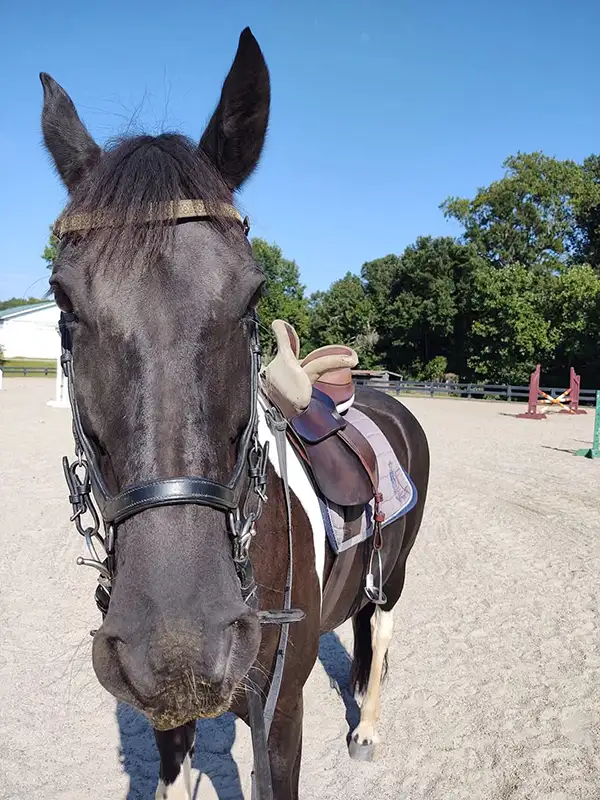
In the short-term, miniature horse Stewie was a definite boost to her mare’s quality of life, Liedle said. But when the mare eventually was diagnosed with a severe neurologic condition and had to be put down, there was no question that Stewie was staying put at Liedle’s farm in Knoxville, where he lives now with her retired eventer and her current dressage mount.
While Liedle had purchased the mini as a cute companion, she thought Stewie had more to offer.
Liedle had been a physical therapist at The Pointe at Lifespring for only a few years when she asked executive director Rebecca Mills if she could bring Stewie in to visit the residents.
Bringing her animals to work was nothing new for Liedle: Her agility dogs, Border Collie Graham and Border Terriers Miley and Griffin, often accompany her, encouraging and motivating the residents during physical therapy sessions and visiting patients in their rooms.
Trips to The Pointe became another way for the dogs, who Liedle says “are fantastic but need direction,” beyond their regular agility training, to feel like they have a job. And the positive impact they have on Liedle’s patients was nothing short of extraordinary.
“One of my patients was put into hospice care,” Liedle said, “and she specifically asked for Miley. So the next day I brought her in. The patient, bed-bound at that point, asked if I could put Miley on her bed. And I did, and Miley just gently crawled up and laid down on the patient’s chest and just sort of spread herself out and lay there for a long time. She just knew. I’ll never forget it.”
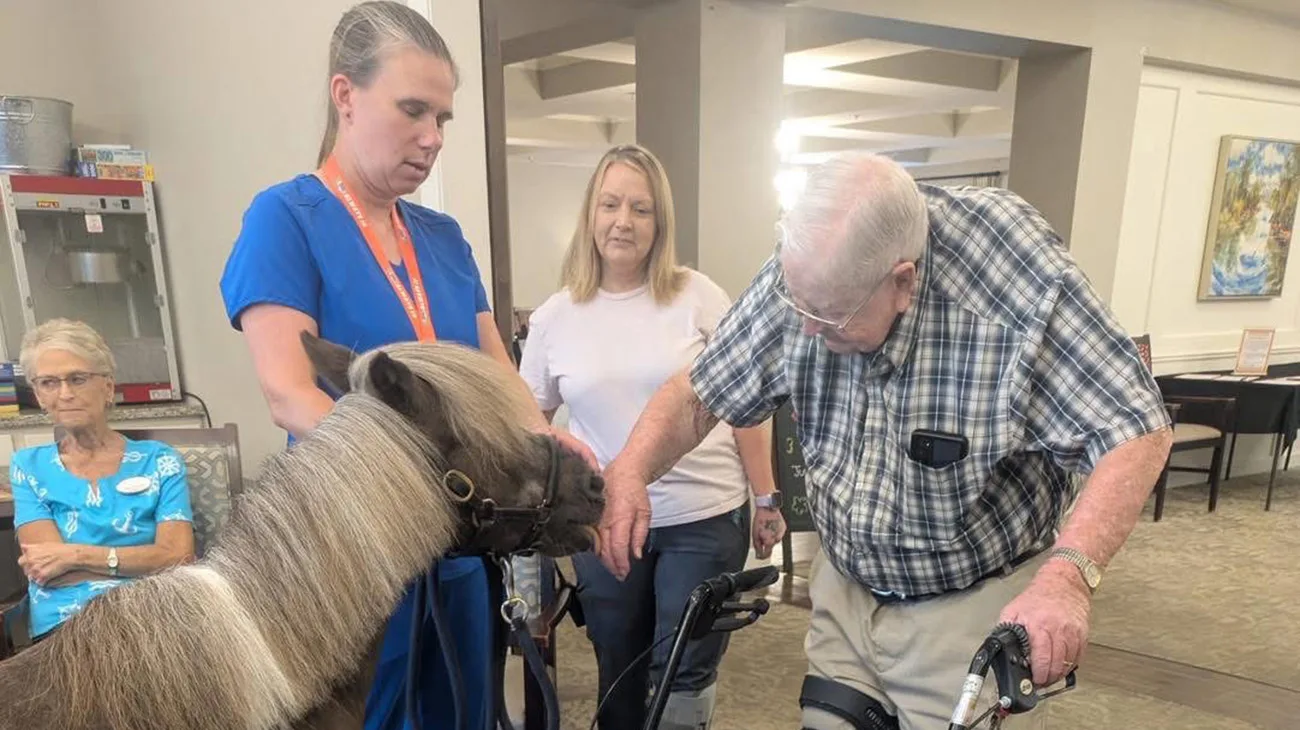
Knowing how much joy the dogs brought The Pointe’s seniors, when Liedle asked Mills about Stewie, the answer was a resounding yes.
The Elevator Pony
“I was a little worried that he might, you know, do his business,” Mills said, laughing. “But then he showed up, and he was so beautifully groomed, and he smelled so good, and he had a better haircut than most of the men who work here…
“He’s so good that we can bring him inside,” she continued. “The fact that he’s so calm and accessible and approachable just allows him to reach everyone. He just brings so much joy. How can you be stressed or worried when you’re petting a miniature horse? Or is he a pony? I’m not a horse expert—I just know he’s cute!
“He’s become a celebrity here,” she added. “We have some residents who don’t attend a lot of activities and aren’t super social. They can be hard to reach, especially some of the residents in memory care. But then one of the dogs or Stewie comes for a visit, and it’s that animal who is able to bring that resident out of his or her shell. It’s just priceless.”
Liedle remembers a particular visit when a resident on the second floor wanted to meet Stewie but couldn’t come downstairs.
“He grew up on a farm and really, really wanted to see the pony,” she recalled. “So my colleague asked if Stewie would ride on an elevator. I said, ‘We’re going to find out!’ and that little champion, he walked right on and went up to visit that patient. It was amazing.”
Liedle said that bringing her pets to work—especially Stewie—enables her to do her physical therapy work even better.
“For so many of my harder-to-reach patients, he bridges the gap,” she said. “He has changed my relationship with so many patients because he opens something up in them that allows them to let us in. It’s just so special. I never could have imagined that my career would have turned out like this, that I could, in this incredible way, couple my love of animals with my love for the geriatric population and get to share one with the other.”
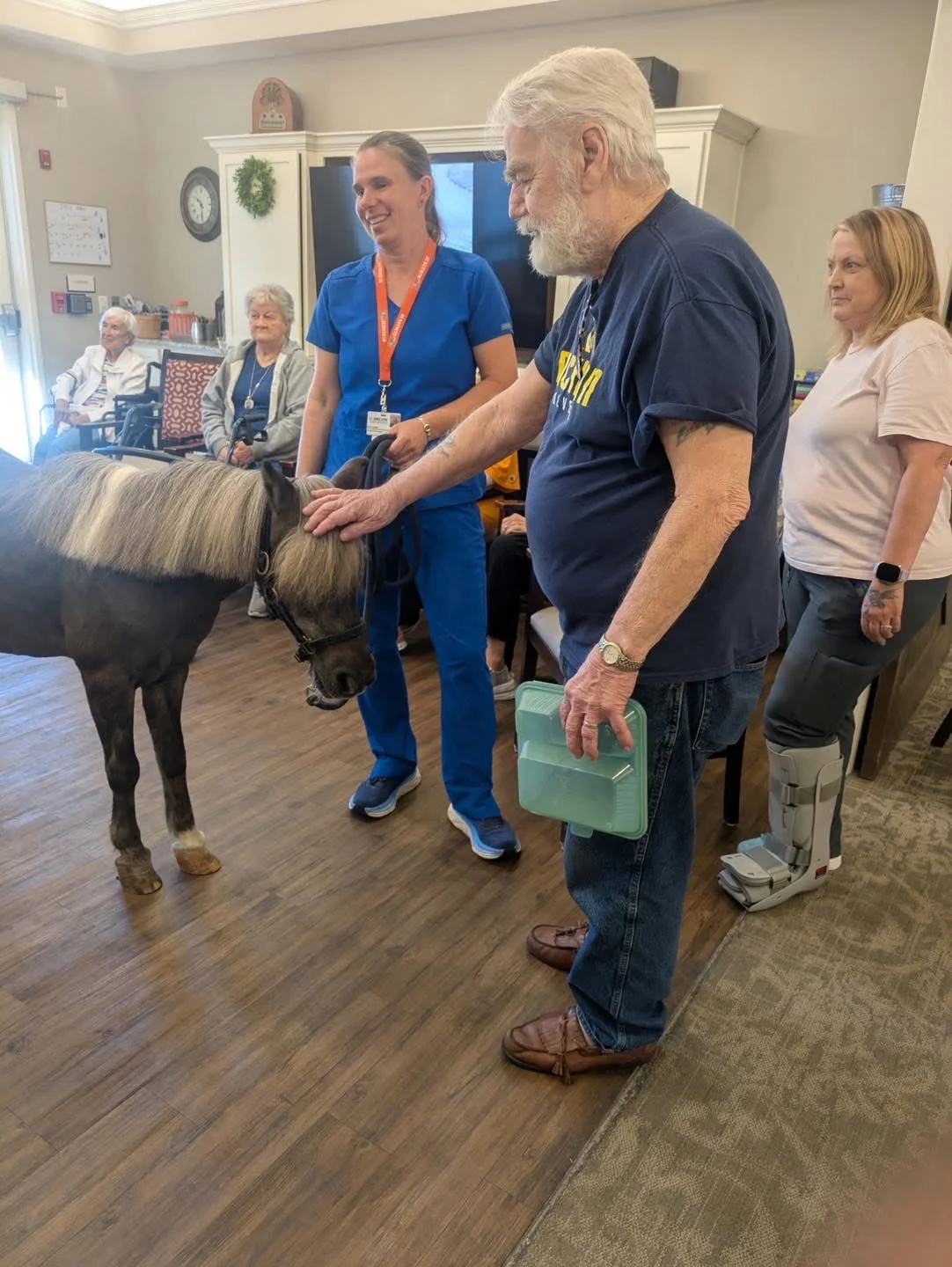
“Erin wears so many hats here,” Mills said. “She’s an incredible physical therapist, but she goes above and beyond that role daily in everything she does. What she does for everyone here goes so far beyond a job—it’s a passion and a calling.”
Equestrian Steward
While Stewie may be the biggest celebrity living in Liedle’s backyard, the company he keeps is rather impressive. Liedle’s mostly retired eventer, Fernhill Boodle, won the amateur training level championship at the 2019 USEA American Eventing Championships (Kentucky). When “Boodle” had some off-and-on lameness issues, Liedle decided to retire him to hacks around the farm while she shifted her focus solely to dressage.
“Eventing is a really high-risk sport, she said. “And I’d found an incredible trainer and a great group of friends in Knoxville who were dressage riders. Making the switch from eventing, which I’d done since childhood, just made sense.
“I’d always loved dressage,” she continued. “But I didn’t understand the sport in its entirety because I’d never had a purpose-bred horse to do that specific job.”

She has been riding with dressage trainer Emily Brollier Curtis for almost a decade and said that Curtis’ guidance in the sport—and as a person—has been life-changing. Liedle also credits Curtis for finding her current dressage mount, a 7-year-old Dutch Warmblood gelding named No Limit (Just For You—Heriti, Vitalis).
“Emily saw his ad and said, ‘You need to go sit on this horse,’ ” Liedle recalled. “I’m pretty calculated in my decision making, but I really trust Emily, and so I bought a ticket to Texas. I told my mom when I was at the airport, ‘I’m not going to buy this horse.’ Then I walked into the barn and realized that I was in trouble.
“Three years later, it’s the best decision I ever made,” she continued.
And while “Rocky” has taken her to the U.S. Dressage Finals for the past three years and is beginning Prix St. Georges work, Liedle isn’t talking about their successes in the show ring. She’s more interested in what she’s learned from Rocky and the relationship that they’ve formed since their partnership began.

“He was not the easiest young horse,” she said. “He was cut late, and he has very, very high opinions of himself. He refused to give to pressure; he couldn’t handle it. So we started off doing a lot of groundwork, and I taught him that he could trust that there would always be a release if he just kept looking for it. When he came to realize that I was never going to trap him, and that he just needed to work to figure out what I was asking for, we really started to become a team. And he has really improved my horsemanship and my riding; I have so many more tools in my toolbox now because of him.”
Once the pair sorted out those early kinks, they took to the show ring, which Rocky really enjoys.
“His extra bravado is really working for us now,” she said. “It’s an unknown variable when you buy a young horse; you don’t know if they’ll even enjoy showing. But Rocky loves the show ring, especially the big shows. Like, he goes to finals, and he steps up.”
But she tries hard to keep her showing goals in perspective.
“I try to look at horse shows as litmus tests,” she said. “I love competing, but at the end of the day, if my horse is happy and content at the show, we’ve won already. The mental and physical health of the horse is always most important, and feedback from a show just lets me know what we need to keep working on.”
“It’s about the personal journey for her,” Curtis said. “I cannot tell you how many times she checks in with me on an ethical standard, asking if something is fair to the horse. She’s constantly coming back to that, being a steward for her horse. Her horsemanship is outstanding. She’s always questioning: Is this right? Is this fair? Am I asking the right questions? Is this too much or not enough? She’s always circling back to what is right. And because of that, her horse is so generous with her. Erin is as good as they come. The real deal.”
Liedle says that having her horses at home fosters the special relationship she has with each one of them.
“It helps to remind me of what’s really important,” Liedle said. “I’m the person who asks Rocky to work, but I’m also the food lady and the stall cleaner, and we’re always just hanging out. It’s the absolute best when I walk out of the garage, not even going to the barn, and the horses start talking to me.
“What gets me up in the morning is knowing that these animals, whether the dogs or the horses, put their trust in me even though they don’t have to. That’s most important,” she added. “Rocky is by far the nicest horse I’ve ever had, and probably ever will have, and I just feel so blessed to be his person. God entrusts us with these animals to be stewards to them, to do right by them and take care of them the best that we can.”
But while Liedle is grateful for the animals and people in her own life, so many in Knoxville would say that they feel blessed, too, by her presence in their lives, whether it’s her colleagues and residents at The Pointe, or her friends at the barn, or the horses and dogs she loves.
“She’s an amazing physical therapist,” Miller said. “But more than that, she’s a phenomenal human. She’s so humble. She cares so much about the people here. Really, she cares about all living things. She’s just a phenomenal person.”
The post Amateur Dressage Rider Erin Liedle Has A Mini And A Mission appeared first on The Chronicle of the Horse.
]]>The post Helicopter Flight Nurse Finds Her Footing In Dressage Ring appeared first on The Chronicle of the Horse.
]]>As a helicopter flight nurse tasked with taking care of critically ill patients mid-air, Jill Ekis knows about the necessity of unwinding after a long day at work. But as a dressage-crazy mother of two, Ekis’ so-called “free time” looks a little different.
When she’s on the ground, Ekis’ life is dominated by horses. Whether she’s at the barn with her 25-year-old Arabian gelding MS Fires Comet, studying to become a dressage technical delegate, or driving her daughter to vaulting practice, hooves are never hard to find. But when she’s in the air, the Pittsburgh-based nurse puts everything else out of mind.

It’s what she would have wanted from medical personnel, if she hadn’t been alone with her stepfather when personal tragedy struck her family in 2002.
“I had a stepfather who passed away. I wasn’t a medical person at the time. My mom was, but she was at work that day. He had a massive heart attack, and I remember just feeling helpless, like I didn’t know what to do,” said Ekis, who was 25 at the time. “Now I know that no matter what I would have known then, or whatever equipment I had, or medicine I had, he was going to die. And now I feel like, if that happened again, or [happened to] someone close to me, I know I’m capable of doing everything I can, and if they still pass, then that’s what was always going to happen.”
Motivated by her experience, Ekis started in the trauma surgical intensive care unit before she got into a helicopter.
“When I went into trauma medicine, I was like, ‘Who do they call when everything goes wrong?’ That’s who I want to be,” she said.
Some flights are much less intense than others. The Center for Emergency Medicine of Western Pennsylvania-owned STAT MedEvac helicopter crew transports all kinds of patients, from those experiencing routine health issues to life-threatening medical emergencies.
“Everyone’s like, ‘That’s so stressful!’ But I don’t feel like it is,” Ekis said. “To you it might be stressful, but for me … I like to know what’s going on. I guess that’s why becoming a technical delegate fits too, because you know what’s going on with everybody.”
Ekis started on the path to become a TD more than three years ago, when she found herself wanting more education than she could find online and listening to podcasts.
“I wanted to get more involved,” she said. “I enjoyed dressage so much, and I wanted to get deeper into the education portion of it. Soaking up everything, reading everything, and listening to all the podcasts—it was still not enough. Becoming a TD was a way for me to have a bigger purpose in the sport, even if I couldn’t ride anymore, or couldn’t afford it.”
Not one to shy away from opportunities out of the saddle, Ekis also serves on the USDF Adult Programs Committee and was recently re-elected from Region 1 as a participating member delegate to the 2025 USDF Convention in December.
Though she hasn’t been down the centerline in a couple of years, Ekis still gets to the barn regularly to ride “Comet.” The 14.1-hand Arabian (TA Prince Sharif—Galant MS Fire) joined the family eight years ago, after a career as an endurance and games pony, initially as a Pony Club and eventing mount for Ekis’ son Kai Ekis, now 15. Watching her son made Jill, who grew up dancing rather than riding horses, a little envious.
“I didn’t think adults did this,” she said. “I knew about the Olympics, but I thought, like with dance, if you don’t become a professional by a certain age, there’s really nothing for you. I didn’t know about this whole adult amateur world out there. My son was riding, and I was with another adult and I said, ‘I wish I could ride.’ She was like, ‘Well, I ride.’ I thought it was just for the kids, but it’s not.”
So, when her son lost interest in horses, Jill happily took over the ride on Comet. Though she followed in Kai’s eventing footsteps briefly, she soon decided both for her personal risk tolerance and her detail-oriented nature that dressage was a better fit.
“I said, ‘I don’t really care what anyone’s going to say about my old man to me. We’re going to do this,’ ” she said. “We got some pushback. There were people who said, ‘I can’t believe you’re going to recognized shows with him.’ But I was like, ‘I don’t really care if I go and get a 50. I just want to go see what it’s like.’ That’s the only way I was going to learn to just jump in.”
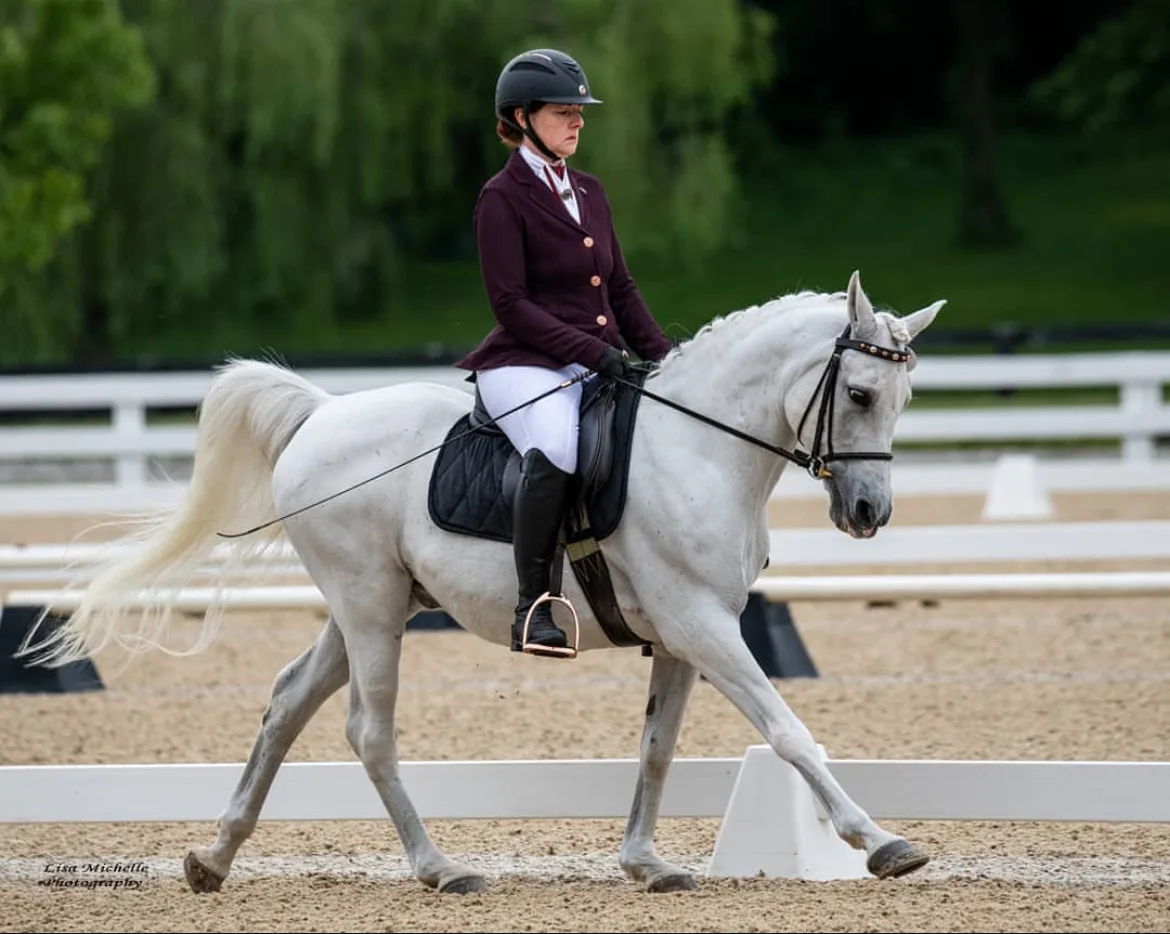
The pair competed through third level together, earning four of the six scores for Jill’s U.S. Dressage Federation bronze medal.
In his semi-retirement, the gray gelding has confidently stepped into the role of babysitter at Dark Horse Farm in Baden, Pennsylvania, expertly teaching younger horses how to munch grass quietly in turnout.
While Comet’s life has begun to slow down, Jill cannot say the same of her own. One fateful trip to Dressage at Devon (Pennsylvania) with her daughter Imogen, now 8, four years ago resulted in one more horsewoman in the family.
“I almost didn’t take her with me that year, because I thought she was too young to pay attention at that show,” Jill said. “But I took her, and they had a vaulting demonstration. She looked at me and she said, ‘That’s what I want to do.’ She wouldn’t stop bothering me until we found the girls and she got to practice on their barrel. We found a team near us, and she’s been vaulting ever since.”
Looking ahead, Jill plans to spend more time focused on horses. After spending years helping others through emergencies like the one she herself experienced with her stepfather, she is ready to prioritize other aspects of her life. Recently, she’s switched to working part-time.
“That demon I used to carry around is quiet, so I’m going to just slowly start to back myself away and do things that are more fun,” she said.
Among the more fun things: finishing her TD program, attending the 2025 USDF convention, and maybe even returning to the competition arena with Comet.
“I’ve thought about pulling him out for a first level freestyle, for a reprise,” she said. “I have all these grand ideas that I want to do for a freestyle. We’ll see.”
The post Helicopter Flight Nurse Finds Her Footing In Dressage Ring appeared first on The Chronicle of the Horse.
]]>The post Early Mornings, Late Nights Have Helped Amateur Sara Schulman Reach Advanced appeared first on The Chronicle of the Horse.
]]>Amateur rider Sara Schulman graduated from college in May 2020 with neither pomp nor circumstance; the early months of the COVID-19 pandemic had shut down the nation so her graduation ceremony from the University of Virginia didn’t take place until the following year. But her entrance into the workforce—virtually—in those early months of the pandemic provided her a unique opportunity to launch her career while simultaneously pursuing her dream of climbing to the top levels of eventing.
The journey hasn’t always been easy, but the successes she’s had with her equine partner Cooley Chromatic over the past few seasons have made that quest for balance more than worth its challenges. They are now competing successfully at the advanced level around her full-time job for mortgage giant Fannie Mae.
Back when she was an incoming college freshman, Schulman lasted just one horseless week at the University of Virginia before driving a few hours home to bring back a relatively green off-track Thoroughbred she’d purchased at the end of high school. Her parents—not horse people—hadn’t wanted their daughter to worry about either the time or the expense of a horse while adjusting to college life, but she assured them she could find balance between school and “Snip.”
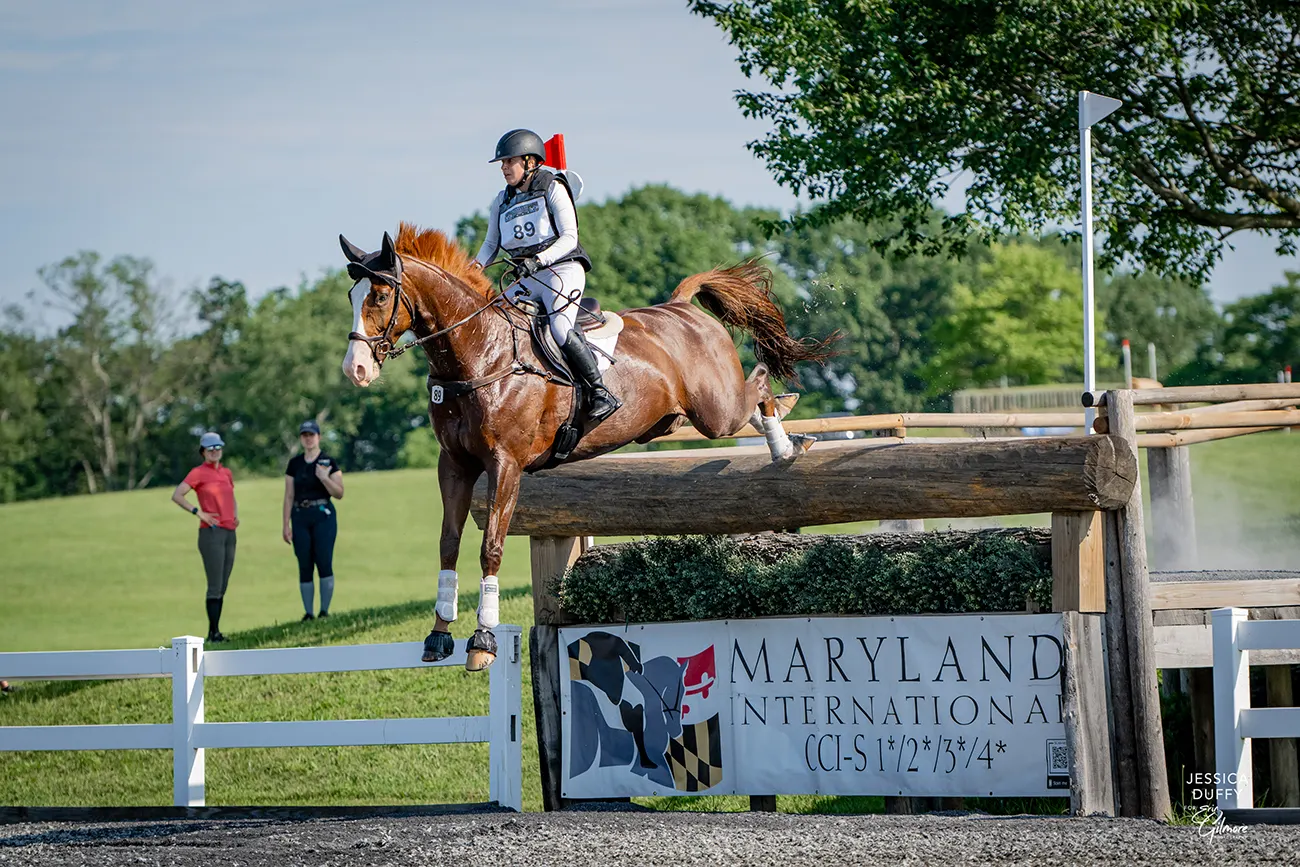
A variety of part-time jobs enabled her to make equestrian ends meet.
“I did the afternoon feeding and chores at Kim Severson’s barn to work off board,” she said. “And I house-sat, rode a horse for a professor, and worked at Dover Saddlery, though it was easy to just spend my paycheck right there!”
Throughout college she rode on UVA’s eventing team but said it was relatively small, and they only competed together a few times each year. So Schulman focused on Snip’s training, starting out at novice. By her senior year they were competing successfully at the CCI2* level.
Snip, who was then 13, was maxing out, and Schulman knew her own ambitions were too big to ask of him. So she made the tough decision after a successful season to sell him, knowing those funds would help her buy her next partner.
During the first semester of her senior year, Schulman received a job offer. She signed on with Fannie Mae in the housing mortgage industry; she’d begin working in July 2020, shortly after graduating with her economics degree.
But then COVID hit, and Schulman learned that she’d start her new job remotely—with a significant amount of flexibility.
She took the funds from Snip’s sale and went to Ireland. She knew she couldn’t afford a made horse; her budget would allow, instead, for her to invest in a quality young prospect.
She took a chance on a leggy, red 3-year-old Oldenburg gelding named Cooley Chromatic (Thorgal—Castrade, Sandreo).
“It was a risk,” she said. “Getting a horse that young, I didn’t know if he would actually have the desire to be an upper-level event horse as I hopefully intended him to be, so I had to make sure he was marketable in general if I brought him back and he didn’t want to be an eventer.
“I watched him free jump over there [in Ireland] and while it’s hard to see a lot at that age, I could get a general sense of his natural athleticism. He was a beautiful mover,” she continued.
Working remotely allowed her to spend nearly every day of the week with her new partner, “Caden,” as well as continue to work as an assistant trainer to Jan Byyny, with whom she’d been riding and training.
During those early years post-graduation, Schulman juggled her full-time, real-world career with long hours spent at the barn. She’d visit the barn twice a day to do chores and ride multiple horses around her day job.
“There were some jam-packed days and early mornings and late nights,” she said. “But I think that period of time was really instrumental for my own riding, Caden’s development, and in my relationship with him.”
For an amateur wanting to make it to the top levels of the sport, having just one horse was hindering her own progress as a rider—especially in the early years when Caden was still growing and his training had to be careful and slow.
“At first, he could really only flat for like 20 minutes at a time,” she said. “I had to curb my ambitions and not push him too much.”
But it’s hard to progress as an upper-level rider with a one-horse string.
Schulman credits Byyny for allowing her to ride and compete horses for Byyny and her clients, which gave her the additional saddle time she needed to develop her own skills. She still catch-rides when she can and appreciates the trust Byyny has in her to ride relatively unfamiliar horses in new environments.
Schulman realized Caden was a keeper at one of their first preliminary-level events.
“He’d always been super nervous over water jumps; he didn’t understand the question he was being asked,” she recalled. “I’d always had to school him through the water at every horse trial. But I have this picture of us jumping into the water, and I have a giant smile on my face because he’d popped in confidently.”
As they moved up the levels, it became clear that Caden was really enjoying his job and had the talent and drive to take the pair to the top levels of the sport.
“I started to noticed a change in him at the start box,” she said. “When we moved up to intermediate, he started to get really excited. He felt ambitious, and I hadn’t really felt that from him before.”
It’s Schulman’s boyfriend, Mike Dewhirst, who leads the bouncing duo most often to the start.
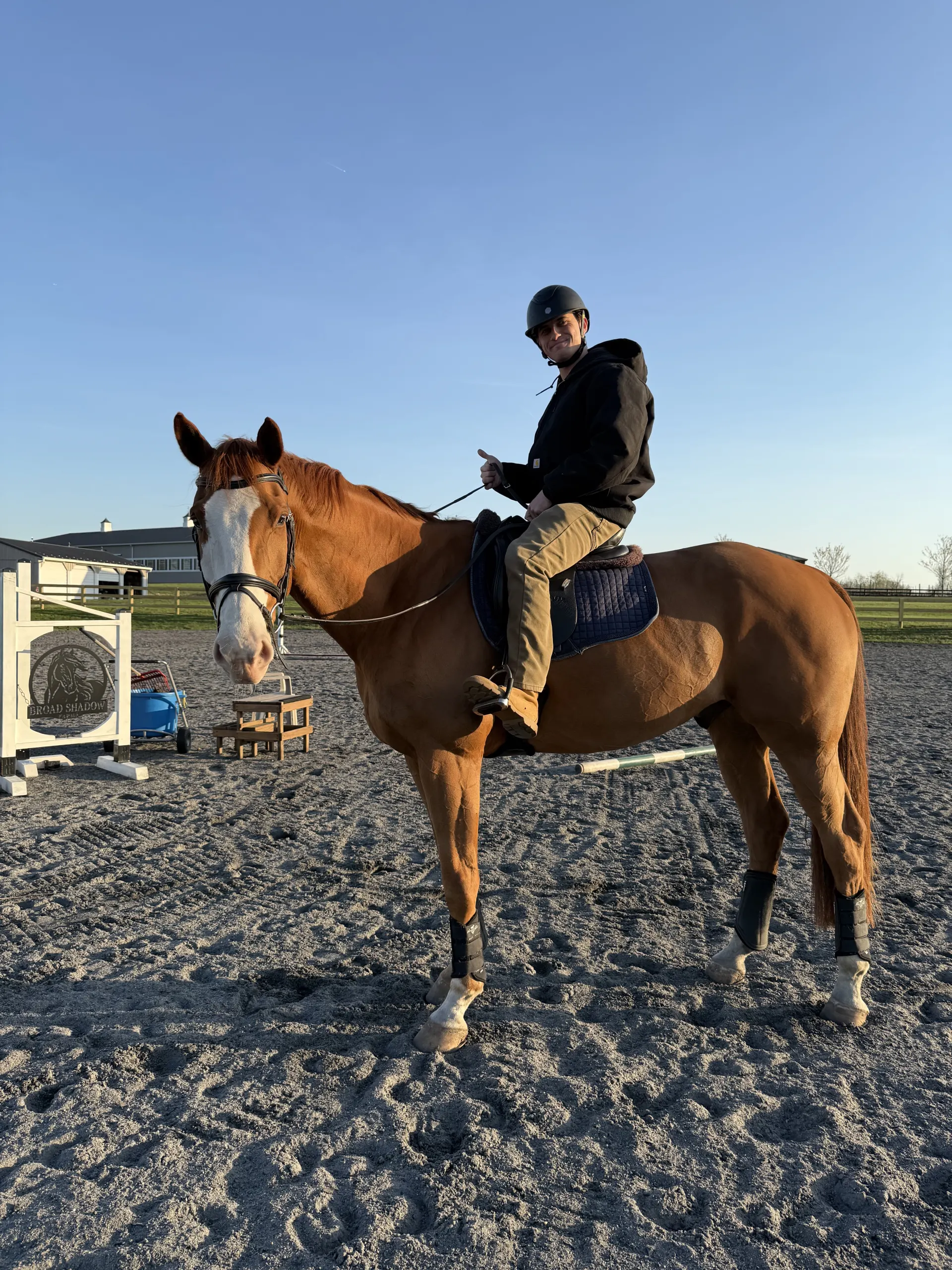
They’ve been dating for about a year and a half, and it seems like he might be a keeper, too. He’s an avid supporter of Schulman’s passion—a key, she says, for being able to balance a relationship with high-level riding.
“He was not a horse guy, but he’s turned into one,” she said. “He comes out to the barn with me often and thinks of Caden as ‘his friend.’ Two months into dating, I was in Florida for the season. We’d only been on a handful of dates, but he flew down to spend time with me. Six months in, he came with me to Bromont [(Quebec)].”
“He does just about everything now,” she continued. “He observes everything and just learns what the next step is. He grooms and helps bathe. He jogs horses out for people. He volunteers on his own to pick up poop, and he wipes snot out of Caden’s white nose. Often, I think he knows a course better than I do, and he’ll walk courses with me and suggest the lines I should take.”
It’s not just Dewhirst’s understanding and flexibility that helps Schulman find some sense of balance in her life.
“You can’t do this unless you have people around you who understand the limitations of your schedule,” she said.
That includes Dewhirst but also Schulman’s trainers, who will meet her for lessons as early as 6 a.m., or the barn staff who may help with fitness rides if she can’t make it to the barn due to work, or her managers at Fannie Mae who allow her flexibility around competitions.
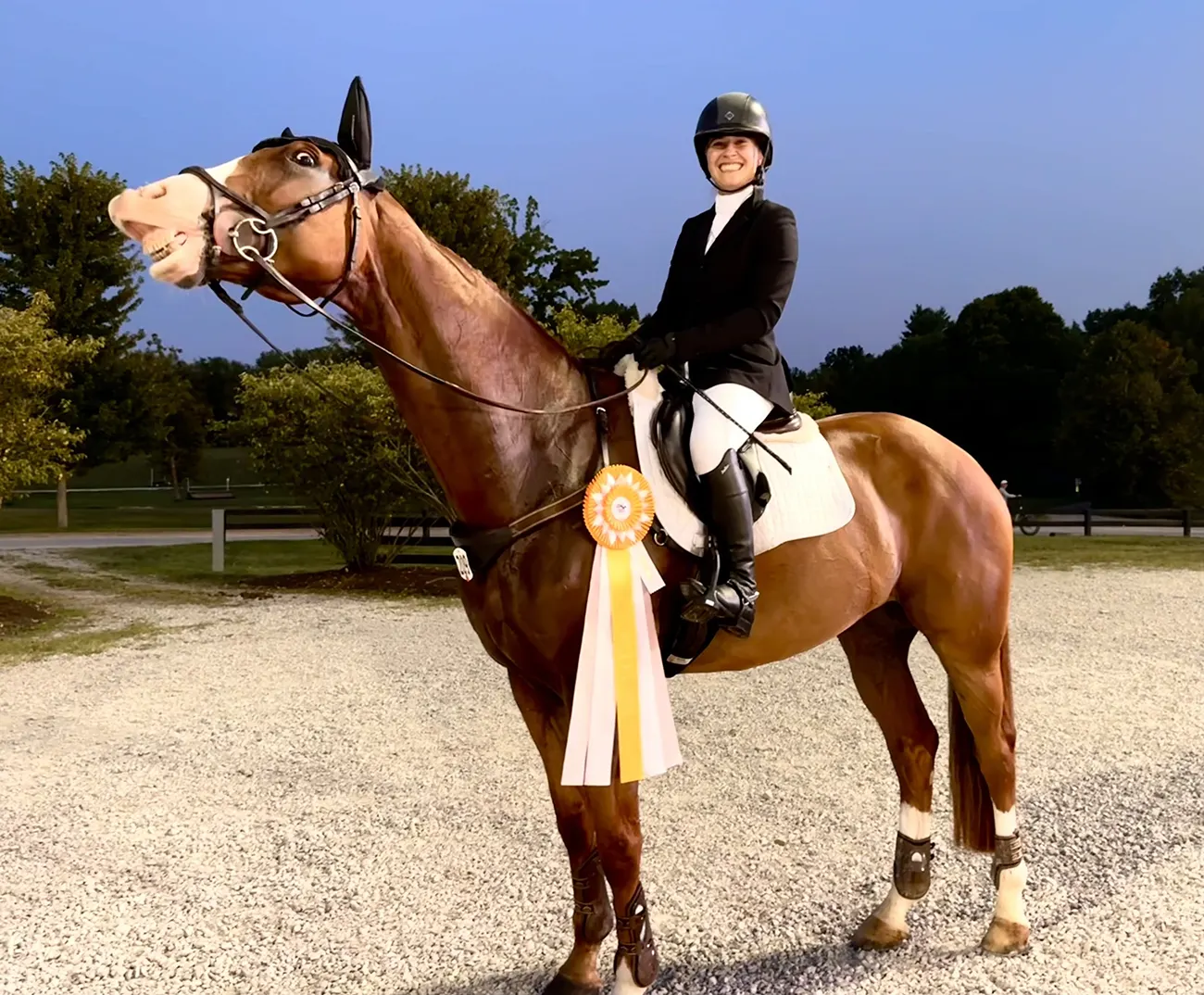
Her support system has been particularly helpful recently; in December, after more than four years of fully remote work, Schulman was offered a new position at Fannie Mae. It was great offer, she said, that would challenge and teach her. But the caveat was that it required in-person work in the Washington, D.C., office several days a week.
She weighed her options. She was scheduled to leave for the season in Florida just two weeks later. But the opportunities it offered her career were too great, and she decided to take the job.
“I was all ready [for Florida] and was on a riding high since 2024 with some great three-star results,” she said. “We were fourth in our first three-star long at Bromont in June [of 2024], then third in the intermediate division in that [USEA American Eventing Championships] in Kentucky, then second at the Maryland CCI3*-L.
“I was planning our move up to advanced,” she continued. “Then I had a job offer in my hands, a completely new job role in a more challenging area that I knew was going to be interesting and rewarding. I knew it was a privileged position to be in, to have a great job offer and an amazing horse. But it was hard at the time to make the decision.”
For Schulman, there was a bigger adjustment than a new role within the company: This was the first time in her career that she would have to report regularly to an office or navigate a commute.
“I actually had to move and find an apartment on the Metro line,” she said. “I have a pickup truck, and knew I’d never fit into any D.C. parking garages!”
She’s continuing to navigate the balance between the new job and the horse world.
On days when she works from home, she fights her self-proclaimed “non-morning-person” nature and often rides before work. On days that she makes the 75-minute commute by Metro train from Herndon, Virginia, to her downtown office, she rides in the evening, usually not making it to the barn before 7 p.m.
“I try to make it to the barn six days a week,” she said. “But I’m also trying to be better about socializing, whether it’s with friends or Mike.
“And when I accepted the offer in December, I made it really clear to my new manager that I ride competitively, and it’s a priority,” she added. “He’s really supportive, and I still have flexibility in the job.”
Despite the new job and new obligations, Schulman and Caden made their advanced debut—just in Maryland instead of Florida. After moving up at the Fair Hill International April Horse Trials, they notched their first advanced-level win in June, topping the division at the Maryland International and Horse Trials, held June 27-29 in Adamstown.
“I love the job I’m in now,” she said, “but it’s always going to be a challenge to balance my career and my riding. I got a lot of exposure and spent a lot of time in the horse world. I have an amazing horse, and if I have a season where I’m a little behind [due to work], we have lots more seasons ahead of us. It’s never going to truly be 50/50, but I’ll keep trying to find that balance.”
The post Early Mornings, Late Nights Have Helped Amateur Sara Schulman Reach Advanced appeared first on The Chronicle of the Horse.
]]>The post Professor And Her Spotted Mare Tackle Grand Prix—Aside appeared first on The Chronicle of the Horse.
]]>Riding Grand Prix dressage is challenging. Riding side-saddle is challenging. Doing both at the same time? That’s a job for … an academic and her spotted mare.
Abbey Dondanville, a longtime university professor and administrator who now teaches high school, is used to drawing attention whenever she rides her pinto mare, Alter Ego, down centerline in FEI tests. The 17-year-old Friesian Sporthorse isn’t just flashy, she’s also notable for her unique physique—by a Friesian stallion and out of a Percheron-Spotted Saddle Horse mare, “Glory” simply does not look like a typical FEI mount.
In April, they upped the head-turning ante at the Tryon Spring 1 Dressage Show (North Carolina) by performing two Grand Prix freestyles—competing side-saddle at the level for the first time.
In their 15 years together, Dondanville and Glory have done everything from eventing to foxhunting to dressage, the sport in which the mare truly found her niche. Not only did Glory help Dondanville earn her U.S. Dressage Federation bronze, silver, and gold medals, but also the corresponding freestyle bar at each level—making them one of just a handful of USDF Diamond Award recipients in the country. After achieving that milestone in 2022, Dondanville was looking for new ways to learn from and enjoy her special equine partner.
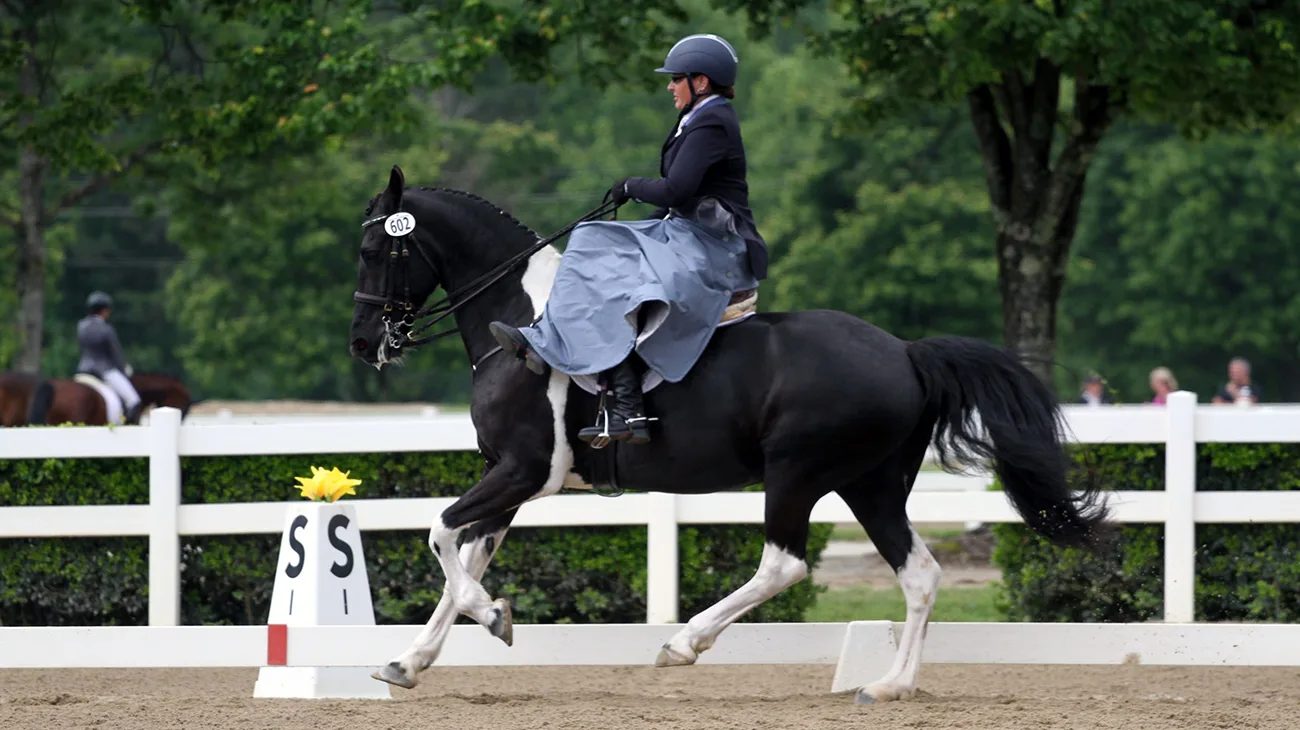
“Side-saddle has always seemed really cool and challenging, and ever since I was a kid, I’ve wanted to try it,” Dondanville, 52, of Easley, South Carolina, said. “I love my mare, but she is not [CDI] small tour material. I like having fun with her, and she seems to be having fun too. She loves to work.
“My mare has answered every single request I’ve ever asked of her, from the time she was 2 until now,” she continued. “I thought, ‘What can we do that is fun and different for us?’ So even though I didn’t know what I was doing, I decided we’d start at the beginning and see what we can do with side-saddle.”
From acquiring the proper equipment to learning modified aids to working with officials to resurrect retired rules, the pair have come a long way riding aside in just a short period of time. But their two Tryon Grand Prix freestyle performances marked two special milestones—not only was it Dondanville’s official side-saddle Grand Prix debut, it was also the pair’s first time back at the level since 2021.
“I wanted to do the regular Grand Prix [test], but I could not get the canter zig-zag riding aside,” Dondanville admitted with a laugh. “But we were qualified for the freestyle, so I decided that’s what we’ll do.
“I have not been so nervous as I was on Friday in a long time,” she continued. “Obviously, riding Grand Prix is hard—it just is—and riding side-saddle is hard. And you get those doubts. It doesn’t matter how many times you do the test at home, it is different when you are doing it in front of other people.”
An Unexpected Equine Partner
When Dondanville purchased Glory as a long yearling, sight unseen off a sales video, it was with the intention of training her for resale. She thought the filly’s three clear gaits and steady temperament would make her an easy horse to develop while Dondanville’s main mount recovered from an injury. At the time, Dondanville was mostly eventing (she has competed through preliminary level), and she thought Glory might make a nice low-level “all-rounder.”
She was in for an unexpected surprise when her new project arrived at the farm.
“The stallion was 17.1, and the dam was 16.3,” Dondanville remembered. “The breeder told me that as a coming 2-year-old, Glory was 15.3, and I thought that sounded about right. Then she comes off the trailer at 13 hands. I didn’t even know if she was going to get out of pony size.”
Fortunately, Glory did end up growing—both taller (she finished at 15.2 hands) and broader—and even though Dondanville is 5’9”, she has never felt overly large on the mare.
Dondanville evented Glory through novice, but it was a judge’s fortuitous comment at a Young Event Horse competition when the mare was 4 that ultimately changed the course of her career.
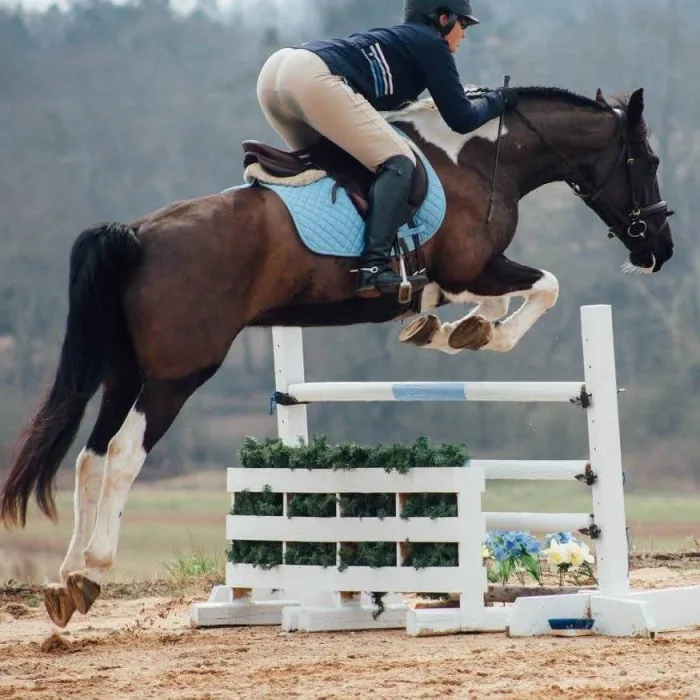
“Sue Smithson said to me, ‘Abbey, I love your horse, she is doing all the things, but she’s a dressage horse, not an event horse,’ ” Dondanville recalled with a laugh. “I knew at that point she was right. But I had never competed more than first level dressage. She and I had to learn together, all the way up.”
Just before she turned 5, Glory was kicked in turnout and fractured her right hock. Veterinarians were unsure of her long-term prognosis; Dondanville opted to give the mare six months of complete rest in a small turnout and hoped for the best outcome.
When Glory came sound after her layup, Dondanville was relieved. But she knew her soundness wasn’t guaranteed, and the damage was still visible on X-ray. That, combined with the extensive external scarring on her hock, meant the mare would never pass a pre-purchase exam. Instead of reselling her, Dondanville decided to see what they could accomplish in the dressage court. As it turned out, the sport proved to be a perfect fit.
“We were schooling Prix St. Georges when she was 6,” Dondanville said. “If we had our [one tempi changes], she would have been able to do the developing Grand Prix at 8. It took us three years to get the ones, and then she was like, ‘Oh, is this what you wanted?’ And then, she did the ones. She has the best brain ever. Just totally willing to try anything I put forth.”
When it came to heading down centerline, Dondanville found that striving to achieve the scores necessary to earn her USDF medals was a good motivator—but even more important was to have fun while doing so.
“I like to challenge myself, and I like to challenge my horses,” Dondanville said. “I didn’t care if I finished last in the class, as long as I got my qualifying score. It’s about me having fun, and learning things, and about my horses using themselves well, so they are happy and their brains are engaged.”
Initially, Dondanville still dabbled in lower-level eventing with Glory while also pursuing her dressage goals.
“She’s an amateur’s horse, and amateurs like to do all the things,” Dondanville said with a laugh. “But once I moved her up to FEI, my dressage trainer was like, ‘Please, stop eventing this horse.’ ”
Before training Glory, Dondanville had never before taken a youngster from halter breaking to under saddle work and beyond. She credits her longtime coach, USDF certified instructor Julie Cochran, for helping her to bring Glory up through the levels.
“She is realistic,” Dondanville said of Cochran. “And she doesn’t back away from the off breeds; she embraces them. Like, this horse may not have the greatest extension, for example, so where can we earn other points in the test to make up for that?”
Although Cochran has since moved to Georgia, Dondanville still seeks her advice and guidance, including when she and Glory began their side-saddle journey.
“Julie has seen all of the trials and tribulations,” Dondanville said with a laugh. “She has been with Glory from second level all the way through Grand Prix. She is a super, fantastic individual.”
Learning To Ride Aside
When she decided to try side-saddle, Dondanville reached out to the International Sidesaddle Organization for advice. Although she found their resources helpful, she also learned there were no instructors focusing on sidesaddle dressage in the southeast—so she began to teach herself. She found a century-old side-saddle and an equally aged “cane,” made of bamboo, which is used to replace the rider’s right leg when it is hooked over the saddle’s horn. Then, she started showing up at traditional dressage clinics in her new equipment.
“I’d walk in the ring, and they’d be convinced they wouldn’t be able to teach me anything,” Dondanville said. “But a good instructor is a good instructor. They might not be able to tell me to put my cane in a certain spot, but they can tell me my horse is dropping her outside shoulder.”
Dondanville admits that at first, she found it harder to stay in the middle of the side-saddle than a traditional one, and she was nervous about leaving the fenced arena in case an unexpected spook caused her to lose her balance. But with practice, she soon learned that many familiar aids were equally effective aside as astride.
“For example, for the one tempis, I do tap her slightly with my heel or my cane, but it is mostly moving the hips, like you would in an astride saddle,” Dondanville explained. “Obviously you don’t have a right leg on the side of the horse, so you have to use your cane. She has to be good about being sensitive to that light pressure, instead of my whole leg.
“I had to get control of myself before I could even think about asking her to understand what I want,” she continued. “Because when I’m all over the place, she’s like, ‘What are you doing?’ ”
Dondanville discovered that the U.S. Equestrian Federation had removed most of the rules related to side-saddle from the dressage rulebook about a decade ago, because its practice had become so obsolete. As she prepared to make her side-saddle show ring debut, Dondanville worked with the USEF Rules Committee to put together a letter that she now shares with the technical delegate at each show. Specifically, it states that her cane is legal equipment, as is her side-saddle apron, which is the same color as the breeches she wears. Dondanville also learned that, according to the rules, spurs must be worn in pairs—but they do not need to match; the letter stipulates this as well.
“I still have to wear a spur on the leg that is crossed, so I use a dummy spur with no shank,” Dondanville explained. “That way, the spur isn’t digging into my shin.”
Dondanville and Glory debuted riding side-saddle at third and fourth levels before moving up to Intermediaire last season. She admits that at first, certain movements—including the travers and the left lead canter depart—were more difficult to perform while riding aside, so initially she strategically chose tests whose movements best matched their side-saddle skills.
Working through challenges like this is nothing new for Dondanville, who has always juggled two jobs in order to support the pursuit of her equestrian goals. After three decades as a professor of exercise and sports science and a college dean, most recently for the University of Louisville in Kentucky, Dondanville recently returned to South Carolina to be closer to family. There, she has been teaching health sciences at Carolina Academy, a magnet high school in Greenville, as well as online courses for American Military University.
“I’m a single person, an only-income kind of household,” Dondanville said with a laugh. “So having a second job is the only way I can afford to have horses.”
On To The Next Adventure
Last fall, Dondanville welcomed a new equine partner to her life, Doubting Thomas. She hopes that the 4-year-old buckskin pinto, whom she purchased at an Amish auction, will one day step into Glory’s hoofprints. His largely unknown background has already led to at least one unexpected discovery.
“They told me he was a Shire cross, but in order to do any of the age restricted classes, horses have to be registered,” Dondanville said. “We had to do DNA testing for the American Warmblood Society and Sporthorse Registry, and he came back as an Argentinian Criollo, which is an offshoot of an Andalusian. If you pull up Argentinian Criollo on Wikipedia, it is my horse.”
While she continues to develop “Sundance” under saddle, Dondanville also plans to keep her side-saddle skills tuned up with Glory this summer, with the goal of returning to the freestyle ring in the fall. When not preparing for a competition, Dondanville only rides side-saddle about once a week; the side-saddle is longer than a traditional one, and because she can’t post or get off Glory’s back, she thinks it is hard work for her longtime partner. But she is still enjoying the journey.
“I think the biggest thing now is to show people it’s OK to have fun,” Dondanville said. “There are too many amateurs who feel like we have to squish everything into that five minutes of time we have allotted for our horses, and we sometimes lose sight that we probably all started riding for fun. Absolutely have goals and aspirations, but don’t lose sight of the fact that you should be having fun.
“We want to do well, and we want to hit our goals, but it’s not the end of the world if you don’t,” she continued. “When I finished my first test last weekend, there were some bobbles. But the mare doesn’t know that. I gave her cookies, I gave her love, and I enjoyed spending time with her. That, to me, is more important than anything else.”
The post Professor And Her Spotted Mare Tackle Grand Prix—Aside appeared first on The Chronicle of the Horse.
]]>The post Life Is A Balancing Act For Kate Rice Nilan appeared first on The Chronicle of the Horse.
]]>“At various times of my life, I’ve had many, ‘What am I doing?’ moments,” Nilan said. “But I think doing horses really got me ready [for creating Stable Secretary]. You make a plan, and then you just do what you need to do to get the job done, regardless of that plan. When I want to do something, I really want to do it as well as it can be done, for better or for worse.”

Nilan got her start with horses ate age 5 at a local saddle seat barn, and she kept riding even as her family moved several times, training with the likes of Nona Garson, Nancy Ciesluk and Peter Wylde. She attended USEF Pony Finals before graduating to horses, when she rode her own Redsox in the small junior hunter division.
She kept riding through her time at Dartmouth College (New Hampshire), showing at indoors with Wylde her first year and then riding on the school’s Intercollegiate Horse Shows Association team.
“I had no idea what I wanted to do—I was still thinking I was going to be a horse trainer,” Nilan said. “I wanted to do horses for the rest of my life; for me, the college thing was just an unfortunate veer-off, so to speak.”
Going Pro
Nilan continued working with horses as much as she could throughout her time at Dartmouth, even taking the winter trimester of her sophomore year off to help trainer Rodney Bross at the Winter Equestrian Festival (Florida). At the time, Bross had the legendary Rox Dene in his barn, with Elizabeth Solter showing her.
After graduating from college in 1998, Nilan took a temporary job at a software company in Cambridge, Massachusetts. She worked half the time as a receptionist and mail sorter and half as an assistant to the systems engineering department. She learned computer programming in that role, a skill that would come in handy in the future. Nilan did a stint at another software company before moving back to the Boston area, where she entered graduate school to earn her master’s in teaching, while working at a barn to pay the bills.
“Then it became time for me to actually get a job as a teacher, and I was like, ‘Huh, I guess I could do that,’ ” Nilan said. “I did interview for some teaching jobs; I really was going to do it. Then I ended up living [back in] D.C. again, so I decided to look for another riding job.”
Nilan was in luck: Trainer Ginny Edwards needed an assistant at her farm in Upperville, Virginia. Nilan worked there for a year and a half, and then in 2005, she took a job teaching high school French and Spanish in Arlington, Virginia. But after two years horses pulled again; Nilan found herself teaching lessons under Miranda Scott at Meadowbrook Stables in Silver Spring, Maryland.
In the fall of 2008, Nilan decided she wanted to try being a professional rider, and she convinced her father to help her purchase an investment horse: Fenway, a 4-year-old chestnut Zangershiede gelding that looked almost identical to Redsox.
“Somehow my dad was OK with this,” Rice recalled with a laugh. “I worked like 19 hours a day for almost three years to afford ‘Christiano.’ I took care of him on my own. He was more like my pet, honestly. He was my life.”
With the help of trainers Sandy Ferrell and Wylde, Rice campaigned Christiano from the baby greens through the first year green hunters before selling him.
“I didn’t buy another horse,” she said. “I was grateful to finally be able to breathe again, because I had zero free time with him. Then I started freelancing locally; I taught lessons, rode other people’s horses, et cetera. It was great.”
Fixing A Problem
While freelancing, Nilan found herself struggling to keep up with horses’ records and health papers.
“I was like, ‘Oh dear, how do I organize any of this?’” she said. “I had papers and binders everywhere. I knew there had to be a better way to organize everything—after all, I had been a computer programmer, and there’s a thing called a database. You could put everything in there and then pull the reports as needed—it would be so easy. I really wanted to make my own solution.”
In the summer of 2012, Nilan found out she was pregnant, which left her with a decision to make.
“I realized that I wasn’t going to be a horse trainer anymore,” she said. “I was about to have a new role in life as a mom, so I decided to focus on creating the barn management software.”
She started asking friends and colleagues at horse shows if a program like this would help them, and she mentally logged their feedback and suggestions.
“My original idea was just to deal with the health documents and Coggins papers, which I personally found frustrating to chase down,” said Nilan. “But with other people who had normal-sized operations with many clients, it became clear that the invoicing was a massive problem for them.”
“I think the hardest thing about being a working mom is feeling like you’re not giving either thing a hundred percent because your attention is split.”
Kate Rice Nilan
Taking money she’d socked away from her investment horse, Nilan started shopping around for a developer who would meet her needs and build the first version of the Stable Secretary online software and mobile app to fulfill her requirements. In February 2013, Stable Secretary was finally ready to be launched.
“Honestly, not many people knew what I had been doing,” Nilan said. “At the time, I just wanted some of my horse friends to start using it to tell me what was good, what was bad, what needed to be changed and what didn’t work. And then almost immediately, people started signing up for it. It was clear that there was a need there. I had to hit the ground running with the business, and then I also had to give birth to my oldest daughter, Emma, at the same time. It was a lot all at once.”
Nilan had a steady stream of customers from the start, eventually growing to the over 1,000 subscribers she has today.
Making A Comeback
Nowadays, Nilan works from her home in Natick, Massachusetts, with her two daughters, Emma, 11, and Nora, 10, and her husband, Jay Nilan, who is a financial trader. Kate is also now a member of the Dartmouth equestrian team’s advisory board.
Although Kate had put her own riding career on the backburner for the past decade, she’s recently made a comeback as Nora fell in love with ponies. In fall of 2023, StableSecretary served as a sponsor for the New England Equitation Championships in Springfield, Massachusetts, so Kate attended the show to watch.
“A friend encouraged me and said, ‘You could do this next year,’ ” Kate said. “And I was like, ‘OK, but how?’ ”
With childhood friend Annie Dotoli helping her, Kate qualified for the 2024 New England Equitation Championships with Calvorno WP Z, owned by Madeline Papitto. She and “Calvin” went on to finish sixth in the NEHC Adult Medal, 46 And Over, Final.
“Calvin is an amazing horse; he is truly a unicorn,” said Kate, 49. “It was so fun to do this again. I was nervous though; it’s a whole new experience, after doing it as a junior and a professional years ago. You just hope everything works out now. If I could practice more, I think I would feel less nervous, but I can’t right now with my schedule. I would love to do [New England Equitation Championships] again this year, but Nora has a pony now, so we will see.
“If everything could go exactly my way, I would love to have a fun, kind, scopey gentle horse to do a low derby on,” she added. “When I’m alone in the car now, I say out loud, ‘I would like a fun horse to ride and show’ over and over and over again. Maybe—you never know. You’re not going to get it unless you ask, right?”
Out Of Survival Mode
Juggling career and parental responsibilities has been a shifting challenge as Kate’s daughters have grown.
“I can’t just decide what I want to focus on because I have two other humans that I also have to focus on, and they have needs and wants, too,” she said. “I think the hardest thing about being a working mom is feeling like you’re not giving either thing a hundred percent because your attention is split. But I do think it’s good for my kids to see their mom working hard at something she is passionate about.
“When [my daughters] were little, it was like survival mode: They needed so much, and my business needed so much, that I felt like the need and the adrenaline had to keep me going a hundred percent of the time,” she added. “But I really wanted to do both things, work and have the kids, so I just did both as best as I could, which left zero room for much else.”
Throughout most of her daughters’ younger years, Kate would wake up at 5:30 a.m. to fit in 30 minutes of exercise before starting her day.
“I function badly if I don’t exercise daily, but on most days, I was either working or doing something for the kids for all waking hours of my day,” she said. “The tricky part was having a start-up business and therefore no extra money. So I basically needed to work on my business and take care of my kids, because I couldn’t afford to pay someone to do my job or pay for someone to take care of the girls.”
Now that her daughters are older, Kate’s been able to find more flexibility in her schedule.
“I am their driver to and from their activities after school,” she said. “I accomplish a lot of work from my phone or laptop while waiting for them. So even though it can be hard and stressful, I just try to do all the things I want: family time, work success, and some bits of horse time. The hours spent on each thing change day to day, month to month, year to year, but life is short, and all of those things feel rewarding and joyful. If they are present in my life in some combination, then it’s a win for me.”
The post Life Is A Balancing Act For Kate Rice Nilan appeared first on The Chronicle of the Horse.
]]>The post ‘In My DNA’: Sasha Said Leveraged A Health Care Career To Reconnect With Horses appeared first on The Chronicle of the Horse.
]]>“Had you asked how I got into horses prior to that trip, I’d have told you I was just drawn to them,” she said. “But discovering this legacy confirmed what I’ve always felt: They’re in my DNA.”
And perhaps it’s her equine heritage that has kept Said fighting her way back into the saddle over the decades.
Said grew up in Norfolk, Massachusetts, a first-generation American with a rich Japanese and Pakistani heritage. But as one of only two non-white students in elementary school, she often felt like an outsider.
From the time she learned to talk, she was asking for “horse” and begging to ride. By 5 she was taking up-down lessons at a local farm. Horses, as they do for so many of us, gave her a safe space to be herself.

Her desire to do more quickly outgrew basic instruction. She idolized Karen O’Connor, Bruce Davidson and Phillip Dutton and wanted to be an eventer, but there weren’t any eventing programs in her area. So she began riding at Woodlock Farm, a competitive hunter/jumper and dressage barn where she could improve her skills and start competing.
But without owning a horse, which simply wasn’t in the cards, she felt her riding plateau. She knew she needed to find a way to spend more time in the saddle, so she negotiated to lease a horse at the barn in exchange for mucking stalls, tacking and turning out five days a week.
But as Said entered high school, she began to realize that her small town couldn’t match her desire to expand her boundaries and set herself up for future success. She convinced her parents to let her investigate prep schools, and she secured admission to the prestigious Deerfield Academy. There weren’t many stables near her school, so Said put her riding on hold during the academic year and picked it back up on summer breaks at home.
During those formative high school years, while she was at home academically, she felt like a fish out of water with her classmates. At a school of 600, she was one of only four South Asian students, and most of her classmates were from an entirely different level of privilege and access. She was determined to find her place—on her terms.
Around the same time, Said started to notice increasing discomfort in her upper back, but she chalked it up to a combination of hours spent studying and being a three-season athlete.
During the summers, she reconnected with horses by taking jobs grooming and teaching beginner lessons at local farms.
“Even when I wasn’t riding regularly, I was still very much in love with horses,” she said. “They’ve always been my happiest place on earth.”
But in college at Brown University (Rhode Island), as she threw herself into rowing and her finance degree, juggling multiple part-time jobs while working toward a 4.0 GPA, she realized something about the horses she loved so much.
“It was too hard to be around horses on a limited basis but not be able to totally devote myself to it,” she said. She decided to step away from horses until she had the time and money to go all-in.
After graduation, she entered the world of finance, looking for work that offered the greatest intellectual challenge for the biggest paycheck. When colleagues asked why she chose to work in hedge funds, her answer was simple: She wanted to make a positive impact, and she wanted to be able to afford returning to the horse world.
As an outdoor enthusiast, she found New York’s “concrete jungle” challenging. Almost daily she biked from her Upper West Side apartment through Central Park, stopping to feed treats—sometimes sugar cubes she’d surreptitiously pocket at meetings—to the carriage horses. She wished, on those days, that there was a way she could pursue horses and her career simultaneously.
In New York, she promised herself that she’d put her nose to the grindstone to reach financial independence as fast as possible so that she could ride again in the way that she longed to. When she traveled, she’d allow herself to dip her toes back into horses, resulting in riding experiences that ranged from galloping across a beach in Bali to doing passage on a Lusitano at a classical dressage school in Portugal.
After four years in the city, the neck and back discomfort she’d begun noticing in high school had escalated into near-constant pain. She saw multiple orthopedic specialists but none could identify anything physically wrong. Most doctors believed that her pain was caused by a combination of job stress and sitting at a desk 10-12 hours a day.
Said decided to leave her job and move back to Boston, thinking she could spend some time with her family while focusing on finding the source of her undiagnosed pain. She tackled her next chapter with purpose: She spent little time at a desk, exercised daily, did physical therapy, yoga, meditation and Pilates. She saw multiple specialists and researched heavily. But orthopedists, rheumatologists, neurologists, endocrinologists, and even psychiatrists all told her they couldn’t see a reason for her pain; it was probably just stress, they said.
At age 29, after a year in Boston focused on her health, Said accepted the fact that she needed to find a way to move forward. Pain and suffering, she came to conclude, were not one and the same, and she refused to let pain define her. She decided to return to the business world and created a plan to network all over Boston. Although her job search was significantly challenged by the 2008 financial crisis, which had frozen Boston’s traditional investment jobs, she eventually found her way into the city’s booming biotech industry.
She secured a position at a biotech family office. Over the next four years she helped launch their biotech fund, and was responsible for building its U.S. venture capital group and digital health strategy. At 33, she helped launch a growth equity fund.
“Although I took a pay cut to get that job, that was the first time I felt I was finally on my way to achieving true financial independence,” Said said. “I was learning that sometimes if I’m patient enough, the exact right thing presents itself. But at that point, I was still waiting for horses to come back in my life.”
“I was learning that sometimes if I’m patient enough, the exact right thing presents itself. But at that point, I was still waiting for horses to come back in my life.”
Sasha Said
In 2019 she joined LetsGetChecked, a company she had invested in because she strongly believed that at-home diagnostics would play a huge role in making health care more accessible for all patients. She was leading the company’s commercial team when the coronavirus pandemic hit, and overnight the company’s test became a necessity for industries, health care professionals and patients everywhere.
But her pain was growing worse than ever before, and she struggled sometimes even to sleep or breathe. So she called in a work favor and eventually ended up seeing Dr. Dean Donahue, who—after nine months of specialized diagnostics—diagnosed her with thoracic outlet syndrome, a condition where compression of the blood vessels and nerves between the neck and shoulder causes a variety of muscle pains and weaknesses.
She’d need a series of major surgeries, she learned, to make space in the thoracic outlet: Surgeons would remove two muscles on each side of her neck, her first ribs, both attachments to her pec minor, and part of her C7 transverse process in a vertebrae in her neck.
All surgery comes with risk, and Said was understandably anxious. She began reading and researching about the procedure and recovery. One source suggested meditating on what you believe is your life’s greater purpose before going in to surgery.
Despite being out of the saddle for over two decades at that point, horses were the first thing that came to mind.
“I’d put this block in my brain that I don’t have money or time to ride,” she said. “But it’s what I’d been working toward my whole life.”
“I’d put this block in my brain that I don’t have money or time to ride. But it’s what I’d been working toward my whole life.”
Sasha Said
She made a promise to herself: If I survive this surgery, I’m going to ride.
So she researched barns in her area and eventually set up a visit Orchard Hill Equestrian Center, where trainer Caroline Teich ran an eventing program. Said’s surgeries were successful, and after almost a year of recovery, she was ready to schedule her first lesson at Orchard Hill.
“Caroline had me start on a Thoroughbred named Smartie, and I fell in love with him immediately,” she said. “He was 23, but he loved to go. He brought me back to riding, and I still tear up thinking about him.”
Because of her increased strength and body control post-surgery, she felt like a stronger and more effective rider in her early 40s than she had been in her teens.
After six months, Said was ready to take on novice, and it was time to move on from Smartie. Said didn’t want to let him go, but a horse named I DunNo was coming up for lease, and Teich thought they’d be a good match.
Said wasn’t sold on dun “Dudley” right away. At 40, and having recently undergone two major surgeries, she didn’t want to get hurt. And Dudley was spooky.
But she decided to give him a chance, and that first winter, Said took Dudley to Florida with her trainer. They took it slow, getting to know each other, and Dudley learned to trust his new rider.
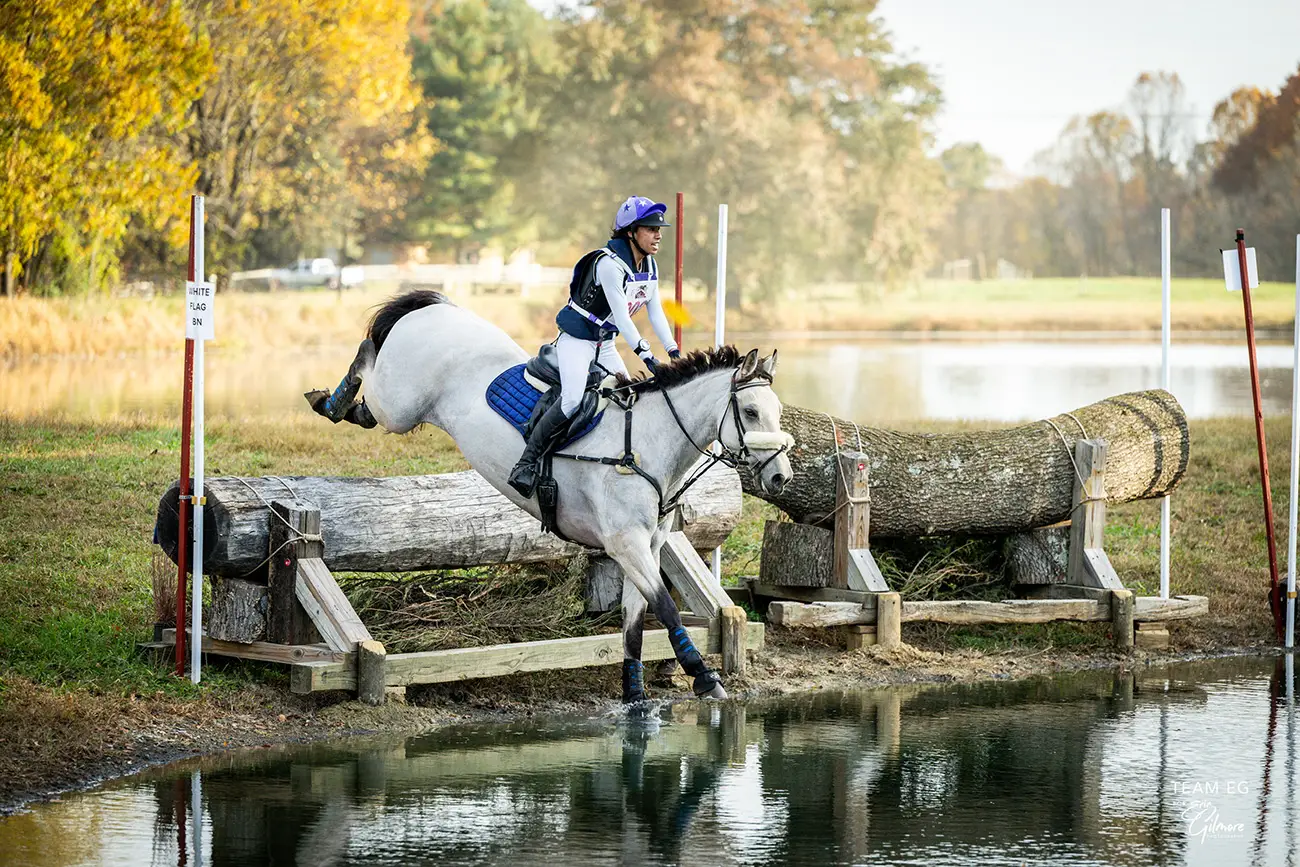
“Over time I recognized the potential beneath his fear,” Said said. “He wasn’t genuinely naughty, just legitimately afraid of everything. I like to think I had the right amount of empathy and compassion to work through his fears and be his source of confidence.”
Within their first year together, they were competing at training level. By the next year, they advanced to modified—an achievement no one expected from Dudley.
“We’ve had tremendous success together, but there were steps forward and steps back,” Said said. “It took time to figure out his quirks. He threw me so many times, but thankfully an air vest is like landing on a cloud!”
In the winter of 2025, Dudley needed some time off; their Florida season was over before it started. He’s expected to come back to full work soon, but his owner, who recently graduated from college, is ready to sell him. And while Said loves him dearly, she has dreams that are bigger than what’s fair to ask Dudley to do.
“Our last show together was Waredaca in October, and we couldn’t have ended on a higher note,” Said said of the Waredaca Classic Three-Day Event (Maryland), which offers beginner novice through preliminary level horses and riders a rare opportunity to compete in a traditional long-format three-day event, including dressage, roads and tracks, cross-country and show jumping—and two formal horse inspections. “Those modified cross-country jumps were the most challenging we’ve faced, and he ate them up. I’m bonded to this horse for life, and I’m so thankful for that.”

The pair also earned a special long-format accolade: best dressed at the horse inspection. Said had Dudley groomed so his dun coat shone like precious metal, and herself wore a beautiful Indian kurta for the jog.
“Representation matters,” she said. “And I feel strongly that there’s not enough diversity in the horse world. Having my cousin and my mom there to see me ride for the first time ever while honoring our shared heritage was particularly meaningful.”
The post ‘In My DNA’: Sasha Said Leveraged A Health Care Career To Reconnect With Horses appeared first on The Chronicle of the Horse.
]]>The post Thoroughbred Fan Earns USDF Gold Medal On Her Former RRP Entry appeared first on The Chronicle of the Horse.
]]>Jenny Spain admits she’s always been one to look toward the future, and she has trouble living in the present moment. But last autumn, the amateur dressage rider allowed herself to celebrate a huge accomplishment when she earned her U.S. Dressage Federation gold medal on her self-made off-the-track Thoroughbred Some Caan Job.
Spain, Catlett, Virginia, had trained her now-retired OTTB Turnaround Tony to Grand Prix in 2017, but she had yet to earn her gold medal. She and Some Caan Job, or “Annie,” made their Grand Prix debut in 2024, and after a few starts where they earned just below 60%, they earned the final score needed for gold with a 64.10% at the PVDA Fall show (Maryland) in November.
“I kind of jumped up and down and screamed in the office for a moment,” she said with a laugh. Then she went to the USDF Awards Banquet in Houston, Texas, in December to receive her medal.
“It’s unusual for me to do that kind of thing—spend the money to get those kinds of awards and take that kind of time,” she said. “I just thought it was important to do that, to allow myself that recognition and to just to realize that that was a big accomplishment, and it’s OK to be excited and to live in that moment for a little bit. I tend to always just kind of look to the future so much that sometimes I don’t allow myself the good feeling that the present can give you.”
Spain, 46, is the co-founder and program director at Simple Changes, a therapeutic riding center in Northern Virginia. She got into dressage through her now-wife Melinda Freckleton, DVM, after working and riding in the hunter/jumper industry.

She rode her first Grand Prix test with Turnaround Tony (Belong To Me—Glamour Girl, Black Tie Affair) in 2017, a year after she’d found Annie as a 3-year-old.
The Retired Racehorse Project Thoroughbred Makeover had started a few years earlier, and Spain thought it would be fun to take a horse there, so she aimed Annie at the annual competition held in Lexington, Kentucky.
RRP Success
Annie (Square Eddie—Caan, Crowning Storm) had 15 starts on the track in California but was in Pennsylvania when Spain found her. She liked her movement and the kind look in her eye.
Spain spent the first two months working with Annie on groundwork and long lining through the winter and got on her in January.
“I’m really a fan of teaching them to long line before I get on because then the steering and the two-rein contact, and the concept of what that means outside of the racing world to the horse, has been taught,” she said. “She was quite good at all that. By the time I got on her, she was just easy walk, trot and canter and get her leads each way.”
The pair headed to Kentucky in the fall of 2017 and were first out of 80 riders on the initial day of the dressage competition. “By that next day [for the final], she was getting a little fried,” she said. “It was in the coliseum with the Jumbotron, and she really was not sure about that, so, she was really tense in the finals.”
They ultimately finished fourth, with Spain the highest-placed amateur rider, and she was proud of her young horse.
Annie needed some time to decompress from RRP over the winter, and by the spring, she was back to work and moving up the levels with Spain and help from her trainer Patrick Tigchelaar.
Medical Setbacks
While Annie was working at Prix St. Georges in 2021, a routine preventative gastric ulcer scope revealed she had an entrapped epiglottis. She’d never had breathing issues prior, but Spain was advised to have a surgery done to cut the epiglottis free so it wouldn’t cause trouble down the road. She took the mare to Marion duPont Scott Equine Medical Center in Leesburg, Virginia, for the surgery.
When vets took Annie in for surgery for the simple procedure, they realized it wasn’t a typical case because the epiglottis had been trapped for so long that it had developed fibrous tissue around it. Annie had to go back for surgical revisions four more times over three months because the area would form adhesions, then re-entrap and need to be cut free.
Annie later started to make noise while under saddle, and Spain began feeling issues in her rein contact, so she took the mare to New Bolton Center (Pennsylvania) about eight months after her surgeries in Virginia. Vets discovered the epiglottis had become misshapen and wasn’t functioning correctly, so they performed a tie-forward procedure and gave Annie a 50/50 shot at returning to upper-level work.
“She mostly does fine” now, Spain said. “There are times that I could tell it does displace some, and she can make a little bit of noise, and I could tell again that she feels a little bit different into contact, but she doesn’t do it often, and we figured out what she tends to need, and it’s just trying to keep her in that right place so that everything stays in the position that it should be.”
The pair were back in the ring briefly in 2022, then Spain dislocated her kneecap in an accident with another horse and was laid up for most of 2023. Finally, in 2024, they made their Grand Prix debut.
A Unique Challenge
Spain says that riding a Thoroughbred at the upper levels of dressage is a unique challenge, but one she’s happy to take on.
“I think the biggest thing is just that a very good-moving Thoroughbred is generally not as good a mover as the warmbloods,” she said. “So that does mean you have to be that much better in the movements and in your accuracy.”
It’s frustrating to see a bigger, fancier mover score better when Spain feels she and Annie rode a cleaner test, she acknowledged, but said that comes with the territory.
“People may argue that, but I think most people who do this recognize that that is the reality,” she said. “You have to be accurate; you have to hold yourself accountable, and you have to keep working to make your horse be the best mover it can be.
“I don’t really honestly care if we win a class or don’t win a class, because I always go back to the idea of, like, I paid $2,500 for my horse,” she continued. “At the end of the day, if I don’t win by a point or two or whatever, that’s all right, because I’m there, and I’m doing it, and I think I’m doing it pretty well. I don’t have that kind of money to spend. Most of the horses I’m competing against are six figures more than what Annie was, which is fine, but it’s just reality.”

Spain noted that while many people question whether a Thoroughbred can do the upper levels of the sport, she thinks the bigger question is whether the rider can do it.
“I push myself all the time, and I have a very good trainer, and that’s a big part of it,” she said. “I may not have spent much on the horse, but I certainly spend my money with having a very good trainer. I do this on a shoestring budget, but I’m out there riding my horse, even when sometimes I don’t want to be or I’m busy, or I’m tired. I try to hold myself accountable to it. I had luck, because anything could have gone wrong, and any of this could have not worked out. So, I’m lucky too for this moment, but I also know that luck can change, and I have to be OK with that and come up with whatever plan will be next and see where that goes.”
Besides the affordability of a Thoroughbred, Spain also says she likes to be a bit of an underdog because it keeps things interesting.
“I don’t even know what I would be like if I got to sit on a horse [bred for dressage.] I know it’d be such a different mindset,” she said. “I’d love to try it one day, to sit on a really nice horse and be like, ‘Don’t screw this up.’ Because, if you don’t get in their way, they can do it. Whereas with what I do [with a Thoroughbred] is like, OK, I have to create this. I still have to ride really well.”
One advantage of riding a Thoroughbred, she said, is their can-do attitude and heart—upper-level dressage might not be as easy for them as for a warmblood, but “they’re the ones who are just going to really try to figure it out.”
Spain’s goal for 2025 is to create a freestyle and improve their scores at Grand Prix to the mid-60s and qualify for the GAIG/USDF Region 1 Championships.
The post Thoroughbred Fan Earns USDF Gold Medal On Her Former RRP Entry appeared first on The Chronicle of the Horse.
]]>The post Retired Veterinarian Returns To Showing After 40-Year Break appeared first on The Chronicle of the Horse.
]]>Three years ago, with his two children out on their own and his successful small animal vet practice recently sold, Mark Dorfman decided the time was right to get back into his childhood love of riding horses.
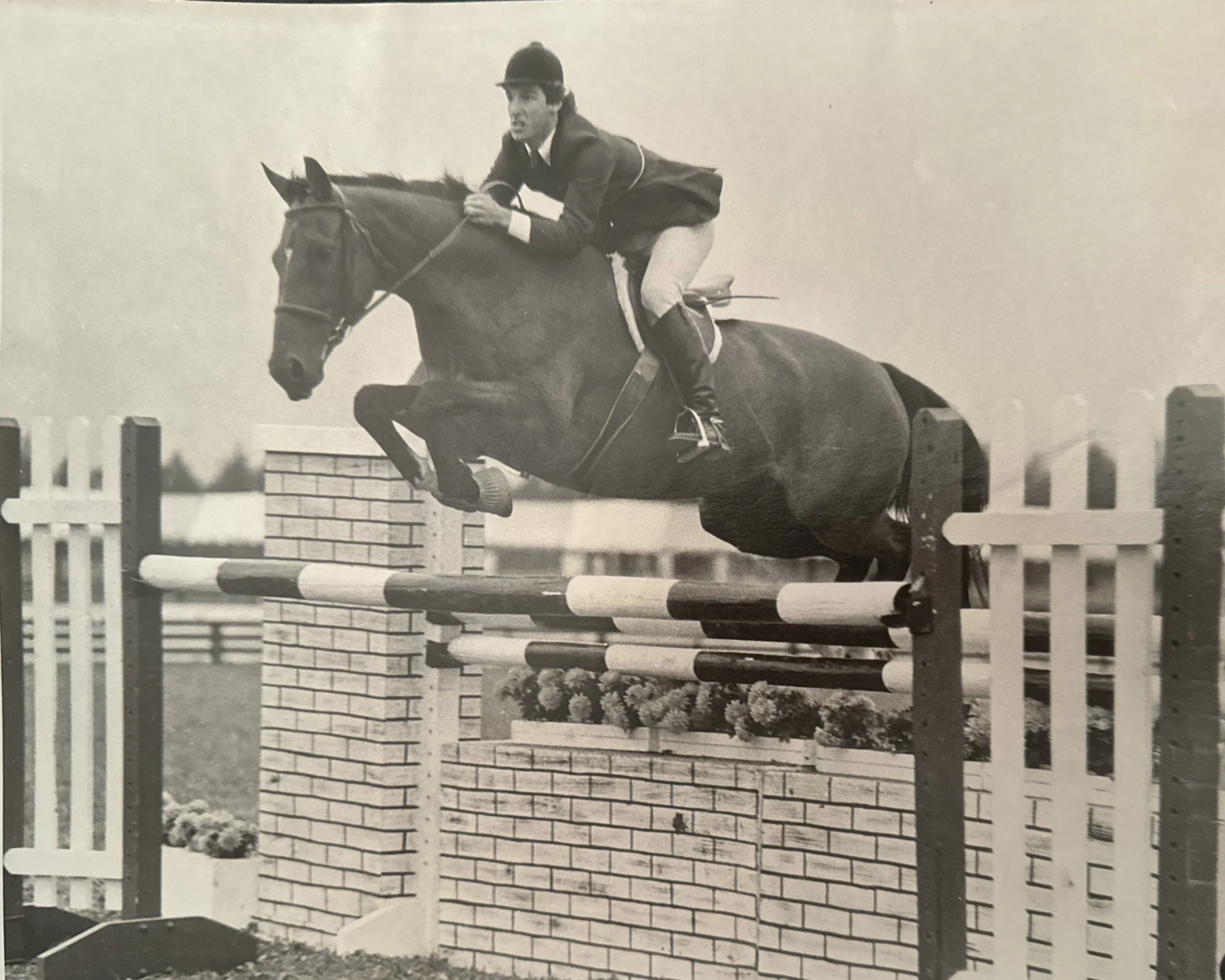
Growing up in Long Island, New York, Dorfman rode with Ralph and Holly Caristo at their Glenview Stables. He competed successfully in the junior hunters, equitation and jumpers, first on leased horses and then his own.
“My parents were super supportive, both financially and emotionally,” he said. “I didn’t grow up riding the fanciest horses there were, but my one horse that was my junior jumper and equitation horse, Cyclone Lad, we were ninth in the 1978 AHSA Medal Finals at Harrisburg [Pennsylvania]. Of course, back then we really just had one horse for everything. One of the things I loved about riding with Ralph and Holly [was that] they had a sale barn, and there were tons of horses that came through there all the time, and I was allowed to ride many of them and exercise them and help with them.”
When Dorfman left for college, he gave up horses because he didn’t think he’d enjoy riding when he couldn’t be fully dedicated. He attended the University of Florida for veterinary school, and briefly considered becoming an equine vet, but he settled on small animal internal medicine. He finished his education at the University of Georgia and started a small practice, Georgia Veterinary Specialists, in Atlanta.
The practice grew tremendously and became known as BluePearl Veterinary Partners. It was sold in 2015 to Mars, which now operates several emergency pet hospitals around the country under the BluePearl name. Dorfman remained with the company until 2022 when he semi-retired. He now serves as a consultant for a different company.
Throughout his career, Dorfman, now 63, stayed in touch with the Caristos and would visit them in Florida during the winter season, but the urge to get back into horses didn’t come until he retired, 40 years after he gave up riding. He was attending the World Championship Hunter Rider Week at the Winter Equestrian Festival (Florida) and reunited with some of his former Glenview friends while watching the hunter spectacular.
“I was thinking to myself, gee, this looks like fun. I’d really like to try doing this again,” he said. “Shortly after I got home, I started exploring some possibilities to start to get on a horse and ride again. It took me a little while to figure out what I could do in Atlanta, but I ended up leasing a horse at a barn in Atlanta for a year, and that kind of got me started.”
“I was thinking to myself, gee, this looks like fun. I’d really like to try doing this again. Shortly after I got home, I started exploring some possibilities to start to get on a horse and ride again.”
Mark Dorfman, watching Hunter Week at WEF
Dorfman started at Chastain Horse Park with trainer Lisa Anderson. By the time his lease ran out, he was more committed than ever to competing in Florida and decided it was time to purchase his own horse. As he did as a teen, he looked to the Caristos to train with for the winter and found Golden Hour, a 13-year-old warmblood (Emerald van’t Ruytershof—Griet) mare. She has been a consistent campaigner in the 3’3” amateur-owner hunters for Dorfman since.
After his first season competing in Florida, Dorfman knew he’d have to find a trainer in Atlanta to continue showing, and Ralph connected him with Michael Britt-Leon.
“He is a super rider,” Dorfman said. “He’s fun to work with. He really cares and is very passionate about his horses and loves to teach.”
Soon after Dorfman started training with Britt-Leon, they thought it was time for him to find a sharper and more competitive mount for the 3’6” division. They looked for a year and a half before finding Can’t Touch This HS, a 10-year-old Holsteiner gelding (Casall—Canturana).
Bred in Germany by American Reece Miller, “Hammer” was sold as a breeding stallion to Hyperion Stud before being gelded last year. He’d been showing on the West Coast in the green and professional divisions with Jason McArdle.
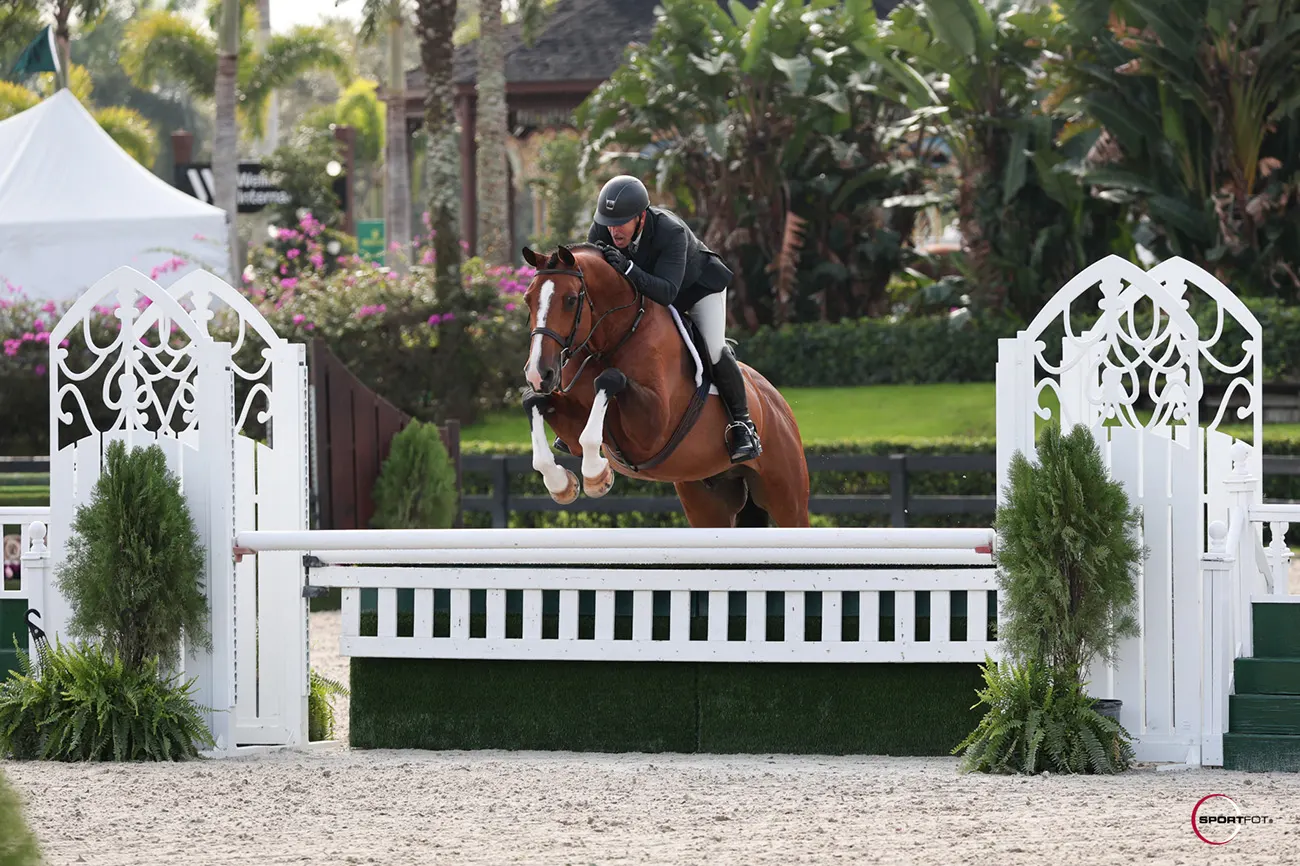
“He is a beautiful horse,” Dorfman said. “I don’t say that because he’s my horse, but he’s just physically a beautiful horse. He’s got a lot of chrome, a lot of white, and he jumps spectacularly. Every jump, he puts his ears forward. He just has a really pleasing look, the way he carries himself around the ring.”
“He’s a dream to ride,” Britt-Leon added. “He’s so much fun. He’s one that the more you challenge him, the better he goes. He studies the jumps and wants to do it right. It’s very special when you can find one that can win in the professional divisions and the amateurs.”
Dorfman and Hammer qualified for indoors last year in the amateur-owner hunter division and competed at Capital Challenge (Maryland). Hammer also competed in the 3’9” green hunter division with Britt-Leon at Capital Challenge, the Pennsylvania National and the National Horse Show (Kentucky).
“I’ve already gotten him spoiled,” Dorfman said. “He’s a character. He’s very persistent. He likes to look at things, just everything that’s going on. He’s on high alert all the time. He’s always very aware of what’s going on around him, whether it’s a tractor in the field next to him, whether it’s a car going by, whether it’s a photographer at the edge of the ring, he’s on high alert.”
Dorfman’s goal since getting back into horses was to compete at the 3’6” height like he did as a junior, and Week 2 at the 2025 Winter Equestrian Festival was his fourth time back at the level. The pair earned a big win that week, taking home the championship ribbon in the amateur-owner hunter, 36 & over, division, something Dorfman was pleasantly surprised by.
“It was fun,” he said. “I am not a person that rides for the ribbons or for the championships. I want to ride well and to do the best that I can, but it is nice to get recognized for your hard work.”
Dorfman says he’s enjoyed getting back into the sport and has noticed a lot of changes since his time away.
Besides the price of a competitive mount being much higher, “the competitions have changed a little bit,” he said. “We used to have classes scheduled in a division at different times, and you would have to warm up your horse multiple times and jog them. All that has changed so you get to do your rounds back-to-back or pretty close together.
“I also will say one of the things that has changed noticeably is the adult divisions and the amateur divisions have gotten extremely big and competitive,” he added. “They were not that big back in my junior days. But I think a lot a lot of people have stayed in the sport or come back to the sport, like myself, and those divisions have gotten extremely large and quite competitive.”
Britt-Leon has enjoyed teaching Dorfman and having him as a part of his barn.
“Mark is the absolute kindest individual who loves his horses, and it shows,” he said. “He is 100 percent of the time about what’s best for the horses. He’s a true horseman. He learned how to do things correctly from the beginning. He took a big break but has the most incredible attitude about coming back to it. I think that would be the hardest thing to do, because you know what it’s supposed to be and feel like and look like, but when you take such a long break, it doesn’t come back as easily. He’s had an incredible attitude about getting back into it and getting strong again and taking the time with his horses.”
Dorfman doesn’t have any big goals this year with his horses, other than doing the best he can and enjoying the process, though Britt-may take Hammer to some international derbies or compete in the high performance division.
“I enjoy the sport,” Dorfman said. “I’m certainly glad to be back in it. I feel very fortunate that I have the ability to do this now, both physically and financially, and have the time to do it. My kids are finished with college and are professionals, and I just have that time on my hands now, especially being semi-retired, so I just feel lucky to be able to do what I love doing.”
The post Retired Veterinarian Returns To Showing After 40-Year Break appeared first on The Chronicle of the Horse.
]]>The post New Amateur Member Brings Her Veterinary Experience And Focus On Welfare To USHJA Board appeared first on The Chronicle of the Horse.
]]>Ever since equine veterinarian Lori Bidwell, DVM, DACVAA, CVA, was a little girl growing up on a farm in Grand Rapids, Michigan, horse welfare has been her No. 1 priority.
“Now there’s a sign hanging in my office that says, ‘We do this because we love horses,’ ” Bidwell said. “I think it’s important to remind people of that every day.”
She and her husband, Duncan Peters, DVM, MS, DACVSMR, have created their entire lifestyle around that philosophy. The couple has a small breeding farm, Five O’Clock Farm, in Lexington, Kentucky, where they raise young jumper prospects. They also own and operate a mobile veterinary practice, East-West Equine Sports Medicine, and divide their time between being the official show veterinarians at the Desert International Horse Park in Thermal, California, for the winters and the Great Lakes Equestrian Festival in Traverse City, Michigan, during the summers. Peters specializes in equine sports medicine, and Bidwell, a board-certified equine anesthesiologist, has turned her focus to acupuncture, massage therapy and general medicine.

“I love doing the acupuncture,” Bidwell said. “It looks at the whole body, and I can keep the sport horses feeling good without needing medications. It’s not perfect, but it’s nice to be able to help the horses feel their best.”
At the 2024 Capital Challenge Horse Show (Maryland), the couple was honored with the David Peterson Perpetual Trophy for their dedication and commitment to the care and well-being of horses.
Both Bidwell and Peters are also competitive on the hunter/jumper horse show circuit, traveling around the country with their four show horses. They currently own about 16 horses together, which are a mix of the young horses they bred that are in training to become successful jumper prospects, and more experienced horses that are stepping down to teach the next generation. Bidwell also competes in the 1.20-meter and 1.30-meter jumper divisions, as her work schedule allows, on her mares Nim and Fostyne. The couple train with Katie Monahan-Prudent when they’re on the East Coast, and Kyle King when they are on the West Coast.
Balancing her work schedule with riding and showing is a challenge, and Bidwell has learned through experience that she does best when she focuses on one or the other, despite often being at a show grounds with abundant opportunities to try to do it all.
Each week that Bidwell shows, she tries to choose a jumper class that goes at 8 a.m. She also aims to be the first rider in the ring so that she can be finished showing early and then can focus on her work for the remainder of the day.
“Some days we will see 40 cases a day in Thermal, [my work schedule] can be crazy busy,” she said. “I’ve learned the hard way that I cannot show and work at the same time. Last year, I was competing in the 1.30-meter and I won a class in the division, and then two days later I was going to try to do another 1.30-meter class, but we had people trying to jog horses for a Young Rider qualifier while I was trying to learn my course and watch, and it was too much all at once. My brain was not in the right place, and I rode so horribly and fell off.”
After spending a week in agonizing pain and hauling her horses from Thermal home to her farm in Kentucky, Bidwell saw her doctor in Lexington and learned that she had fractured her pelvis in multiple places from that fall.
“That really reminded me that I need to ride and show only when my head is in a good place,” she said. “My husband and I agreed that when it’s so busy like that, we shouldn’t add us showing into the mix. So now I try to set myself up for success.”
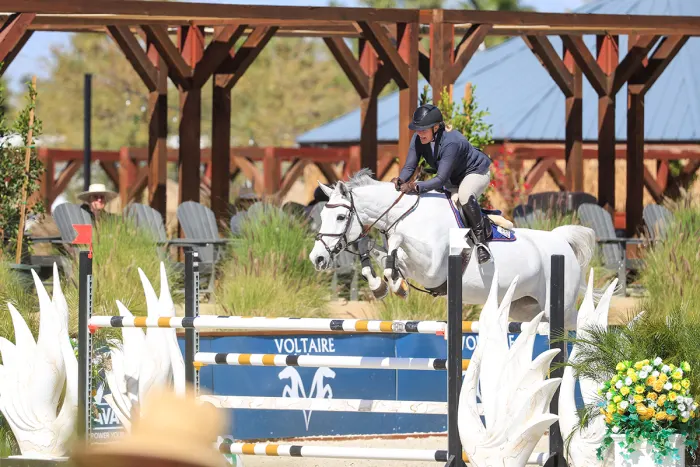
If she is not showing, Bidwell and her husband will wake up and take the horses out on a morning trail ride or a hack before they start their work for the day.
“It makes our day so much better,” she said. “It’s not like we have to show—honestly sometimes just going for a trail ride or hack is the best.”
In addition, Bidwell is a sought-after teacher in equine anesthesiology, and she often travels the country to educate other veterinarians. She spent many years performing daily surgeries when she worked for several top veterinary surgical practices, including Rood and Riddle Equine Hospital (Kentucky), and she also taught equine anesthesia at the Michigan State University College of Veterinary Medicine.
“There are not many equine-specific anesthesiologists, so there’s definitely a need for teaching,” she said. “I’ve even gone to Ireland and Australia to teach. It’s really fun for me.”
And now, Bidwell has accepted a new task, being named to the U.S. Hunter Jumper Association as a director at-large representing amateur riders. A majority of the USHJA board meetings are held via Zoom, so the job is an easy addition for Bidwell to add to her schedule.
“I’m in my 50s now, and I finally feel like I have knowledge that I can give back to the equine industry,” she said, also referencing her experience riding in a variety of different disciplines like Western, saddle seat and hunt seat as a kid.
Her work as a show vet also has put her on the frontlines of disease outbreaks, having dealt with vesicular stomatitis outbreaks and working at Thermal during the 2021 equine herpesvirus-1 outbreak that ultimately shut down the California show season.
“I feel like [our governing body] does not always make decisions backed by science. I feel like it’s time that I’m a part of those decisions.”
What she sees from uneducated people working in the barns at show grounds, she said, motivates her to look for ways to advocate for horses.
“I also want to help bring back horsemanship,” she said. “I feel like there are a lot of grooms that are hired [now] who aren’t horse people, and they ultimately don’t care about the horses. … When you drive around [the horse shows] on any given day, you can see grooms blasting the horses in the face with water from the hose [during bath time]. There aren’t many rules to protect the horses, and I think we need to do more on the welfare-side of things for the horses. I do not want to go creating a whole bunch of rules, but I do think we need to do something.”
“There aren’t many rules to protect the horses, and I think we need to do more on the welfare-side of things for the horses. I do not want to go creating a whole bunch of rules, but I do think we need to do something.”
Dr. Lori Bidwell
A focus on welfare is important not just to the animals, but to the long-term survival of horse sports, she noted, pointing to the growing importance of social license to operate.
“What does our industry look like to outsiders?” Bidwell asked. “Have we become habituated to behaviors that would be appalling or considered inhumane to people outside of our industry? Currently, this really matters because people outside of our industry are making laws and regulations that could end our sport.”
“The European equine federations are being aggressive with making changes to appease this concept,” she continued. “And the United States is behind on making changes that work towards improvement in equine welfare. It becomes more complicated because we have so many more breed and discipline organizations that have their own governing bodies. We need to make changes to our ‘normal’ practices quickly. That includes less medications, less longeing, less intense competition schedules and more downtime and rest for the horses. Horses were not meant to be in stalls 23 hours a day. We need to find ways to allow horses to be horses again.”
In addition to being on the USHJA Board of Directors, Bidwell hopes to have a voice on USHJA’s Young Jumper Task Force in the future. Many of the young horses that she and Peters breed go on to be successful jumper prospects, and Bidwell wants to ensure the continued success of the division in the United States.
“I’m very passionate about the young jumper divisions; I compete in those as well,” she said. “As a U.S. breeder, we don’t have a lot of outlets for selling young horses. For me personally, that’s frustrating because it’s so much fun [for us] to develop young horses.”
She’d like to see the age and jump height requirements of the young jumper divisions re-examined, she said, to ensure the program allows horses to develop appropriately for each individual.
“Right now, we have a 6-year-old jumper that got overfaced in the 5-year-olds in Europe, so we really had to back him off here,” she said by way of example. “There’s no way I could have shown him in the 6-year-old young jumpers here, because it’s pretty big for him, and he wasn’t quite ready for that. And now he’s a 7-year-old, and that means he has to jump 1.30 [meters]. So my goal is to find a way to really promote the young horses and make it affordable and appropriate for the way different young horses develop. That’s something I hope to have some input on and help with.”
The post New Amateur Member Brings Her Veterinary Experience And Focus On Welfare To USHJA Board appeared first on The Chronicle of the Horse.
]]>The post Top Finisher In USHJA Adult Horsemanship Quiz Studied Through Cancer Treatment appeared first on The Chronicle of the Horse.
]]>Sarah Jarosinski Holy, DVM, DACVAA, is no stranger to test-taking. For 14 years after high school, Jarosinski Holy forged a rigorous path to meet her childhood goal of becoming a veterinarian. But when a devastating cancer diagnosis shocked her in October 2023, just days after her wedding, Jarosinski Holy turned to test-taking again, this time in the form of the USHJA Adult Horsemanship Quiz Challenge, to help distract her through the draining cancer treatments ahead. Those treatments led to her recent clean mammogram—and her hard work earned her a second-placed finish in the national horsemanship contest.
At first, Jarosinski Holy wondered if she would even be eligible for the HQC, thinking that being a veterinarian might be an unfair advantage. But when she downloaded the study packet, she realized that she was, in fact, a little rusty. Vet school and various internships and residencies over the past decade had limited her barn time, so she cracked open her study materials and got to work.
Jarosinski Holy started riding in second grade, after a friend at school told her about her own horseback riding. She marched right home and requested “pony lessons.” What started as a hobby quickly became all-consuming. Her parents were her biggest supporters, buying their daughter a pony when she was 9.

“It snowballed from there,” Jarosinski Holy said. When she was 11, they added a horse she showed to their small herd, and by the time she was in high school, sick of chauffeuring their daughter to the barn daily, her parents bought a farm near Richmond, Virginia. It was their daughter’s job to care for the horses, so every morning, she fed and cleaned stalls before catching the bus to school.
Jarosinski Holy attended Hollins University (Virginia), competing on the school’s IHSA team. During her freshman year, she walked into a meeting with her academic advisor toting a binder that detailed her planned path to veterinary school. Her advisor laughed and asked, “So what do you need me for?”
The binder must have worked: Jarosinski Holy eventually was accepted into all six vet programs to which she applied, and she chose to continue her education at Texas A&M. While there, despite a rigorous schedule, she found ways to “keep her butt in the saddle.” At the dressage barn where her roommate boarded her own horse, she’d hop on anything that was offered, whether it was the barn owner’s Prix St. Georges mount or a greenie in training. When that barn closed, she took a stab at polo, playing for several semesters on the Texas A&M team.
Once her post-graduate internships, and then a three-year residency in veterinary anesthesiology began, however, 100-hour work weeks replaced barn time.
“[I] missed riding regularly, but I just kept telling myself to just keep grinding,” she said. “I was so close to having both the time and money to get back into horses in a real way.”
During her residency, Jarosinski Holy met the man she would marry, Josh Holy, a surface warfare officer in the U.S. Navy, and a naval science instructor at Texas A&M.
Holy was moving to San Diego, and Sarah joined him, having secured her first post-residency position as a veterinary anesthesiologist at Veterinary Specialty Hospital-North County in San Marcos, California.
Most pressing on Sarah’s list of tasks post-move was finding a place to ride. She started taking weekly lessons at DVG Show Stables in November 2022, and by the next spring she was looking for a lease. Her trainer came across a cute 5-year-old gelding named Torrey. He was for sale, and seeing his potential, Sarah decided to pursue a lease-to-own situation.
“It’s the most stressful thing, as a vet, to vet a horse,” she said. “He was only 5, coming 6, but something was slightly off, and I was uncomfortable. I wasn’t in a rush to get back into the show ring. He was a lovely young horse, and I wanted to give him some time.”
The pair rode lightly over the summer, and Sarah and her trainer played around with some medical treatments to see if he could be totally sound. They entered their first local show in August 2023 and went home with a handful of ribbons. She was excited about their future together.
But the same week, Sarah paid a visit to her primary care doctor. She had found a mass in her breast that was getting uncomfortable, but she didn’t think much of it beyond a possible cyst or clogged duct. She was only 33, and there was no history of breast cancer in her family.
A mammogram and ultrasound followed, then she underwent a biopsy just days before she and Josh flew to the East Coast for their wedding. On Oct. 7, the pair married on the beach in Duck, North Carolina. Sarah asked her medical team not to contact her with the results of the biopsy while she was away. But the pathology report came through her online medical chart, and she decided to open the results surrounded by her family.
Three days after her wedding, Sarah learned she had breast cancer. In the airport lounge on their way back to California, she made calls to her nurse advocate, scheduled various appointments, and began to research her specific disease.
“Those first days felt like being hit with a water hose [of information],” she said.
From the early days after her diagnosis, Sarah was focused on making something positive out of her illness. Entrenched in the medical field herself, she wanted other professionals to learn from what she was going through.
She enrolled in the I-SPY study, a clinical trial that looks to personalize treatment based on a patient’s tumor characteristics. Unfortunately, after two of four rounds of the recommended immunotherapy, Sarah’s tumor wasn’t shrinking, meaning she would have to undergo chemotherapy.
Right around the same time, Torrey’s six-month lease was up. A heartbroken Sarah told her trainer that she couldn’t go forward with the purchase. She’d been working a second job to pay for the horse’s training board, and she didn’t know how much she’d be able to work or ride in the months ahead.

Sarah began 12 rounds of weekly chemo in January 2024. Recognizing that she “doesn’t sit still well” (she worked through chemo, and prides herself on not missing a single day of work), she also signed up for the HQC as a fun way to pass the time in the hospital, and when she needed to lay low at home.
“I’d realized that a lot had changed in the 10 years since I was riding really regularly,” she said. “And there were other things I needed to refresh, like the correct way to measure for a blanket.”
“And man,” she continued, “I needed a review on tack. I was sitting in the hospital thinking about horses in my past: Why did that one horse go in a Waterford, and what does that bit even do?”
She credits the HQC for giving her another goal to work toward after having to give up on purchasing Torrey. In her chemo chair, tubes hooked to the port in her chest, she’d pore over her HQC study materials, preparing for the first rounds of written tests she’d take in the fall.
At the end of her chemo, an MRI couldn’t detect any cancer on Sarah’s scans, but a biopsy confirmed a small percentage of living tumor still present. She either needed to undergo more chemotherapy or a complete right-side mastectomy followed by 25 rounds of radiation.
She chose the latter, more aggressive option, and in the four weeks between the last chemo and her April surgery, she felt good enough to ride. Her trainer had purchased Torrey and insisted Sarah come ride or visit the horse whenever she was able. That saddle time was vital; she knew she’d be required to rest following surgery and admitted, “I’m not good at that.”
In the meantime, Josh learned that the Navy would be relocating him to Virginia to serve as a combat systems officer on the USS Laboon. Both of their families were in Virginia, but the move was bittersweet since it meant Sarah would be saying goodbye to a fantastic medical team and barn friends that she cherished.
In the short weeks in between Sarah’s last radiation appointment on July 19 and her move to Virginia on Aug. 1, her trainer suggested she show Torrey in the 3’ adult amateur division at a show at Del Mar Horsepark.
“I was terrified to do the 3’ because I’d hardly ridden,” she said, “but my trainer really thought I could do it. So I did. And you couldn’t have wiped that smile off my face all weekend.”

This past fall, barely settled into their new home, Sarah ended up back in the hospital, needing surgery to address an infection caused by the tissue expander that had been placed in her chest during her mastectomy.
“A silver lining was that I got to watch the entirety of the Maclay finals online,” she said, “and I had a lot of time to study for HQC Nationals.”
Sarah spent 12 days in the hospital, then roughly a week later sat for the Adult HQC national written exam. She had an hour to answer 100 questions, and she welcomed the challenge.
“I can’t turn off my Type A personality,” she said, laughing. “This was meant to be fun, but I had nerves that were similar to when I was taking my boards!”
The interview portion of the HQC followed, where over Zoom, Sarah spoke with two judges. The top four competitors would move on to the practicum, and her 27/30 score put her in fourth place.
For the practicum, qualifiers were given a set of six skills that they needed to demonstrate and submit in video form. Sarah hadn’t yet found a barn in their new community, so she made the several-hour drive to her parent’s farm—her childhood home—to film her submission.
Her first pony, Tyko, now 29 and still living with her parents, was her model. Josh filmed his wife demonstrating the correct way to wrap a hoof, one of the skills she needed to complete. The weekend was special, Sarah said: She spent time with her horses and her family and even made it to her niece’s first birthday party.

To prepare for the practicum, she’d put herself in the evaluator’s shoes—a tactic she’d perfected studying for her anesthesia board exam—and attempted to think like the graders. What were they looking for? What would they want her to demonstrate? Her efforts paid off, and she scored highest in that element of the competition.
Each part of the HQC is weighted slightly differently, and when the final results came out in early December, Sarah learned that she had come in second place overall.
“I felt over the moon,” she said.
Sarah had her right breast reconstructed last month, and she’s doing her best to rest and heal.
“My mom came to stay for a week to make sure I didn’t go back to house projects,” she said.
She is continuing her cancer care at Duke University Medical Center, and her most recent mammogram was clean. To enable doctors to continue learning from her case, she enrolled in another multi-center study in the area. She’s doing some veterinary consulting work as well, which she says is enabling her to connect with many different people in her field while being able to create a flexible schedule.
Her diagnosis annoys and angers her, and she struggles with coming to terms with what it means for her long-term health. But she’s learning, she said, to jump on opportunities when they arise, and not wait for what might seem like a more opportune time. She’s started looking for places to ride when she’s cleared to do so, and she’s started putting money aside for when she crosses paths with the right horse in the future.
The post Top Finisher In USHJA Adult Horsemanship Quiz Studied Through Cancer Treatment appeared first on The Chronicle of the Horse.
]]>