The post Throwback Thursday: Reiner Klimke Wowed The World At 1984 LA Games appeared first on The Chronicle of the Horse.
]]>After the first day of the Olympic team dressage competition on Wednesday, Aug. 8, 1984, the heavily favored West German team was in trouble. Their first rider, Herbert Krug on Muscadeur, had scored (for him) a mediocre 1,575 (63%) for a test lacking in energy and riddled with mistakes. There seemed to be a hole in the German armor.
The Swiss, meanwhile, who weren’t expected to get a medal because Christine Stuckelberger’s ’76 Olympic and ’78 World Champion, Granat, had been retired, were the interim leaders. Stuckelberger had scored 1,606 (64.24%) points on the young Tansanit, competing in only his third international Grand Prix, and Otto Hofer, the eventual individual bronze medalist, had scored 1,609 (64.36%) on Limandus. Denmark was second, due mostly to Marzog’s 1,701 (68.04%) despite a labored and disappointing test, and the United States was third.
Although his two best riders were yet to go, West German coach Harry Boldt must have been worried on Wednesday night. Uwe Sauer’s performance early the next afternoon couldn’t have done much to ease his mind either. Although a member of last year’s European Championship team and international veteran, Sauer’s test contained more mistakes than energy, and his score of 1,582 (63.28%) meant the Germans trailed the Swiss by 58 points after two riders.
Boldt needn’t have worried, though. The night before, five-time Olympian Reiner Klimke had promised to score over 1,750 points, so Boldt let him go out to dinner instead of early to bed. Klimke made up for any lost sleep by taking an hour-long nap before his test. If he felt any pressure, he didn’t show it.
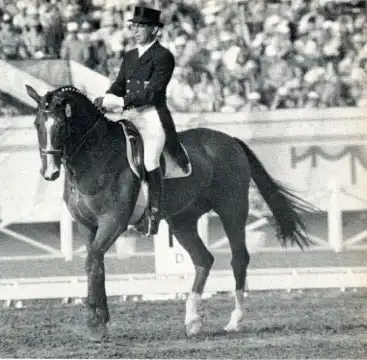
“Because of the heat. I first had in mind to ride a sure test today and ride hard tomorrow [in the Grand Prix Special],” Klimke, a 48-year-old notary, said. “But my chef d’equipe and trainer told me to make a good impression for the team.”
To say Klimke made a good impression is like saying Beethoven was a songwriter. Herr Doktor Klimke nailed it. The sensitive Ahlerich’s eyes were wide when he entered the noisy stadium, but Klimke just kept working him.
They proceeded to produce a lesson in dressage, a test that made you say, “That’s how it’s supposed to be.” So smooth, so light, so active, right down to the last halt, which had to have been a 10. A horse can’t halt any squarer or stand any stiller.
Klimke knew he had just won his fourth team gold as he left the ring to an appreciative roar from the 22,000 fans. “I try to ride in dressage so the spectators must look,” the gray-haired and soft-spoken Klimke said after receiving a score of 1,797 (71.88%). “In this test [Grand Prix], this was his best ever. In our tryouts in Salve in the Grand Prix Special he was the same.”
Sauer and Krug had no explanation for their subpar scores, although others speculated on nerves because this was the first Olympic appearance for both and the Germans were expected to win easily. “I was happy with my horse but not with my result.” was the comment by both riders.
“Maybe we can reconstruct it with the judges’ papers [tests],” said Chef d’Equipe Anton Fischer. Nevertheless, both qualified for the individual final.
Joy In Switzerland
The three Swiss riders were overjoyed with their silver medal, even though Amy-Catherine de Bary on Aintree had received only 1,458 (58.32%) points for a heavy and mistake-filled test. De Bary would have needed a score of 1,741 to beat the Germans. but in finishing ahead of third-placed Sweden and fifth-placed Denmark they reversed the order at the Lausanne, Switzerland, CDI in May. Stuckelberger attributed this to a new line-up and improved performances.
“The problem was we had another team in Lausanne,” said the blonde and always polite 37-year-old. “Amy-Catherine was not on the team [Doris Ramseier was the third member], and she did a better test [here] than [Doris]. My horse did not have a good test there. My horse did so much better here and Limandus went about the same. So with Amy-Catherine we did better.”
Stuckelberger also said they seriously considered bringing Granat, now 20, out of retirement for the Olympics. However, he wasn’t needed. “We knew [last winter] that Transanit had never done a Grand Prix, but in February our chef d’equipe came to see me and he didn’t believe me that I was riding Granat because he looked so good,” she said. “He told me I had to keep him fit to be the reserve horse.”
The Swedes also put two riders into the individual final as their team of Ulla Hakanson. a member of the ’72 bronze-medal team, Ingamay Bylund and Louise Nathhorst won a close contest for the bronze. The Swedish total of 4,630 put them only 44 points ahead of Holland, 56 ahead of Denmark and 71 ahead of the U.S.

Although there had been hope the U.S. might duplicate its ’76 bronze medal, the team’s sixth-place finish has to be seen as a positive sign, especially when you recall that just two years ago they beat only the Bulgarians in the World Championships. At Santa Anita, the American team, with the exception of the Germans, was the only team to have three riders score over 1,500 points.
Robert Dover and Romantico led off for the U.S. on the hot and smog-filled afternoon. Romantico was forward and brilliant at the trot and passage as usual but got stuck in each piaffe and made some mistakes at canter. Afterward, Dover looked exhausted. “I think the high points were in the extensions and some of the passage work,” he said between drinks of water. “And the piaffe work would have been fine too, had I been able to get out of the piaffe. When people clap for him, he likes to piaffe naturally, so I think that’s why he kept getting stuck.”
Coach George Theodorescu pointed out that although Dover is one of the top riders in the U.S., he is a complete novice in international competition. “Altogether it was a very good test, especially for someone who has never been in this ring before,” Theodorescu said. “If you don’t have much experience in international shows you want to do the best you can, especially for your team. But sometimes when you do more you get less, and when you do less you get more.”
Coach George Theodorescu pointed out that although Dover is one of the top riders in the U.S., he is a complete novice in international competition. “Altogether it was a very good test, especially for someone who has never been in this ring before,” said Theodorescu.
By the time Sandy Pfleuger-Clarke went it was practically dark and considerably cooler, much to Marco Polo’s advantage. Pfleuger-Clarke, an experienced international competitor in both dressage and three-day, put forth a highly professional test to keep the U.S. in the hunt by scoring 1,516 points (60.64%). All but two transitions were crisp and accurate, and the test as a whole was smooth and forward.
Like Dover, Pfleuger-Clarke looked drained after her ride. “I liked the end of it better than the beginning. He was a bit more settled and easier to ride,” she said. “For the Grand Prix it was definitely the best one this spring—there were much fewer mistakes.”
Pfleuger-Clarke added that after seeing how tough the Swiss were, she doubted the U.S. could get the bronze. Nevertheless, when Hilda Gurney and her ’76 hero, Keen, entered the ring, it looked as if a score in the high 1,500s might do it. The 17.2-hand chestnut was also smooth and forward, but he missed a one-time change and sometimes appeared irregular in the half-pass to the right or at the passage.

The score (1,530 or 61.20%), although the best on the team, was disappointing to Gurney.
“Good test, disappointing score. I was very pleased with the test,” she said in her usual staccato sentences. “I hoped I would make the ride-off [as she had in Montreal by placing fourth], but when you’ve been out of international competition for a while and the judges haven’t seen you, it’s hard to come back.”
Gurney was asked to compare this test to the now almost legendary Montreal test, which the late Bengt Ljundquist, then the coach, called the best test Keen had ever done. “That was so long ago,” she responded. “I don’t think the judges have the confidence in him that they used to. I think an older horse has to prove himself more than a younger horse. We’ll take him to Europe this fall to show him, which I wish I could have done before [the Olympics], but he wasn’t fit enough.”
The Master Does It Again
Although two former individual gold medalists qualified for the Grand Prix Special on Friday, neither of them came close to repeating. Elisabeth Max-Theurer of Austria, the 1980 gold medalist and ’79 European Champion on Mon Cherie, finished 11th on Acapulco, a lovely chestnut who made mistakes at the trot and piaffe.
“He was a jumping horse before, and he did only a little flying changes and half-pass,” Max-Theurer said. “He did his first Grand Prix in about August, 1982. He was ready [for the Olympics], but there are some things I hope will improve.”
Stuckelberger was just pleased to qualify with her young horse and worried that he would once again find the Grand Prix Special too difficult. “He was eighth in the Grand Prix at Lausanne and 12th in the Grand Prix Special because we mixed everything up. Then we were seventh at Aachen but 12th again in the Special,” she said. Stuckelberger rode in her usual full-out style, but the 9-year-old Transanit appeared stiff and had trouble with the Special’s demanding transitions, mistakes that put the pair ninth.
One Swiss who didn’t make mistakes was 40-year-old Otto Hofer on Limandus. Hofer and the 14-year-old Dutch-bred rode a forward test with active and effortless passage and piaffe to gain the bronze medal well ahead of Ingamay Bylund on Aleks, Krug and Sauer. Hofer, who could hardly contain his joy either after the test or the awards, hugged his horse and wore an unflinching smile. “It’s unbelievable for me. To be better than the two Germans has happened never in my life. To be third—this makes me really happy,” he said. “I never thought I would win an individual medal. My wish was to be in the first 12, but yesterday when I was third, I thought it was possible.”
A businessman specializing in packaging systems for pharmaceutical products, Hofer had lost 20 pounds during the last three months while training for the Olympics. However, he found the final preparation at Santa Anita too intense, so with his wife and three children he visited Los Angeles attractions like Disneyland and Marineland in an effort to relax.
Weight loss and relaxation must have worked. He was asked how long it would be before he took his medal off. “I’ll do it for my wife,” he said.
The expected showdown between Klimke’s Ahlerich, the current World Champion, and Anne-Grethe Jensen’s Marzog, Ahlerich’s conqueror in winning the ’83 European Championships, never really materialized. Early in the week rumors circulated that the beautifully built Danish horse was lame, but they were proven false when he jogged out sound at Monday morning’s vet check.

Nevertheless, the light bay Marzog performed disappointingly in the Grand Prix, at times looking stiff and labored. Jensen declined to talk to the press after her ride, saying through team captain Hanne Valentin she did not like to talk while the competition was still in progress. Valentin said Jensen, 33. had been nervous because of the great expectations everyone had for her and that the heat had bothered her but not Marzog.
Valentin also allowed that Marzog had made some uncharacteristic mistakes. “I was a little disappointed. I found too many faults today, but I have never seen the passage better for Marzog,” she said.
The judges liked the test enough to place the Danish pair second by a wide margin, showing how important reputation—or what Hilda Gurney called “confidence”—is in judging.
Marzog showed considerable improvement in his canter and piaffe work on Friday, going about two hours later than on Wednesday on a cooler and much clearer day. All in all, it was a more accurate and enjoyable effort, easily giving them the silver. “He did very well indeed. It was our very best to date,” Jensen said through Valentin. “Marzog felt better today and he was not disturbed by the spectators, and I didn’t feel the heat so much.”
Ahlerich and Klimke had gone just before, and it was probably a good thing Jensen couldn’t see Klimke’s test. It wouldn’t have given her much confidence. Although the 13-year-old Westphalian gelding wasn’t quite as brilliant as the day before, there wasn’t much to criticize either. Klimke was afraid Ahlerich wouldn’t be able to produce back-to-back show-stoppers, but the Special was a beautiful test too.
“I had to fight for it today,” Klimke said. And perhaps that is what makes Klimke so skillful—he never seems to be fighting. He looks calm, he looks determined. but it seems to happen without him doing anything. And the movements happen precisely where they should, the way they should. Klimke’s two tests were a joy to watch, and when he left the ring the 27,662 fans cheered long and hard.
Watch Klimke and Ahlerich perform at the 1984 Olympic Games.
This was a meaningful medal for Klimke, because although he had won three team gold medals before this year, the best he had done individually were bronze medals in ’68 and ’76. He finally had the Olympic gold to go with his two World Championship titles. “I would lie if I said I wasn’t happy,” he said. “I may never have the chance again to ride such a super horse as Ahlerich. I think Ahlerich is better than [’76 bronze medalist] Mehmed, but my first horse, Dux [1968] was nearly as good, but I wasn’t as good 16 years ago.”
Someone asked if he would retire now that he has won every international dressage title there is. “My friend Anton Fischer tells me to keep going, that they still need me,” Klimke replied with a smile. “As soon as good young riders from Germany come up to replace me, I will stop. Not until then.”
Klimke, the German master, had done what two other German masters. Josef Neckerman and Harry Boldt, had failed to do—win the individual gold medal. And watching him and his brilliant horse take their victory lap of one-handed one-time changes, passage, piaffe and then extended trot, one had to believe they would be back. Klimke was having too much fun.
Watch Klimke and Ahlerich take their victory lap.
The post Throwback Thursday: Reiner Klimke Wowed The World At 1984 LA Games appeared first on The Chronicle of the Horse.
]]>The post Back From The Brink: An Amputation Can’t Keep Andrew Diemer Out Of The Tack appeared first on The Chronicle of the Horse.
]]>“You can’t keep me away from the barn for too long,” he said with a laugh. “And I wouldn’t want to be.”
Born with a bicuspid aortic valve—his heart had only two flaps instead of three regulating the outward flow of blood—Diemer was at a higher risk of contracting infections involving the heart. But beyond being prohibited from playing full-contact sports like football, the condition had never slowed Diemer down or prevented him from doing what he wanted to do.
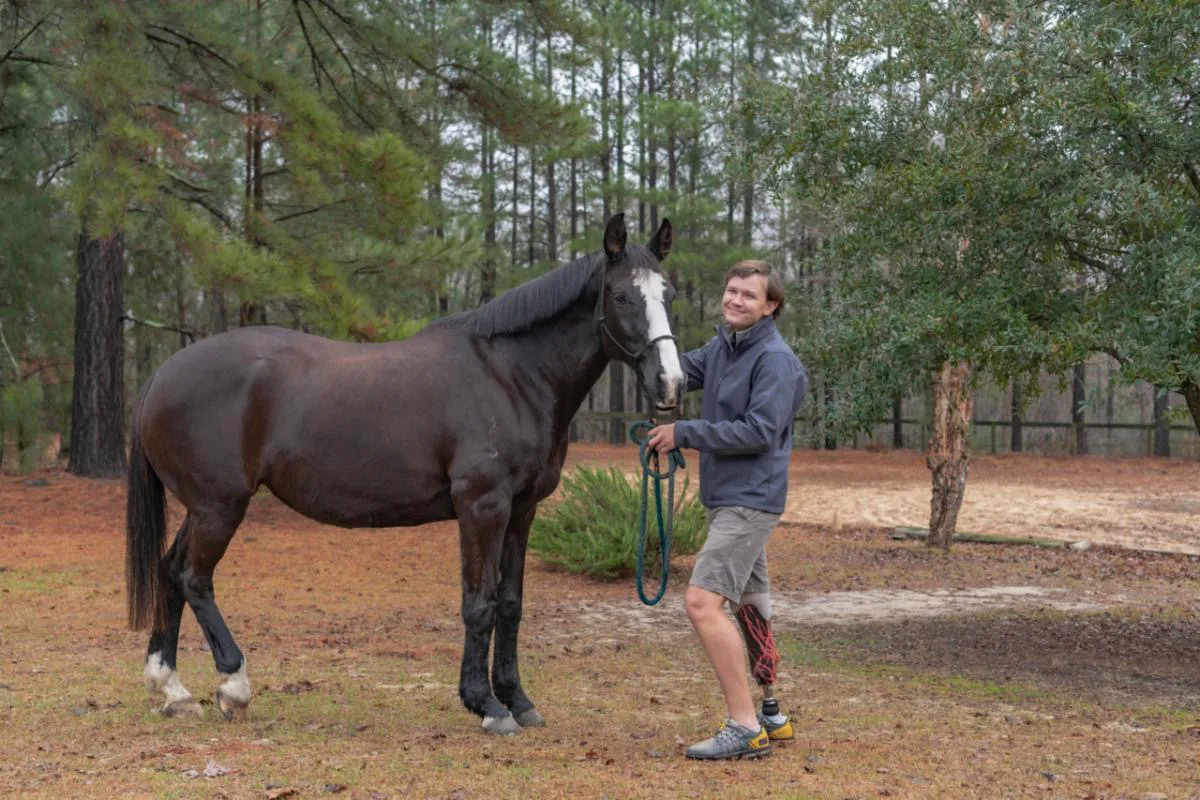
That all changed in 2014, when a series of atypical symptoms culminated in a diagnosis of endocarditis, a rare but life-threatening infection causing inflammation of the heart’s inner lining and valves. In the quest to save his life, Diemer would ultimately undergo a series of open-heart surgeries and lose part of his right leg. But true to his past, Diemer didn’t let even these major health issues keep him out of the tack for long.
Watching Diemer ride today, whether in the jumper ring or on cross-country, you wouldn’t necessarily notice he wears a prosthetic on one leg—except for the time when, according to his mother Dana Diemer, he left the polocrosse field calling for an Allen wrench because “his foot had come loose and turned around.”
Trying Every Sport On Offer
After getting his start foxhunting in New England, Andrew rode with several clubs around the country, as his military family moved regularly; at 6, he earned his junior colors with the South Creek Foxhounds in Tampa Bay, Florida. In 1997, the Diemers settled in North Carolina, where Andrew joined the Moore County Pony Club and began to explore other equestrian disciplines. In what he calls “traditional young boy fashion,” he tried every sport on offer within his first year.
“I developed an affinity for eventing, because, of course, you have the adrenaline of cross-country,” he said. “But largely, for much of my early career, I was sort of your stereotypical young boy. I was pretty good at the jumping, and pretty terrible at the dressage. And as far as Pony Club went, when it came to keeping myself clean—well, my horses were always well tended, but at formals, I was often the kid who had dirt on his breeches.”
Andrew and his father Manny were first exposed to polocrosse through U.S. Pony Clubs; Andrew describes the sport as a cross between polo and “father-son go out back to toss the baseball.”
“What’s great about polocrosse, unlike many other horse sports, is that it is a true team sport,” Andrew said. “Eventing, show jumping or dressage can be team sports, but you are never in there with your teammates at the same time. They are individual sports, where you compile the scores.”
Both Andrew and his father were excited to bring polocrosse back to their local Pony Club—the organization’s first polocrosse rally was held at the Diemers’ leased farm—and they also became some of the first North Carolina-based members of the American Polocrosse Association.
“Polocrosse is still a very small sport in the U.S.,” said Andrew, who noted it is most popular in Texas and Wyoming. “Which means if you show any form of talent, you don’t have as much competition for [international] teams.”
That is perhaps Andrew’s modest way of acknowledging that, by age 16, he was invited to represent the U.S. in international tournaments, making several trips to play in Australia. At 17, he was part of a group of 20 American polocrosse athletes to spend a month training and playing in South Africa. Andrew admits he made it to his C-2 certification in Pony Club expressly to be eligible to represent the organization in a polocrosse exhibition held in the United Kingdom in conjunction with the 2011 World Cup.
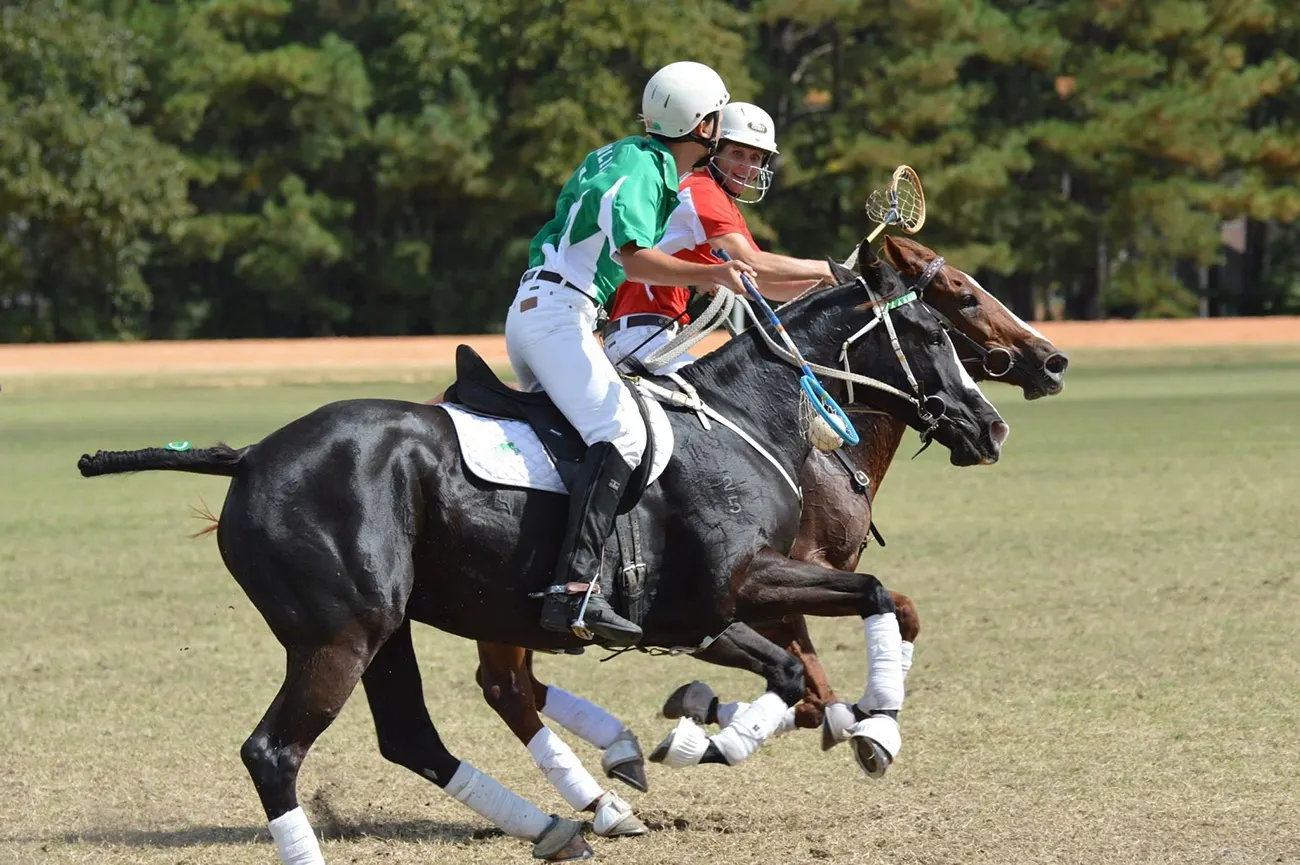
Andrew eventually played polocrosse at the “A” grade level, which he equates to advanced in eventing. In 2013, riding his Australian Stock Horse mare Keystone Silhouette, Andrew was part of the first—and perhaps only—non-Texas-based “A” grade team to ever win an American Polocrosse Association national championship. “Stella” was named best conditioned horse.
“That year, the nationals were held here, in Pinehurst [North Carolina], so it came with all the added emotion of winning on home soil,” Andrew said. “I am very proud of that. But as much as I loved polocrosse, because it is such a small sport, you can’t really be a polocrosse professional. As far as a professional sport, I was going down the road of eventing.”
Andrew had always pursued his eventing goals alongside his polocrosse game, and a Canadian Sport Horse gelding named Cold Harbor eventually brought him to the intermediate level. Under the tutelage of Holly Hudspeth, the pair qualified for the 2008 Young Rider Championships (Colorado) at the two-star level, finishing ninth individually and second in the team competition.
From Joint Pain To Amputation
By 2014, Andrew was 24 and living in Maryland, working an assortment of jobs to make ends meet while riding. When he started experiencing joint pain that fall, Andrew’s doctors assumed he had contracted Lyme disease, because his outdoor-based lifestyle meant he was constantly exposed to ticks. He was put on a course of doxycycline, a powerful broad-spectrum antibiotic known for being effective against the disease’s causative agent.
“The doxy seemed to be tamping down the symptoms, but it wasn’t stopping anything,” Andrew recalled. “And then, I started developing a fever on a regular basis.”
This additional symptom, combined with the mediocre response to doxycycline, led to a rheumatoid arthritis diagnosis. He wasn’t convinced; no one in his family had a history with the autoimmune disease, and he had no other symptoms. But he started taking the prescribed immunosuppressant anyway—with disastrous results.
Two weeks later, Andrew woke up coughing so badly he vomited. Soon, he could barely breathe, and his fingernails had turned blue. He texted his then-girlfriend, who left work immediately to take him to the local emergency room.
“When my immune system was already fighting what would later be revealed to be a severe bacterial infection, having my white cells have their legs come out from underneath them was not what needed to happen,” he said. “Pun totally intended.
“By the time I got to the ER, they realized I was going into cardiac arrest,” he continued. “My aortic valve was already rotted away, and my mitral valve was on the way out. The bacteria had been sitting on my heart valves and fighting against my immune system. When the immune system was no longer there because of the medication, it just went haywire.”
Andrew was transferred to the Johns Hopkins Hospital in Baltimore, where he was immediately rushed into surgery. Ultimately, he underwent five open-heart procedures to repair the damage, replace his valves and install a pacemaker. But further complications followed.
“One of the concerns with this kind of infection is if the bacteria doesn’t all come out with the surgery—if it gets into the bloodstream—it can cause clots,” he explained. “That’s what ended up happening to me, in two places.”
The first, and most obvious, clot impeded circulation to Andrew’s right foot; the second was more subtle, affecting his left thumb. With little blood reaching the front half of his foot, Andrew underwent a thrombectomy, in which doctors attempted to remove the clot surgically. When the procedure was unsuccessful, Andrew and his medical team arrived at a difficult crossroads.
“I needed to think about my overall health. I realized I can, as brutal as it sounds, lose a foot. But I couldn’t have any more heart problems.”
Andrew Diemer
“We reached a point where I needed to be a bit more mobile to help my heart get more healthy, and we had to make a decision: Do we wait even longer [for the clot to resolve] and risk having more issues with my heart, or do we go ahead and do the amputation, so I can get into rehab?” Andrew recalled. “In comparison to what was going on in the rest of my body, the foot was cosmetic. I see this in hindsight, but at the time, it made it feel like losing the foot was a side thought.
“It was a huge thing to think about—‘Just chop off my foot, so things will be fine with the rest of me,’ ” he continued. “Obviously, the doctors weren’t putting it across that way. No one was judging me, but a decision had to be made, and soon.”
When it became increasingly clear there was no sign of the clot breaking—unlike the thumb, which had improved on its own—and the health of his foot declined, Andrew began to accept what needed to happen.
“I needed to think about my overall health,” says Andrew. “I realized I can, as brutal as it sounds, lose a foot. But I couldn’t have any more heart problems.”
As Andrew was wheeled into the operating room in February 2015, he didn’t know how extensive his amputation would be.
“The orthopedic surgeon was fantastic, and he had a lot of experience with amputations,” Andrew said. “He was honest with me, that there was a 50-50 chance they would have to take the whole foot, but there was also a chance of saving enough foot to give me a platform to stand on.”
He woke up to learn the amputation began just above the ankle, and his entire foot was gone. But thanks to his surgeon’s skill, Andrew was set up to heal in such a way that adding a prosthetic would be as easy as possible.
“My prosthetic limb has almost always been incredibly comfortable,” says Andrew. “And thanks to the ingenious way he stitched my good, healthy tissue, I was never putting full weight on any of those incisions on the prosthetic.”
In recovery, Diemer defied his doctors’ expectations. His original prognosis involved an initial lengthy in-patient stay, followed by a series of step-down transitions to independent life. But after only one month, Andrew walked out of rehab on his new foot with the aid of a cane. He credits the support of his parents, friends and “great technicians and staff” for his rapid recovery—and the addition of a polocrosse racket to his rehab routine.
While in recovery, Sarah Dancsisin, a fellow polocrosse enthusiast who worked for a racket manufacturer, gifted Andrew with a “trick stick.” Where a traditional polocrosse racket is typically too long and awkward to use while unmounted, a trick stick is designed to allow players to work on their ball handling skills out of the saddle.
“I added that into my rehab routine and all the PT I was doing,” Andrew said. “So, if I was doing the balancing ball, I was having the techs throw me the polocrosse ball, and I would toss it to them.
“Because of the relatively small polocrosse community, they all just rallied around me,” he continued. “I got a lot of calls, support and messages. But Sarah in particular, sending me that racket—not only was it super sweet; it affected how the rest of my rehab went.”
The first stop Andrew made after leaving rehab was the barn.
“Horses were always involved in my rehab,” he said. “My girlfriend had a horse named Dude, the chillest gelding you can imagine, and the first day I was out, she helped me get on him and ponied me around the pasture.”
Andrew admits that learning to ride with his prosthetic—and not being able to feel his right stirrup—did take some adjustment. For a year, he had to remind himself to keep his foot down so it wouldn’t bounce out of the stirrup.
“That was disconcerting for a while, and not feeling balanced in the saddle was incredibly unsettling to me,” he said.
“Ultimately, it gave me new perspective,” he continued. “I can’t remember a time when I was not riding, and while I had to work at certain parts of it—dressage comes to mind—I never had to struggle with the basics. So all of a sudden, at 24, going back and saying ‘How do I post?’ was a struggle.”
He credits lessons with Robin Brueckmann, a USEF “S” judge and para-equestrian, with helping him relearn how to ride.
“What better person to learn from than somebody who has experienced it themselves?” he said. “She was a lot of help to me, especially in those first few years of getting back in the saddle again.”
Andrew eventually felt balanced enough to return to the polocrosse field, though he stepped down a level, playing at the “B” grade in the midfield, a position that typically receives less action. Partnered with Stella, Andrew played on the national championship winning “B” grade polocrosse team in 2016. But after that win, he hung up his racket for good.
“I’m on blood thinners now, and polocrosse is a contact sport,” he said. “I started to realize the bruises I was taking on the field were not going away quite as fast. I was able to go out on a win, and step away from the sport, as far as playing.”
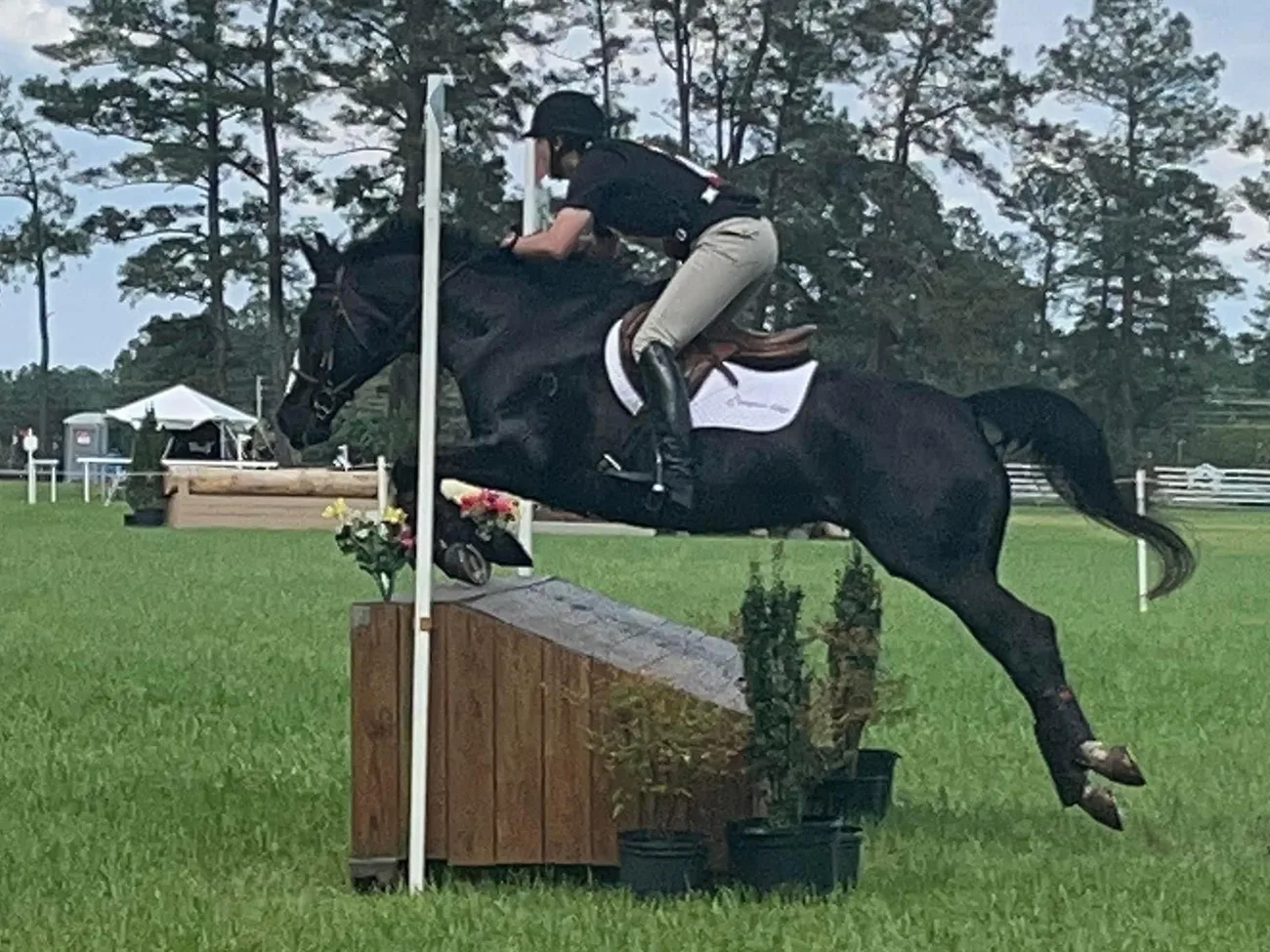
After that, he and Stella focused on eventing, competing to training level. Today, they show primarily in the jumper ring. Andrew also adjusted his career goals; he enrolled at the University of North Carolina at Pembroke, earning first a bachelor’s degree in history, and then a masters in social studies education. For the past three years, he has taught social studies at Southern Lee High School in Sanford, North Carolina.
Last year, Andrew helped his school receive a $10,000 grant to start an Outdoorsman’s Club, with the goal of helping students get outdoors more often. Among the many sponsored activities the club will offer is horseback riding; Andrew has already affiliated with a local riding program to help connect horses with young people who would otherwise never have the opportunity to ride.
“So I’m even bringing horses into the public school system,” Andrew said with a laugh. “I like to share my story with students at the beginning of the school year, just to let them know you can get over this stuff.”
The post Back From The Brink: An Amputation Can’t Keep Andrew Diemer Out Of The Tack appeared first on The Chronicle of the Horse.
]]>The post Polo Pioneer Pansy Poe ‘Raised Up’ Horsewomen Of Her Era appeared first on The Chronicle of the Horse.
]]>Elisabeth “Pansy” Ireland Poe’s membership in the U.S. Polo Association may have been short-lived, but it was also groundbreaking. She registered with the USPA using only her initials to hide the fact that she was a woman and played on men’s teams 50 years before females were granted admittance to the organization.
When her identity was discovered by the USPA, the organization revoked both her membership and her handicap. Poe continued playing in women’s games and went on to make a name for herself in both the hunter/jumper and Thoroughbred racing worlds.
And throughout each of her equestrian ventures, Poe was an avid supporter of fellow horsewomen, from the show ring to the racetrack, and a philanthropist who used her wealth to build up the people and places that she held dear.
A Love Of Stick-And-Ball
Despite being only 5 feet tall, from the first time she swung a polo mallet, it was clear Poe had a great deal of natural talent.
A native of Cleveland, Ohio, with a lifelong presence at her family’s Pebble Hill Plantation in Thomasville, Georgia, Poe played on competitive women’s teams as a young adult, traveling from her local Chagrin Valley, Ohio, to places like Virginia and New York for tournaments.
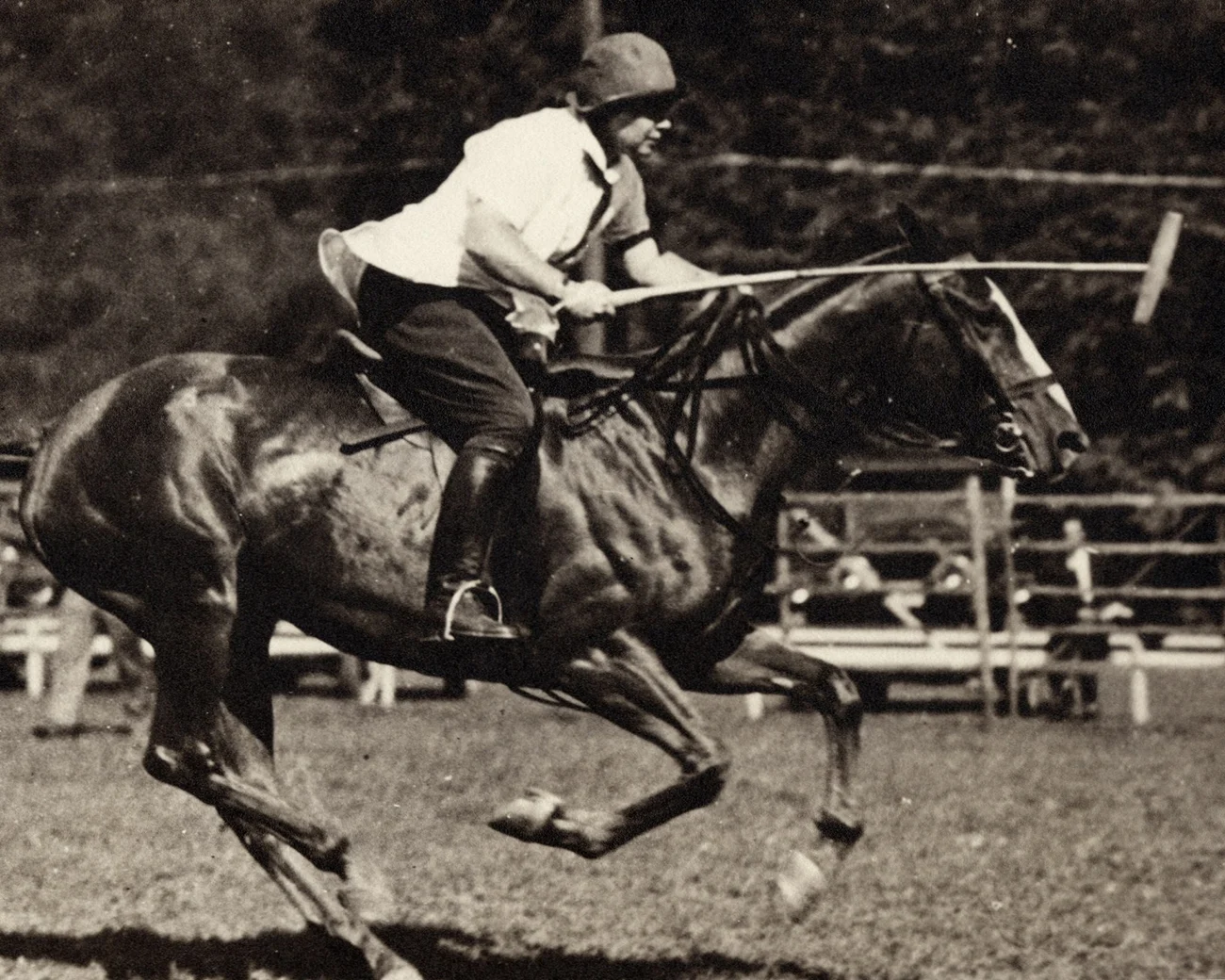
“But I think she grew bored playing with the ladies,” said Kim McCray, communications coordinator at Pebble Hill Plantation, Poe’s family estate. “She was so much better than them.”
Using her initials, the then-Elisabeth Ireland registered with the USPA—an organization that was, at the time, only open to men—in 1925.
“She wasn’t trying to be deceptive,” added Lori Curtis, Pebble Hill’s museum curator. “She didn’t try to disguise herself as a man. She just pulled her hair back, put on her uniform and played. All her teammates knew who she was, but they respected her as a player, and no one on the teams had an issue with it. She just wanted to play polo.”
“I don’t think she was an intentional feminist,” said McCray. “She just did what she wanted to do. She was an excellent player, and she wanted to play with the best.”
She was such a force on the polo field that she was featured—along with notable equestrians such as the king of Spain and the prince of Wales—in an undated, circa 1930 limited edition leather-bound book titled “International Sport” that profiles, according to its editor, “the most interesting and notable names in the present-day world of equestrian sport.”
“Those who deny that women have achieved equal rights with men and claim that the so-called weaker sex are not as capable as the men will have a rude awakening if they happen to witness any of the polo games in the vicinity of Cleveland and see a young woman playing in polo matches against the male competitors, with much the same spirit and dash, quickness and accuracy as her male competitors,” the entry about Poe begins, according to the volume kept at the National Sporting Library and Museum in Middleburg, Virginia.
In 1925, before the USPA realized that she was a woman, Poe earned a handicap rating of “1.” When her gender was discovered, the USPA stripped her of both her membership and her rating. Despite Poe as proof that ladies could hold their own with the men on the field, women were not granted membership to the USPA until 1972—about 50 years after Poe played in a USPA match for the first time.
Poe continued to play polo on women’s teams, competitively through her 20s and more casually through her 30s. Her passion for the sport continued throughout her life, and she regularly hosted matches at her various properties, including Pebble Hill. (This weekend, Pebble Hill will celebrate Poe’s contributions to the sport at its second-annual Pebble Hill Polo Classic. In honor of Poe, every player on the field that day will be female.)
“I’d love to see the USPA restore her membership posthumously,” said Curtis, who also has nominated Poe for admittance to the Museum of Polo Hall of Fame. “I think she’d look down and be really happy about that. She was a trailblazer for the sport, and she deserves to be recognized for her contributions, though she wouldn’t be interested in that recognition. She just wanted to be treated equally. She just wanted to play.”
Ribbons In A Closet
Poe was born into an equestrian family: her stepfather bred and trained trotting horses, and her mother loved to foxhunt. By age 3, young Elisabeth, astride her pony Chintz, was being led on hunts by her mother.
As a little girl, she was also a regular competitor in horse shows that her family helped to establish near their Georgia estate. She remained an avid competitor, trainer, and owner for the next several decades. Poe competed heavily, and successfully, in the Chagrin Valley and along the East Coast. Her most successful horse, Mighty, won three Cleveland Horse Show Championships, according to her International Sport profile.
She also had a title from Madison Square Garden to her name. In 1929, she won the Hunter Stakes Championship at the National Horse Show on her 6-year-old mare Sunrise. But when she didn’t like the topper on her trophy, McCray said, she commissioned the late equestrian sculptor Hughlette “Tex” Wheeler to design a new one in Sunrise’s likeness, and she replaced the offending detail.
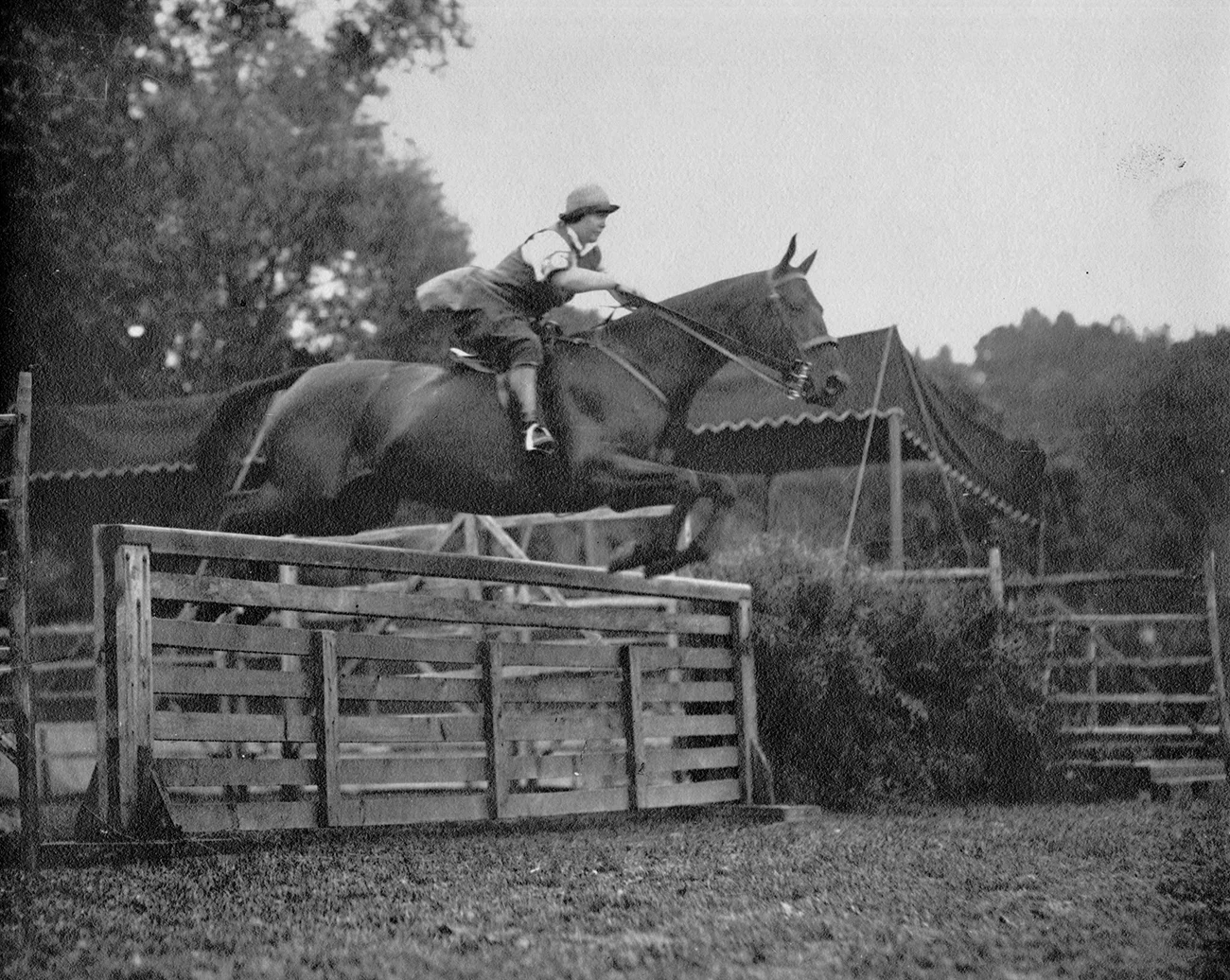
Her strong feelings about that particular trophy were a bit out of character, as very few of her equestrian awards were even displayed publicly in her home.
“She kept her ribbons in a closet downstairs. It was elaborate—it had drawers and doors that opened up to hold everything—but nothing was visible to everyday visitors,” McCray said. “She was really very modest and quiet about all of her successes. She wasn’t ever seeking recognition. She just did her thing with horses—whatever discipline it happened to be—because she just loved everything about them.”
In her late 30s, health issues slowed and eventually ended Poe’s own riding career, but she remained involved in the hunter/jumper world. A number of legendary riders, many of them female, competed Poe’s horses for her.
“When she could no longer ride, she hired prominent riders of the time—mainly women—to ride for her,” McCray said. “ She believed in propelling other women forward.”
One of those women was the legendary Ellie Wood Keith Baxter, who became a dear and lifelong friend. They met on the show circuit; Baxter was one of the nation’s top female riders at the time.
Baxter and her husband divorced at one point and remarried several years later. During their separation, Poe invited Baxter and her son, Charlie, to live at Pebble Hill, often welcoming them to the main house for meals. Poe, who was known for her sense of humor, once played a trick on the two, serving them rubber green beans and laughing with delight as they tried, unsuccessfully, to cut them.
“We were all dressed up,” Charlie remembered. “Coats and tails. And I remember looking at all the elaborate place settings so carefully. I ate everything last, making sure I was using the right utensils for each dish. My mom went right at those green beans, and Aunt Pansy, as I called her, just let out this huge belly laugh. I remember her as a person who often smiled, and who was always so uplifting.”
Poe financed the horse barn at Barracks Way, Ellie’s Virginia farm, and was a great supporter for the rest of her career. Ellie continued to be a regular short-term visitor to and resident at Pebble Hill.
“Those two were more than just employer and employee,” Charlie said. “They were dear friends.
“My mother was a strong woman with a big personality and had ideas and beliefs that were ahead of her time. Aunt Pansy saw that my mother had the potential to be a leader, and so she supported her, investing in her financially and providing riding and training opportunities, so that she could rise to that potential.”
“My mother was a strong woman with a big personality and had ideas and beliefs that were ahead of her time. Aunt Pansy saw that my mother had the potential to be a leader, and so she supported her, investing in her financially and providing riding and training opportunities, so that she could rise to that potential.”
Charlie Baxter, son of Ellie Wood Keith Baxter
McCray said Poe was that way with many of the dedicated horsewomen who crossed her path.
“Miss Pansy was always a cheerleader for other women,” she said. “She was always helping to raise others up.”
Thoroughbreds Across The Pond
When her health grounded Poe, she got involved in owning and breeding race horses, blazing more trails for women in yet another heavily male-dominated environment.
Poe purchased Shawnee Farm in Kentucky, which became her primary Thoroughbred breeding farm in the U.S.
Poe was “obsessed” with Man O’ War, McCray said. The archives at Pebble Hill have fan-girl photos that Poe took of the big red horse, and she bought a number of his fillies for her breeding program. The Pebble Hill archives house all of Poe’s Thoroughbred stall nameplates; many are descendants of the famous racehorse.
Poe was also fascinated by English culture, especially its equestrian aspects. She adopted the English equestrian lifestyle: she was often followed around by a corgi or two, and she had an enormous collection of horse brasses, including one from Queen Elizabeth’s 1956 coronation.
It was only natural, then, that Poe’s involvement in Thoroughbreds would take her across the pond to the United Kingdom. She particularly enjoyed Ireland’s racing scene, and felt strongly that racing on turf was better for the health and longevity of her racehorses. She purchased a farm in Ireland and became more well-known in the Irish racing world than in the U.S.
Some of Ireland’s most well-known jockeys and trainers were under Poe’s employment, including legendary jockey and trainer Rosemary Rooney, who also forged her way in a male-dominated industry. Globemaster, bred by Poe, won the 1961 Wood Memorial Stakes. Another, Young Emperor, won the Gimcrack Stakes (England) and was the champion 2-year-old colt in Ireland and England in 1965, and was honored as Horse of the Year.
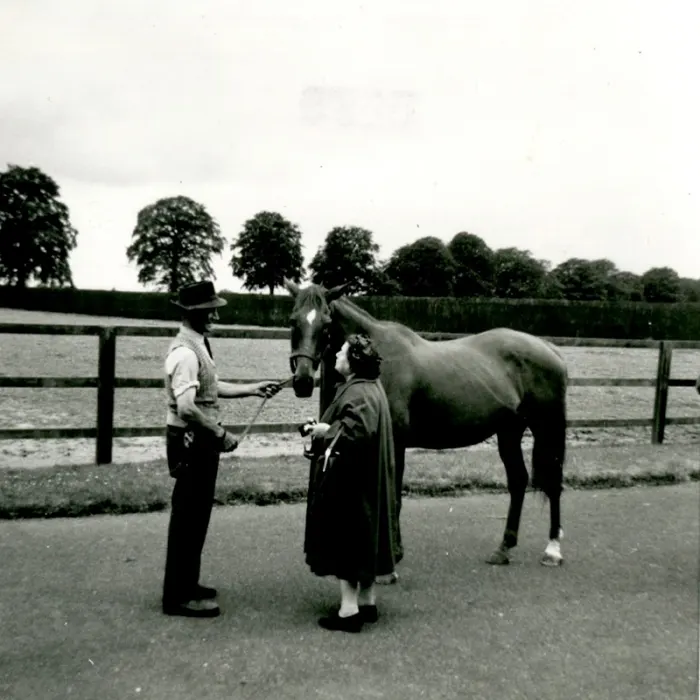
Thanks to that success, Poe was the guest of honor at the Gimcrack Dinner in December 1965 at the Royal Station Hotel in York, England, only the third woman invitee in the 195-year history of the all-male gathering. That night, she was the only woman in attendance. Telling her husband she was “bloody nervous” about addressing the group of 107 men, she asked him, last-minute, to talk on her behalf.
“I’ve never spoken in public in my life,” she said in a 1965 interview with the British Daily Sketch. “I just haven’t got it in me to speak to all those people.”
“For a woman during that time, her success was incredible,” said Curtis.
Poe was celebrated respected stateside as well. In 1958, she was the winner of the Kentucky Thoroughbred Breeders’ Association Ladies’ Sportsmanship award, and in 1972 she was honored by the Thoroughbred Club of America for her contributions to the sport.
She was the first woman named to the board of the Keeneland Association, another pioneering role for women in the male-dominated Thoroughbred racing world.
A Legacy Of Giving Back
Before he passed away, Poe’s grandfather, Howard Melville Hanna, a businessman and philanthropist who amassed great wealth through mining and oil, penned a letter to his children. With the privilege of wealth, he reminded them, comes the responsibility to positively impact other people, as well as the places you call home.
This family conviction passed down through generations and remained strong in Poe.
Having no children, Poe worried about Pebble Hill being split up by developers after her death. She created the Pebble Hill Foundation and willed the property to the public when she died in 1978. The first visitors toured the house and property in 1983.
Poe was also invested in the town of Thomasville, founding and funding the Thomasville-Thomas County Humane Society. In memory of her mother and grandparents, Poe purchased and gifted a historic property to the Thomasville History Center so that the organization could have a permanent home for its collections.
A passionate conservationist, Poe avidly supported local garden clubs and donated property as a space for the groups to gather. When the town’s “Big Oak,” a registered 350-plus-year-old oak tree, was in danger due to the sale of the property it grew on, Poe bought the property and turned it into a public space now known as the Elisabeth Ireland Poe Park.
“Her financial privilege definitely made it possible for her to do so much for others,” Curtis said. “But Miss Pansy was not someone who sought attention for the good that she did. She was very humble. She just wanted to do the things that she enjoyed doing, and help others along the way.”
“She was never fancy dressed,” McCray remembered. “She’d just walk down Broad Street in a muumuu. Everyone knew her. She had to sit on phone books in her car to see over the steering wheel, and she’d drive around Pebble Hill, watching young hunter riders in the jump field. If one did something she didn’t like, she’d honk her horn at them.
“And by the way,” said McCray, “Miss Pansy kept every issue of the Chronicle of the Horse. We have stacks and stacks of them in the archives, from the 1930s to the 1970s.”
The post Polo Pioneer Pansy Poe ‘Raised Up’ Horsewomen Of Her Era appeared first on The Chronicle of the Horse.
]]>The post From Rescue To Ribbons: Gunshot Survivor Finds New Life On The Polo Field appeared first on The Chronicle of the Horse.
]]>After Emily Smedlund lost her Andalusian cross after 11 years together, she decided to rescue another horse to help ease her broken heart.
“I wanted to give something that didn’t have anyone all this love I had,” explained Smedlund, 41, of Cary, Illinois. “I wanted to save a life.”
Smedlund also hoped the horse she found might be willing to participate in her favorite equestrian sport, polo. A member of the Barrington Hills Polo Club in Wauconda, Illinois, for years she had groomed for others in order to get riding time during matches, taking time off from work and leaving her family—husband Michael Tomkowiak and their two young children—so she could get horses ready. Having her own polo horse meant she could pursue her game without having to do quite as much extra work for others.
After browsing on various social media pages, Smedlund’s attention was captured by a gray gelding being advertised by Kaufman Horses, formerly Kaufman Kill Pen, in Texas. He was advertised as around 5 years old and broke to ride; Smedlund liked his conformation and 15-hand size and thought he might be suitable for playing polo.

Smedlund is originally from Oklahoma, and her parents still live there. They agreed to drive down and provide video confirmation that the horse Smedlund was buying matched the horse in the photo. Due to their relative inexperience with horses, when they told their daughter that the gelding was “difficult to catch,” she didn’t think much of it.
“That’s a yellow flag, not a red flag, for me,” Smedlund said. “I had a plan. I had a friend in Oklahoma, an older lady I’d ridden with forever who had land, and she said she could take him in quarantine. Then I had a friend with a trailer who hauls a lot of horses, and she said she could go pick him up.”
On Dec. 5, 2019, the gelding she named Orion officially became hers.
Not long after arriving at his quarantine farm, Smedlund received a call from her friend: Orion was proving too much for her to handle. As Smedlund made arrangements for the horse to finish his quarantine at a professional facility, she wondered what exactly her friend meant. After completing quarantine, Orion spent the month of February with players at the Oklahoma State University polo club in Stillwater, Oklahoma; they also reported his behavior was difficult.
“I kept thinking, ‘He’s supposed to be broke to ride,’ ” Smedlund remembered. “It just wasn’t making sense.”
In March 2020, just as the COVID-19 pandemic was declared, Smedlund headed out to Oklahoma to retrieve her new horse. Upon getting him home to Illinois, she determined he was older than 5, closer to 8 or 9 years. She also quickly realized that Orion didn’t act like a horse who was familiar with human contact. Although he led cooperatively enough, he flinched whenever he was touched, and became nervous when someone approached him.
“He wasn’t quite feral, but he definitely was not super tame,” she said. “He didn’t trust people at all. He wouldn’t even take treats.”
Smedlund spent about a month working with him—handwalking, grooming and, eventually, introducing him to wearing tack and longeing. One day, a friend was available to hold him, so Smedlund decided to try laying across his back. Orion panicked, and Smedlund immediately backed off.
“I decided, ‘This is not a project I can get into right now,’ ” she said. “I didn’t want to end up in the hospital during COVID.”
Through a friend, she found a trainer in Wisconsin to take Orion for three months, after which she assumed he was ready to ride.
“But as soon as I got on him, I could feel he wanted to explode,” she said. “He wasn’t yet a broke-broke, quiet horse. He was a very attentive, nervous horse.”
One day, an experienced friend offered to take Orion on a trail ride, while Smedlund rode another horse. Orion bucked the friend off three times before Smedlund asked her to stop trying.
“I was starting to get afraid of him,” Smedlund admitted. “I’m usually a pretty brave horseperson, but I was nervous. He scared me, and people were getting in my head. They would say things like, ‘He was in a kill pen for a reason; what do you expect? He’s probably broken.’ ”
But Smedlund remembered her original commitment—to save a horse—and was determined to not give up. With her job on hiatus due to the pandemic, Smedlund had the time to work with Orion at a nearby riding facility every day. At first, she could only bear to sit on him for a few strides before she would get nervous and need to dismount. It took months, but gradually she was able to stay on Orion for longer periods of time. By the end of the year, she started stick-and-ball training with him at the walk and trot, swinging a mallet and tapping the ball from horseback, without other horses around.
That fall, she asked one of Barrington Hills’ professionals, Pedro Manion, for his opinion about Orion’s potential for polo. With Manion aboard, the still-green Orion offered flying changes and smoothly performed other basic maneuvers. Smedlund was encouraged.
By spring 2021, Smedlund felt brave enough to bring Orion to “polo school” at her club—mounted lessons during which play is slow as students learn and practice their technique. When her friend Joan-Carles Brugue, an experienced rider who has introduced many horses to the sport, offered to help with Orion, she jumped at the opportunity. Brugue’s assistance with Orion’s training helped to increase both the horse’s confidence and Smedlund’s faith in his future; Brugue and Smedlund ended up sharing Orion for the season.
“He would play him a chukker, then I would play a chukker,” Smedlund said. “That was Orion’s first season, and it was about just getting out there and trying it. But for a horse, who was not even broke the year before, to jump right into polo and be that good at it—I was really amazed.”
Orion’s second involved several tournaments with Smedlund, both on the grass and in the arena, always wearing her signature pink. But as fall approached, Smedlund’s attention was required elsewhere, and she offered Orion to the Oklahoma State University polo club again. This time, the experience was a positive one.
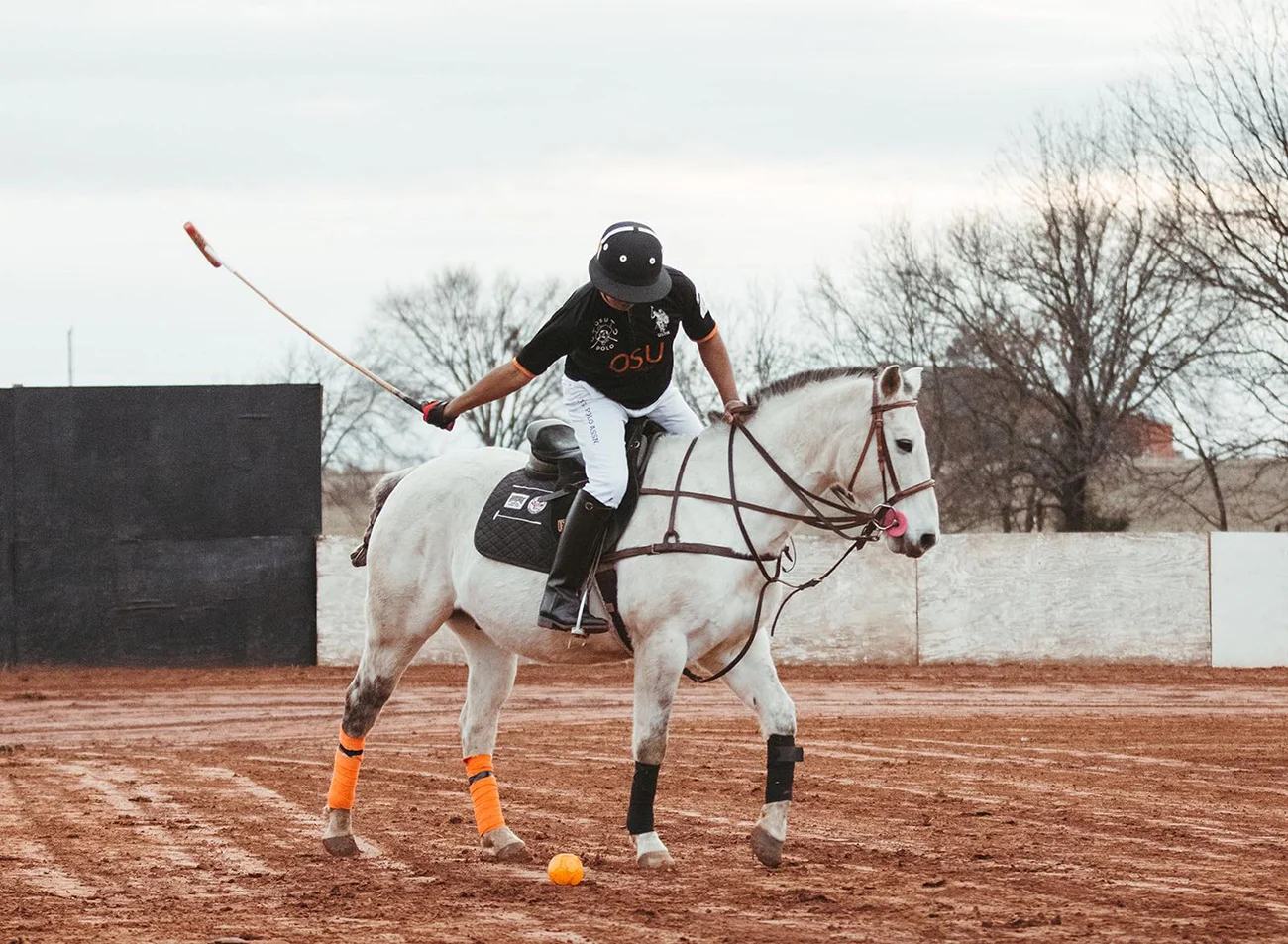
“He was perfect for them,” she said. “He played all their tournaments, including the Fall Fandango, a big arena polo exposition in Texas. He did everything they asked him to, even carting around beginner students. And this was just his second year into polo.”
When Orion returned to Illinois last spring, Smedlund was ready to set some bigger goals with him. He became a regular participant in the Barrington Hills Polo School, even serving as a mount for a physically disabled rider. His confidence on the grass polo field—a venue in which he had still retained some nervous energy—seemed to be increasing. And with each positive experience, Smedlund realized that her own fear was resolving.
“It was like, I’m not afraid of you,” she recalled. “I get you: You are a very sensitive kind of horse, but you’re not a bad horse. I don’t care what these people say about your past—you have put that abuse behind you. You’re trusting me and trusting the people in my life.”
Concurrently with his growth on the polo field, a young woman named Maya Samlan, who helped at Smedlund’s barn in exchange for riding time, asked if she could teach Orion how to jump, and later that year took him to a horse show.
“There were flower boxes, and colors, and people sitting on the bleachers, and horses calling, and he was like, ‘You want me to do this, we’ll do it,’ ” Smedlund said.
He was equally accommodating when Smedlund took him to the biggest event of their career together, the LeCompte/Kalaway Trailowners Cup, a fundraising tournament hosted by her club each year.

“It’s a big event with hats and tents and cars and people everywhere,” Smedlund recalled. “But he didn’t bat an eyelash. He just went in and did his job, and was stoic and calm the whole time. It was like he knew it was important, and stepped up.”
Despite his growth, Smedlund doesn’t think Orion will never be a totally calm horse, and she said she still longes before she gets on, especially if he’s had a few days off. He doesn’t respond well to any sort of rough handling, yet he proved totally trustworthy the day her 10-year-old daughter wanted to play stick and ball with a friend.
“He’s coming around,” Smedlund said. “He does give his heart, and he is trying to trust people. He tries really hard for the people who are trying to give him a chance.”
This fact was driven home when she learned that, at some point in his past, Orion had been shot and still had a bullet lodged in his body, below his right knee. It was discovered by accident, when an x-ray was required for an unrelated injury (and as it seems stable, Orion’s veterinarian decided to leave it in place).
“That, to me, was a testament to how much he’d been through with people, and how much he probably shouldn’t trust people, because they were bad to him,” she said. “At some point, he was shot—but he is still willing to be OK and listen to me.”

Smedlund believes that Orion’s story is common and hopes that sharing it may inspire others to take a chance on a “thrown away” animal.
“I think he was a horse that didn’t have a job, that was in the loose pen when he was auctioned, and they realized he was a little weird, and not broke, so he got tossed around and abused, until he got to the point where he literally was not something anyone wanted,” she said. “But I’m so glad I gave him a chance, because look at him now. He’s a great horse. He’s competitive, he’s fun, he’s great to my kids and my friends. He’s everything I wanted in a polo horse.”
“I think that for these horses that don’t have a person, or have a rocky fate of possibly being slaughtered,” she added, “to give them a chance is so important.”
Do you know a horse or pony who has been rescued from a dangerous situation to become a healthy, valued competition partner today? If you think you have a good candidate for “From Rescue To Ribbons,” let us know by emailing mwright@coth.com.
The post From Rescue To Ribbons: Gunshot Survivor Finds New Life On The Polo Field appeared first on The Chronicle of the Horse.
]]>The post Jonathan Sheppard On Love, Loss And Winning appeared first on The Chronicle of the Horse.
]]>After a hard crank of the steering wheel to the right, the truck reverses, pivots, and we’re suddenly facing the opposite side of what is referred to as the “Hundred Acre Field” on the grounds of Ashwell Training Stables, an hour or so west of Philadelphia. The undulating landscape is covered by the brilliant green meadow grass of early summer, interrupted only by the occasional tree. A small stream divides the field, the far side being reserved for fast works and the area on our side used for conditioning.
“Do you see them?” Jonathan Sheppard asks me. “Do you see the horses anywhere? Ah, yes! There they are! It’s quite different, isn’t it? From the racetrack?”
Talk about an understatement. Silently, we watch a set of three Thoroughbreds gallop single file across the far ridge, turn and race down the hill toward us where we sit idling in the middle of the field. Leaning out the open window, his eyes trained on the horses, he absentmindedly asks me in his Anthony Hopkins-esque accent, “What is this article about again?”
I remind him it’s for a Living Legends feature in the Chronicle’s Steeplechasing Issue. With this, the dapper and elegant Sheppard swivels back to face me and snorts, “A legend? I’m not dead?!”
|
Sheppard’s Statistics Inducted into National Museum of Won first race in 1966, won last race in 2020 Trained 11 Eclipse Award-winning horses to 15 total championships NSA All-Time Leading Trainer by Earnings NSA All-Time Leading Trainer by Wins Earned 1,000th race over fences in Trained eight NSA Horses of the Year Trained Hall of Fame horses |
“Well,” I respond, “it’s a lot easier to interview someone if they’re still alive.”
Sheppard pauses a beat, his blue eyes holding mine, measuring my response, and then he throws back his head laughing. “Well, that is a good point,” he concedes.
He turns his attention back to the horses, and as they approach, the exertion of galloping up and down the hills can be heard on their breath. They will make two to three large figure-8s in this field, each shift in their direction forcing a change in ours, the truck again rotating in reverse. We wait and watch until they finish their works and their riders confer with Sheppard.
He sticks his head out of the truck window again and queries each rider in turn, “How did they go today?” following up with specific questions about each of the mounts, knowing where they’d left off the day before, who had rested, and what needed to be accomplished today. This type of interaction with his staff (of which there are 80) and his horses (150) continues throughout the entire day, intersecting our conversation and illuminating the essential truth about Jonathan Sheppard: The horse always, always, always comes first.
This passion, obsession—whatever one chooses to call it—defines Sheppard’s life. It is his life, and yet, for all the success this multi-Eclipse Award winning, Hall of Fame trainer has known, he’s also experienced episodes of extraordinary heartbreak, rife with emotional hurdles much more challenging than those dotting the steeplechase track.
A Childhood Ambition
As Sheppard admits, such single-minded dedication to his lifestyle and career comes with its price.
“It may have cost me two marriages. My father, a pretty old-fashioned, traditional English gentleman, used to be somewhat critical of the fact that I am not a better husband, and eventually he said, ‘I think I’ve figured out why: You’re really married to your job more than anything else. That’s your first priority,’ ” Sheppard says, then pauses. “And that’s not really something to be too proud of, but it’s hard to have one without the other. If you want to do really well at something, you have to give up something in another area a little bit.”
Sheppard is one of two trainers to win Eclipse Awards for both flat racing and steeplechasing. His devotion to the sport and his equine athletes has resulted in numerous Eclipse Awards as an owner, countless others as a trainer and entry into the Racing Hall of Fame.
Growing up in England as one of four children and the son of a racing official, Sheppard, now 73, was passionate about racing and as a young boy idolized jockeys. While other children were dreaming about becoming football players or firemen, Sheppard was plotting a course to become a jockey or trainer. At the age of 6, he found encouragement to pursue his passion from a most unusual source: the Queen of England.
“We had a governess, and she was trying to encourage me to write and showed me an article in the newspaper about Princess Elizabeth, who is now the Queen of England,” he says. “She had a couple of race horses of her own and had had a winner. So, with a bit of prompting, I wrote to Princess Elizabeth at Buckingham Palace, congratulating her and telling her of my interest in racing. I got a letter back from her, written by her Lady-in-Waiting, saying, ‘Her Majesty has instructed me to thank you for your nice letter, and she’s most interested to know it’s your ambition to be a jockey when you grow up!’ ”
Sheppard adds, laughing, “It’s not very often some 6-year-old boy writes to a princess and even more unusual to get a letter back saying how interested she is!”
After attending Eton College and trying a brief and soul-draining job in the stock market, he circled back to his childhood ambition of a racing career. He left England and his family for America at the age of 19, bouncing around and staying with distant relatives. Sheppard worked as an exercise rider and a jockey at various farms until his path crossed with his soon-to-be mentor, Burley Cocks. After three years of a sort of apprenticeship with Cocks, Sheppard was musing over his next step with a friend who was visiting from England.
“I told him I was anxious to get into training, but I didn’t really have any potential prospective horses or owners,” Sheppard says.
They were at the track in Saratoga, where the friend noted the steeplechase course differed greatly from those in England. As Sheppard recalls, “He pointed out the hurdles in Saratoga were on the inside of the turf course, a very tight little track only about 7 furlongs around with hard ground and smaller jumps, the opposite of what you find in England.”
They noted that the prize steeplechase horses in England are larger, sturdier mounts and that the smaller, quicker horses don’t have much value over there. That’s when a light bulb went on: They might be able to cheaply pick up a few of these European castoffs and race them in America.
In no time, Sheppard and his friend had a business—the latter fronting a bit of money to buy the horses, and the former training them and selling them for a profit.
The Luck Of Opportunity
Sheppard and his first wife, Penny, traveled to Europe and with the help of a bloodstock agent, selected six horses to bring back to the States. Of those, two were later purchased by George Strawbridge, Jr., as part of the wealthy financier’s first foray into race horse ownership. One horse didn’t amount to much, but the other was a big success, winning 21 races and setting into motion a legendary friendship and business partnership spanning some 47 years.
To this day, Strawbridge remains Sheppard’s biggest owner, one of his dearest friends and godfather to his daughter, Diana Sheppard.
“Other than his honesty, he is a very kind man and very conscientious,” says Strawbridge. “He does everything himself! He schedules the horses! He does the bills like Charles Dickens did—by hand! He does! Honest to God! He is the only person I have ever gotten handwritten bills from—and they are very legible.”
“I’ve been extremely fortunate,” says Sheppard, “because however good you are, you can’t do it without the horses, and you can’t really get the horses if you don’t get the owners, so I’ve always maintained that yes, there is luck in it: The luck is getting the opportunity. Once you have the opportunity, then I don’t think it is luck. It’s up to how good or bad you might be. But I was presented with opportunities, more than I probably deserved, and more than most people have been. I couldn’t have done it without that.”
A Career’s Cost
But beyond the wins and achievements, there’s another story of what’s happened to Sheppard—in the spaces between the early morning workouts and afternoon racing, the things that he sacrificed, the casualties of his workaholic tendencies.
“I think he’s a very complicated man who has had a complicated personal life, and I’m sure a lot of that revolved around his drive to succeed,” says Sheppard’s friend and protégée Graham Motion, trainer of Animal Kingdom, the 2011 Kentucky Derby and 2012 Dubai World Cup winner. “It’s not easy to balance—training is a 24-hour-a-day, seven-day-a-week job, and I think to be as committed as he has been for his entire life takes an extraordinary amount of your time and your energy, and you don’t really escape from it, quite frankly. It is difficult, especially on the scale that Jonathan does it, and it’s extraordinary that he has done it so well for so long.”
We’re still in the truck, now bouncing down the dirt road that connects the Hundred Acre Field to his house. We pass the horses making their way back to the barn, walking along the grassy shoulder on a loose rein, sweaty and as calm as children’s ponies, and three more heading out. He points out other structures on the property, a magnificent fieldstone main house, cottages, barns, an indoor ring, gesturing and explaining that at one time, it was all one farm belonging to his first wife’s grandparents.
Sheppard and Penny divorced after 14 years of marriage and two children.
His mood shifts abruptly, and he suddenly seems vulnerable and apologetic as he shoulders part of the blame for relationships gone awry.
“I think she thought her life was too boring, just following along in my shadow, my footsteps, because by that time I was doing quite well, and she was just kind of known as ‘Jonathan Sheppard’s wife’ and wanted to do her own thing or something. I don’t know what it was exactly,” he trails off, pensive. “[The divorce] was not easy, you know. And not my idea.”
Sheppard remained on good terms with his mother-in-law, even moving into her house, also on the property. He chuckles now at the memory, saying, “So I moved out from my wife and in with my mother-in-law!”
But the melancholy creeps back in his voice as he continues.
“It was extremely hard,” he admits. “And when we first got divorced I said, ‘I am never going to have a relationship with another woman again,’ but eventually, after a longish period of time, maybe a year or something, it suddenly dawned on me, ‘You know what? I’m still quite young. I’ve been given my freedom back, I can do what I want, and maybe it wasn’t such a bad thing.’ ”
Diana was about 10, and her brother, Daniel, was about 12 at the time of the split. The family remained close, if not by vows then by proximity, with Sheppard and his ex-wife sharing parental responsibilities, the bulk of which fell to Penny.
Now adults, Diana and Daniel still live within miles of their parents.
“They all did quite well, under the fact; you know how broken marriages are,” says Sheppard’s friend and business partner of 46 years, Bill Pape. “It’s not easy, but he worked hard to see that they did well.”
More Trials
We now hop out of the truck, leaving it parked in Sheppard’s dirt driveway surrounded by birdhouses, evidence of his love of animals beyond horses. He leads me into his house and motions for me to sit down at the cluttered kitchen table. Orderly stacks of magazines, bloodstock catalogs, files and books surround us. Perched on these are dozens of framed family snapshots of Sheppard as a young man and his children when they were little, and on the walls hang photos and news clippings.
“Where were we?” he asks. “Oh right….” Unexpectedly, our conversation picks up the personal thread where we left off.
Despite Sheppard’s pronouncement of never getting involved with another woman, he soon married his second wife, Mary. After spending a good part of their relationship living apart, even after the birth of their son Parker, the two eventually decided to give cohabitation a try. Mary brought not only their son but also her horse, pony and Sicilian donkey, but the arrangement didn’t last. Pregnant again, Mary moved with Parker to Kentucky shortly after to help care for her ailing mother.
The couple’s second son, David, was born soon after, but the marriage only lasted about 18 months; like any relationship, it was filled with highs and lows, but, as Sheppard recalls, “We had a lot of fun together.”
Sheppard visited Parker and David when he could and kept up with Mary until, at age 47 in 2005, she died from a heart problem.
“She’d had two or three spells where she just sort of collapsed, and they weren’t sure if it was exhaustion from her registered nurse schedule or something more serious, so she agreed to have a proper check-up following the Christmas holidays, after the boys went back to college,” Sheppard recalls. “They had both been home for Christmas break from their school in Durango, Colo. She was found dead in her bed on Jan. 5, 2005.”
He taps a pen absentmindedly on the table, flipping it end over end. Flip, tap. Flip, tap.
“So now I’ve got these two college-age boys living in Colorado, and I’m here, and no mother. And then… Um…”
He pauses and then exhales.
“The oldest boy was killed. Parker was killed.”
Tragedy After Tragedy
It was Halloween 2006, and Parker, who was then 24, and David, 22, were attending college in Durango, living in a house together outside of town. They went out to celebrate the holiday, reserving a taxi as they knew they would be drinking. After some time, David called it a night and caught a ride home with a friend.
Parker had been chatting with a girl, and they headed to another bar, at which point they met a group of firefighters who asked Parker if he could drop them back at their hotel, as they didn’t have a car. Parker agreed, but about halfway to the hotel the firemen wanted to stop and eat.
Parker reluctantly obliged but, as Sheppard recounts, “They were really being a nuisance, and Parker was getting pissed off at them. They got into an argument, and this one big bruiser, a 6’5″, 220-pound fireman, cold-cocked my son, and he fell over backwards and fractured his skull on the sidewalk. He never regained consciousness.”
We sit in silence for a moment, and when Sheppard speaks again, this time his soft, lilting voice is loud and shaking with anger.
“You know what they did? These people? These people who knew better, because they teach firefighters paramedic skills? They were hoping it was just that he had too much to drink and would suddenly come out of it,” he says. “Instead of calling 911, they took him back to their motel room! And laid him on the bed for about two hours! So it’s possible, if he had immediate attention to it, it would have made a huge difference.”
Parker was eventually medevaced to Denver, where he remained on life support for two weeks until it was determined there was nothing else to be done. Shaking his head, lost in the horrific memory, Shepard whispers, “It was a nasty experience and so tragic.”
As hard as it was on Sheppard and his other children, it was most devastating to David.
“To lose his mother and brother like that, so close together, in less than two years—it’s been very difficult on him,” says Sheppard. “But he’s doing much better and has started his life over in Taos, N.M.”
Sheppard pushes his chair back, steps over to the shelves and starts passing me framed family snapshots, one after another, continuing to reminisce. There’s one of Parker as an adorable dark-haired little boy, one of Daniel, another of Diana, David and Parker as young adults on a college visit, and several of his current wife of 25 years, former jockey Cathy Montgomery Sheppard. There’s another of a younger Jonathan with his siblings and mother.
Pointing at the laughing group in the picture, he says, “These are my two brothers and sister with my mother when I was visiting England. My brother, Gurney, was always goofing around, and my mother was always telling him to be sensible.
“Anyway,” he continues almost matter-of-factly, “he died, as did my sister.”
Sheppard stares at the photo for another moment and places it back atop the stack of books. Their deaths occurred about five years ago, he says, around the same time as Parker’s. His brother was one of 150 people to die from Mad Cow disease, and his sister from breast cancer. Their mother’s death followed not long after.
The mood is now somber, but with a small shake of his head, Sheppard suddenly seems to return to the present.
“So anyway, this is pretty morbid,” he says. “We’re supposed to be talking about my horses.”
A Lifetime Of Achievements
With that, he turns and opens the door of the kitchen.
“I should mention, even though I’m married, I live on my own,” he says.
Cathy lives year-round at their house in Florida where she has her garden and animals, and Sheppard joins her after the summer meets end.
“Because of this, I just kind of dump stuff in here,” he says. “It’s not tidy, of course.”
The door opens a portal to another world. We step into a large living room, circa 1730, with a low-beamed ceiling and a big fireplace.
It isn’t that it’s not tidy; it’s merely no match, despite its size, for the bountiful treasures it holds. There’s no surface—walls, floor-to-ceiling shelves, tables, even the floor—not covered with trophies, silver cups, platters, Eclipse Awards. On the floor, stacked side-by-side, some 300 framed stakes win photos lean against couches and tables; there’s simply not wall space enough to display them. It’s an overwhelming visual representation of a lifetime of achievements.
Still reeling a bit from the personal tragedy this reputedly very private man has just shared and wanting to lighten his mood, I ask him to tell about his favorite horse. I’m met with silence so I give him an out and tell him he can pick three.
His blue eyes dance, and without missing a beat he smiles and answers, “Storm Cat, Flatterer and Forever Together. And not because they were so successful, but because of my respect for them as athletes. You know, you have to be good, and you have to try really hard. And they did. And they all had very different temperaments.”
Always The Horse First
Sheppard’s astonishing triumphs as a trainer are only eclipsed by his complete devotion to his horses. Just last month, he rounded up a few people from his staff and visited Flatterer to celebrate the horse’s birthday. At age 34, Flatterer is the oldest surviving Hall of Fame Thoroughbred.
After a quick glance at his watch, Sheppard announces it’s time to return to the field and watch another set of horses train before he needs to leave for the afternoon races at Delaware. We hop back in the truck and make a quick detour to the barns, going first into the mare and foal barn. He leads me to one of the stalls, opens the door and gestures for me to enter. A beautiful bay mare with a kind eye stands quietly, taking me in, and curled up on the straw near her hindquarters is one of the tiniest foals I’ve ever seen.
“Go ahead, go in, he’s very friendly. He’s only about half the size he should be because she was pregnant with twins, and mares aren’t supposed to have twins; there isn’t room for them,” he says. “The other one was born dead, and this one is real small. I probably shouldn’t have kept him; he’s not going to be able to race. Everyone kind of feels sorry for him and has made a bit of a fuss, so he’s particularly attuned to people petting him. His nickname is Tadpole, but I don’t think it’s a very nice name. The first three to four days he couldn’t even get up to nurse; they had to lift him and also feed him with a bottle.”
Tadpole is now two weeks old and the size of a small fawn, so little I could easily pick him up. He lies in the straw, letting me stroke his face, his ears, his muzzle, eventually unfolding his spindly legs and haltingly standing up to nurse.
Tadpole’s story doesn’t surprise Strawbridge. “Sheppard believes if you’re living, you have a fighting chance to be good,” he says. “That’s it. He is a great, great supporter of the underdog, and I can just see him loving this weakling foal—he’ll love it forever. Oh my goodness gracious, but that is typical of him! You saw something absolutely that is true. And unusual.”
Laughing, he continues, “Last year I sold 15 horses, and most of them were out of Jonathan’s barn. Of the 15 he bought four of them back; I swear to God. He can’t let go!”
Strawbridge can’t stop laughing now, charmed by his friend’s devotion. “Absolutely, he loves them,” he adds. “He loves them whether they’re champions or maiden claimers. He just loves the animal.”
Pape concurs, “I think he’s enormously patient. He sees the best in the horse, and he really takes care of his horses. He doesn’t—in any way—overextend them and is totally devoted to them. And the evidence of that is by his behavior and his daily work ethics.”
A key distinction in the Sheppard training method, beyond galloping and working his horses in the open field and jumping them over natural obstacles on a trail weaving through the woods, is the unwavering routine of morning turnout prior to working the animal.
Motion considers the five years he spent working under Sheppard “the equivalent of going to college for me, and I’d say—very much—that my career has been modeled after his philosophy. Jonathan is always all about the horse and about getting the horse to settle and relax. I don’t think there are many trainers left who are real horsemen like Jonathan. He turns his horses out religiously, and I’ve tried to duplicate that as much as I can.”
Fellow Sheppard protégée and Hall of Fame trainer Janet Elliot agrees: “I have a huge amount of respect for him. He is a tremendous man and a tremendous horseman.”
Sheppard, ever humble and a bit reluctant, eventually concedes his friends and colleagues may have a point.
“Well, I suppose I kind of thrive on horses that are a little bit more of a challenge,” he says, “maybe getting something out of a horse that someone else couldn’t.”
Perhaps, under the love and guidance of Sheppard, this little weakling foal will one day surprise us all.
Passing It On
What does Sheppard hope his legacy will be?
“It sounds trite, but that maybe I made a difference in some way?” he says. “There are a lot of people involved in racing now that came through the stable here at different times or have gone on to train or be involved in some aspect of the horse business and, hopefully, use a little bit of the same philosophy. Not that it’s a huge mantra that’s written down or anything, but just the fact that you know, to get the best out of a horse, you have to see the best in the horse. How to put the horse first, how to take care of the horses, how to be responsible for them when they’re getting towards the end of their career or their career is over; we try to find good homes for them.”
He stops for a moment, thinking, and says, “I think we try to keep the horse in as close to nature as you can, which a lot of people don’t, necessarily, and I think if people can see it’s possible to be successful being kind to the horses, being patient, not being too greedy, not using more medication than is essential just for normal ailments and things, not cheating. I try to be pretty transparent.
“I think to be a successful trainer it’s several different things: It’s not someone who gets the horses fitter than somebody else,” he continues. “You have to be good at communicating with your owners; you have to be good at dealing with your help and staff.”
And, of course, you have to be good to the horse. Sheppard pauses again to ruminate.
“Consistency. I think consistency is the mark of success, and if you can do something well for a long time—not that you are necessarily the best at any given moment or any one year—but over a long period of time, if you have consistently done well at a top level, that would be something I would be proud of and would hope to continue to do.”
“You Gotta Like Him”
Sheppard’s kindness and generosity extend to those who help care for his beloved equine athletes. Bob Bailey has been working for Sheppard for 42 years, starting one year after Sheppard set up shop. As Bailey describes it, they were introduced by a mutual friend one day at the track when Bailey was looking for work following an injury that prevented him from further riding.
“Jonathan invited me to come up and take a look around, and if I liked it, I could have the job, and if not, no hard feelings,” he says. “That was a Sunday. I started work the next morning, and I’ve been here ever since.”
Bailey is now at the age where he’s slowing down a bit, and I find out—quite by accident—that he lives in a house on the property purchased for him by Sheppard. Bailey still pitches in around the farm, doing whatever needs to be done.
“Jonathan is such a good horseman. I mean, you gotta like him. He knows what he’s doing,” Bailey says, “and he treats me as good as gold.”
I ask Sheppard what he would be doing if he wasn’t a trainer, and we circle back to his old friend Bob.
“Twenty or so years ago, a little store in town started carrying lottery tickets, and Bob was one of the first to purchase one, and as such, was asked what he would do with the money if he won,” he says. “His answer? ‘The same thing I’m doing now—playing the ponies and chasing women.’ ”
The hour has come for Sheppard to head to the track and play the ponies; he has two runners in the afternoon races at Delaware. The truck slows to a crawl one last time, keeping pace with the final exercise rider on the back of a gorgeous bay returning from the Hundred Acre Field.
“How was he today? How did Parker’s Project go?”
I give him a quizzical look.
“Yes, he’s named for my son,” he says. “At the time of his death he was co-authoring a math textbook. He was brilliant at math. That was the project he was working on when he died, so I named this horse Parker’s Project, and he’s quite a good horse. He won a stakes race in Saratoga two years ago, steeplechase.”
Clearing hurdles, jumping life’s obstacles one at a time, Sheppard steadily moves through life and racing with elegance, perseverance, grace and humility, always believing the best is there to find—in horses and in life—if one just looks hard enough and is patient.
This article originally appeared in the July 29, 2013, issue of The Chronicle of the Horse. You can subscribe and get online access to a digital version and then enjoy a year of The Chronicle of the Horse and our lifestyle publication, Untacked. If you’re just following COTH online, you’re missing so much great unique content. Each print issue of the Chronicle is full of in-depth competition news, fascinating features, probing looks at issues within the sports of hunter/jumper, eventing and dressage, and stunning photography.
The post Jonathan Sheppard On Love, Loss And Winning appeared first on The Chronicle of the Horse.
]]>The post Side-Saddle Appaloosa Spotted At Upperville appeared first on The Chronicle of the Horse.
]]>“This was my first time at Upperville,” said his owner and rider Erin Stormont, who was delighted to come home with a red ribbon to commemorate the occasion. “As a hunter kid growing up, I had always wanted to show there but didn’t have the resources to participate, so Upperville in particular has been on my bucket list for a long time.”
In “Finn,” a 15-year-old gelding (Straws Mighty Magnum—R Rumor Has It) she’s owned for the past 10 years, the Locust, North Carolina-based trainer and owner of Storm’s Haven Farm found the ideal partner.
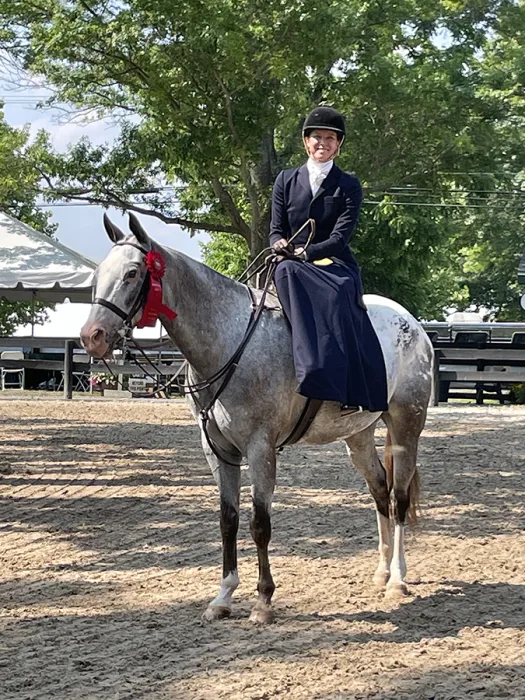
Stormont got the gelding from a young woman who was going through some life transitions and needed to find him a home quickly. After discovering his willing nature and innate athleticism, she decided to dig a little deeper into his background and connected with several more of his past owners. She discovered that Finn was also previously owned by a close friend of her aunt’s, in addition to being used as a lesson horse down the road in Mebane, North Carolina.
“There’s a whole community of people who have known and who continue to love and follow Finn,” Stormont said. “It’s been really amazing to see it grow over the years and have people comment on Facebook whenever they see him and share their memories of him.”
In their decade together in North Carolina, Stormont foxhunted with Finn for years, riding him to whip-in with the Mecklenburg Hounds, as well as eventing with him and using him in her lesson program. In 2019, Finn was crowned champion at Tryon International’s Festival of the Hunt Field Hunter Championship, and he’s a regular outrider horse for the prestigious Queen’s Cup Steeplechase in North Carolina, where he recently celebrated his 15th birthday.
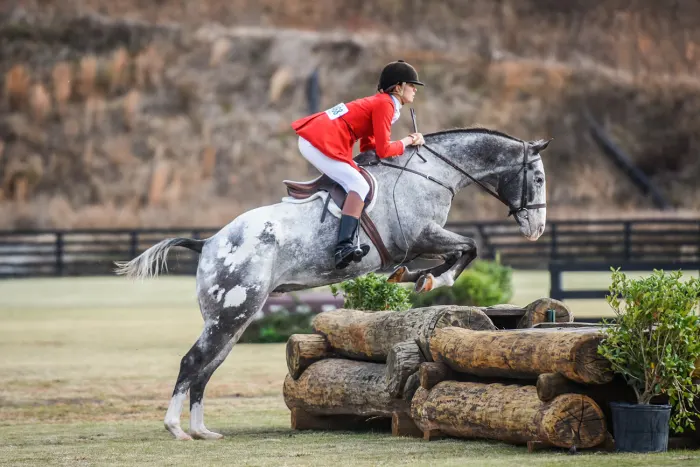
Finn’s jumping days ended when he was diagnosed with degenerative suspensory disease, but that does not prevent him from participating in another of the pair’s pursuits, side-saddle, which Stormont was introduced to via a camp put on by the Aiken Ladies Aside club in South Carolina.
“I went down there for a week one summer and had an absolute blast,” Stormont said. “Once I got Finn in the barn and saw how sweet and willing he was to try new things, I thought he might make a perfect side-saddle partner, and I was right.”
The gelding’s side-saddle debut was in 2019 at the Aiken Horse Show, where the pair finished as reserve champions.
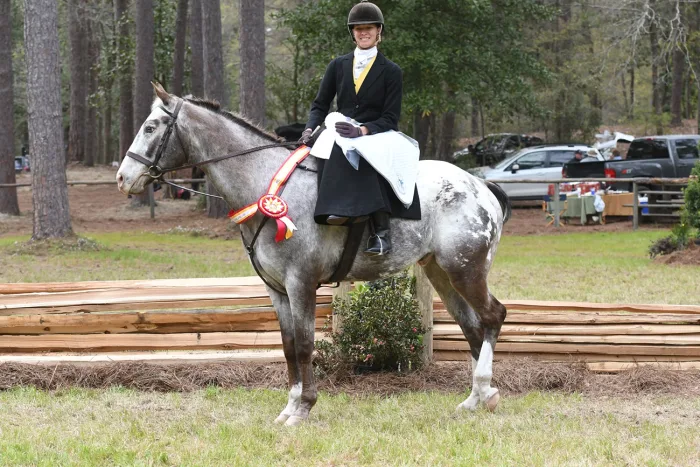
“I hadn’t really even planned on doing it with him, but my friend asked me to come so they could make the numbers; I even borrowed her outfit,” Stormont said. “It was so special. He won the hack, and it was the last show where we were able to jump over fences before his diagnosis.”
Now, the pair are ticking shows off Stormont’s bucket list—and doing it aside. Last year, they took on Devon (Pennsylvania), and she has her eye set on the Warrenton Horse Show (Virginia) side-saddle division next year.
Both horse and rider enjoyed Upperville’s unique atmosphere, Stormont said. For the occasion, her student Ellie Burton lovingly braided a fake tail into Finn’s naturally short Appaloosa tail.
“We had to keep it wrapped up until we were at the in-gate, and I think Finn had a lot of fun swishing it around while he had it in,” Stormont said.
When Stormont outrides Finn at the Queen’s Cup, she also does it aside.
“We’re out there on the race course in full side-saddle regalia, including the top hat and veil,” she said. “He absolutely loves the attention; he’s just naturally drawn to people and always wants to make new friends. I love seeing him interact with the crowd.”
Finn enjoys having a job and being around people, so Stormont plans to keep him doing what he’s comfortable doing, and then he’ll have a home with her for the rest of his days.
“I tell everyone that Finn is my adult pony,” she said. “I can take him literally anywhere and have fun with him. He’s so special; he’s my real life unicorn, and I’m just so lucky he’s my partner.”
The post Side-Saddle Appaloosa Spotted At Upperville appeared first on The Chronicle of the Horse.
]]>The post 2021 Holiday Pets Gallery appeared first on The Chronicle of the Horse.
]]>
Dash and George Clooneigh are “mini mental health ambassadors that regularly visit residents and frontline healthcare workers at senior living facilities, many of whom have had a really tough time throughout COVID,” says Tracy Starchuk of Calgary, Alberta, who submitted this photo. Photographed by Megan Hutchinson
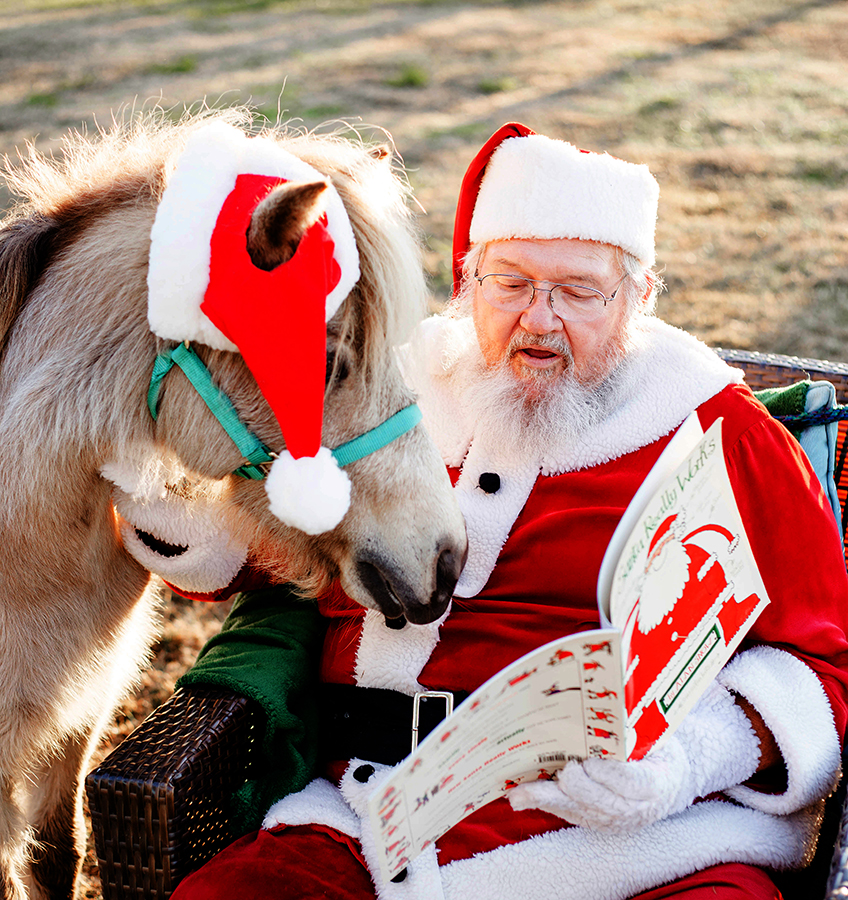
Doc listening to Santa Claus read a Christmas story, Devers, Texas. Submitted by Sara McNeil; photographed by Shelby Wittie
Aidan, Oneonta, N.Y., with a Christmas toy. Submitted and photographed by Joy Dunn
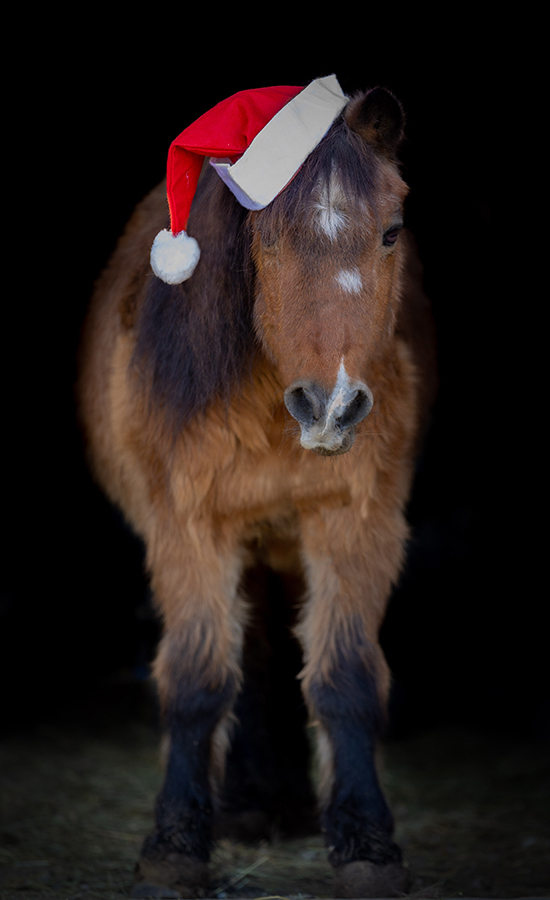
Sporty has got the perfect coat to get him through a cold winter season in Whitewood, S.D. Submitted and photographed by Amber Christians of Prairie Thunder Photography LLC
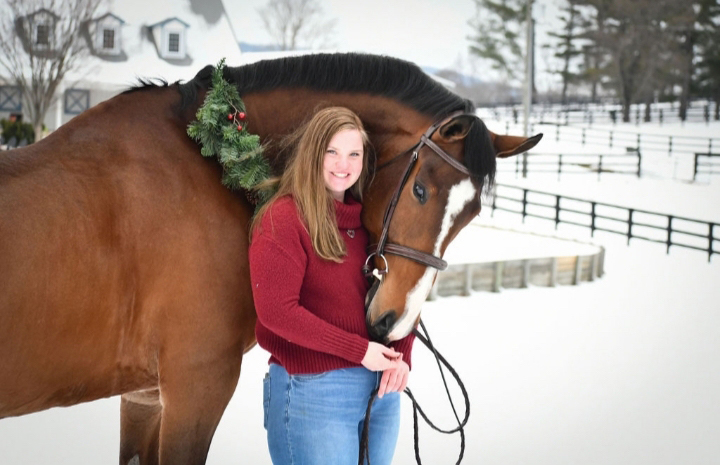
Caroline Warren and Beau Bichon are full of holiday cheer in Hillsboro, Va. Submitted by Deb Bowers; photographed by Madeline Gammill Photography
Who needs a tree? Jack Russell Terriers Berkeley Sophie (Windermere Tally Ho) and Madeleine Marie (Lilliput Full Cry) look extra festive with ornaments adorning their collars. The two are owned by Father Michael Tang of Whittier, Calif. Photographed by Julie Hopkins of Camera Creations

Kathy Boyle of Canter Haven Farm in Utah sent this photo of her corgi/minion-inspired holiday photo shoot. Hannah is in the sleigh and Winston is the reindeer. Photographed by Ash Boyle
Casablanca is dressed for the season in Cross Roads, Texas. Submitted and photographed by Erin Tinnerman
Charlotte and Julia Murray with their holiday-ready ponies Sissy and Duchess, Exeter, R.I. Submitted by Heather Murray; photographed by Emma Guillot
Christine Leafdale and wreathed Wi Degro look ready for the festive season in Mount Vernon, Wash. Photographed by Alyssa Hamedi
Isabella Pina and Jagger enjoy a sunny Christmas in Delray Beach, Fla. Submitted by Shannon Pina
Cooper, West Chester, Pa., is reconsidering “Jingle Bells” as a holiday favorite. Submitted by Lisa Lee
Sharon Hirsch took this photo of Sweet Coraline, her 8-year-old Connemara, posing with a carrot and apple wreath, “before it got all eaten” at Rivendell Farm in Durham, Conn. She said, “I had planned a ‘normal’ photo, but, Coraline being Coraline, gave me a big smile, and I grabbed the shot.” Submitted by Sharon Hirsch
Donovan asks, “Do you hear what I hear?” from his front door in Horsham, Pa. Submitted by Elisaabeth Williams

Dozer, Lilo and Fergie, owned by Whitney Brunner in Chesapeake, Va., might not be bearing gold, frankincense or myrrh, but they’re still three smart pups. Submitted and photographed by Catherine Michele Photography
Mary Mockus shared this photo of Dude and Babe, her rescued German Shepherds, on the lookout for Santa Claus in Novato, Calif.
Ella and Lucinda B. with Winnie, Mass. Submitted by Katie Bowles; photographed by Barbara Konieczny
Fabio is waiting patiently for his presents under the Christmas tree in Orland Park, Ill. Submitted and photographed by Marian O’Brien
For Your Love, “Lily,” posed for her festive glamor shot in Easton, Md. Submitted by Kerri Ginn; photographed by Tom McCall Photography
Greta and Mateo look like they are watching the chimney of their Alexandria, Va., home vigilantly, waiting for Santa’s arrival. Submitted by Karen Rudolph
Susan Garvey submitted this photo of her Gulfstream looking like he’s ready to help Santa build some toys. “Gus” lives at Cedar Ridge Farm in Quakertown, Pa.

Gum Tree Lane, “Artax,” of Wildwood, Mo., was the cover horse for our December 2021 issue. Submitted by Crystal Marshall; photographed by Irina Hulse Photography
If Harlow looks familiar, you may have seen her in past Chronicle Holiday Pet Galleries. The 8-year-old Pembroke Welsh Corgi belongs to Brooke and TJ Schneider of Phoenixville, Pa.
Holly the horse and her canine companion, Lunabear, having a secret chat with Santa in Creedmoor, N.C. Submitted by Elizabeth Cozart, photographed by Nancy Hight
Julie Kjellberg says her horse Holy Mackarel was a perfect model for his holiday photo shoot. “Amos” is a Dutch Warmblood gelding. Photographed by Morgan & Ian Ward in Durham, N.C.
Claire Stevenson took this photo of Santa’s helper, her amateur jumper-sometimes turned eq horse Irish Coffee, and Santa, her rescue dog Nigel. Nigel was in a shelter in South Carolina before Danny & Ron’s Rescue scooped him up, and Claire adopted him. They live in Southampton, N.Y.
Santa had no doubts that Jackson, Fairfield, Conn., had been a very good boy this year. Submitted by Kara Golden; photographed by Tina Marie Photography
Emily Jones of Indian Valley, Idaho, sent this photo of her crew, Junior, Hyde, Grizzly, Oslo, Sparks and BudLight. Photographed by Taylor Shanks

Leroy enjoys dressing up for the holidays during his retirement in Guilderland, N.Y., “after being a three-ring hunter/jumper/equitation unicorn,” says his owner Hallie Brooks. Submitted and photographed by Hallie Brooks
Veronica Finkelstein of Lumberton, N.J., sent us this photo of her dog Maggie enjoying the snow. It was taken by Pandemic Pets, a photography company started by a high school student who takes photos of pets to raise money for animal shelters.
Friends Donkey, Fuzzy the dog and Pippa the horse getting in the holiday spirit in Powhatan, Va. Submitted by Maile L’Herro
Meadowridge DayCoach inspecting the holiday decor at the barn in Virginia Beach, Va. Submitted and photographed by Victoria Tunis
Finnegan is the snowball in this, Acton, Mass., holiday scene. Submitted by Michelle Conlon

Miss Piggy is ready to fill in for Rudolph. She was found as a stray in West Virginia, and after spending some time in a shelter made her way to her forever home with Katie Hasse in Haymarket, Va. Submitted by Katie Hasse
Munchkin, Columbus, Ohio, is ready to fill out his elf job application. Submitted by Janis Fox; photographed by Michele Lindner Nash
Santa’s helpers Myrlie (left) and Cutty are on their way to deliver holiday cheer in a vintage Amish buggy. Submitted by Kathy Pinera, Emerson, N.J.
Has anyone “spotted” an elf around here? Nash, New Park, Pa. Submitted by Beauty Brown
Otto the Friesian sure makes a handsome Santa. He’s owned by the Joubran Family in Northern Virginia. Photographed by Valerie Durbon
Parker, Northampton, Pa., is dressed in the colors of the season. Submitted by Ann Harrington
Pebbles looks like she could be a ballerina in The Nutcracker with her festive tutu. She was adopted from Danny & Ron’s Rescue by Caroline Moran of Malvern, Pa. Photographed Amanda J. Cox Photography

Who wouldn’t want to find a gift like Pippa, Manchester, N.H., under their tree? Submitted by Hannah Strobel; photographed by Michael O’Keefe
Red Notice and Jack Russell friends Bert and Ernie want to make sure Santa can see them and their Christmas spirit. Their owner Brenda Tananbaum sent us this photo taken at the Fairfield County Hunt Club in Westport, Conn. Photographed by Leslie Newing

A Christmas message submitted and photographed by Debby Thomas, Manakin Sabot, Va.
Roxanne Louise, Gainesville, Ga., definitely was not on the naughty list. Submitted by Amy Trent
Saluut2u is trying his best to stay on Santa’s nice list, but Final Saluut isn’t making it easy. “Final Saluut, AKA ‘Teddy,’ is quite impish, and this photo shows off his unique personality,” says Anne Walker, Loxahatchee, Fla., who submitted and took this picture.
Sassy the Cow is happy to get a festive glow-up for the season, but she’ll leave any sled pulling to the rein-dogs in the barn, beagles Libby and Levi. Submitted and photographed by Michele Verderosa
What do you want “Fjord” Christmas, asks Santa’s helper, Signe, of Essex, N.Y. Submitted and photographed by Audrey Sparre
It’s a bit hard to tell what Squibble, Boonville, N.Y., thinks of being the target of so much holiday cheer. Submitted by Leeanne Greene
Stella the snowman (center) is back this year, posing with her new little sister, Ruby, a 10-month-old schnauzer, and Binky the pony. Submitted by Tricia Costa of Verona, N.J.
This magical scene of Stubben getting a peek inside Santa’s bag in Church Hill, Tenn. Submitted by Rebecca Marshall; photographed by Kathy Schultz, Farm Fresh Photography
A festively wreathed Sundance poses with Judy Kurz in West Chester, Pa. Submitted by Judy; photographed by Priscilla Millard
Santa’s new reindeer, from left, Melimion, Count Chokula and Galadriel, snuck inside for a quick warm-up in Wicksburg, Ala. Submitted and photographed by Tammy Nenni

Santa gives a pep talk to reindeer Nala, a rescued Saddlebred mare up for adoption at the Virginia Equine Welfare Society near Ashland, Va. Photographed by Amanda Lelia Photography
Wesley Spalding gets in the holiday spirit in Atlanta. Submitted by Natalie Spalding; photographed by Alison Bearman
Danny & Ron’s Rescue manager Christy Edens submitted this photo of Whopper, taken by Michael Schofield in Rembert, S.C.
The post 2021 Holiday Pets Gallery appeared first on The Chronicle of the Horse.
]]>The post Behind The Photo: Icabad Crane Gets A Third Career appeared first on The Chronicle of the Horse.
]]>The bay gelding (Jump Start—Adorahy, Rahy) had raced 33 times with trainer Graham Motion for owner Earle Mack, and when it came time to retire, Motion suggested he go to Phillip Dutton’s True Prospect Farm in West Grove, Pennsylvania, to try a new career in eventing.
Fans followed the gelding’s eventing career as Dutton took him through the CCI2* level, and then his daughter Olivia Dutton took over the ride.
After suffering a pasture accident in 2018, “Icabad,” now 16, came back to compete in 2019 with Olivia. Most recently, Phillip’s wife Evie was riding him as his competition career wound down.
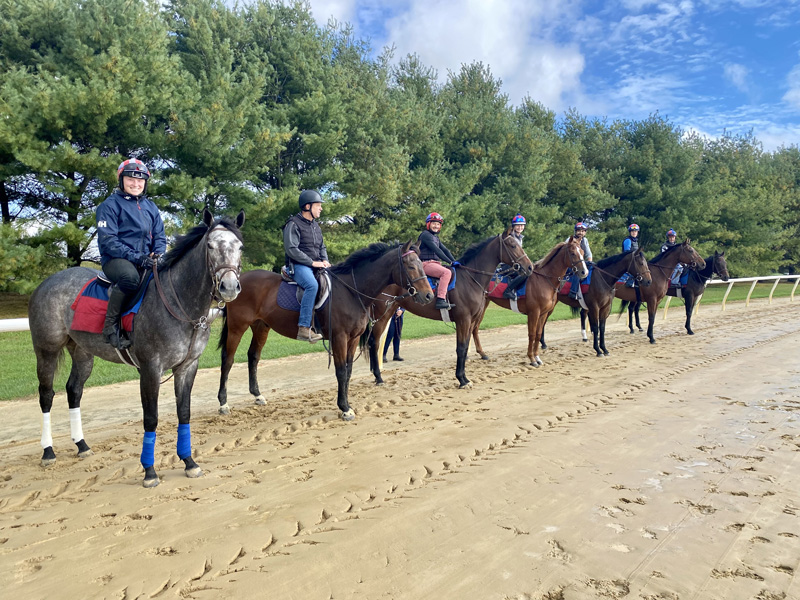
Icabad Crane (second from left) has begun a new career as a pony on the track. Graham Motion Photo
“He had a pasture accident where he broke a bone in his hindleg, but typical Icabad, he was OK with stall rest and put up with it,” Phillip said. “He was in a sling for a little bit. He’s got the temperament that he went through it and recovered well. Then we got him back in work, and he’s a bit older now and a bit crotchety, so [my wife] Evie started riding him and had a great time and was jumping him. He was in full work with her.”
Icabad has become a member of the Dutton family, but Phillip recognized the gelding was perhaps a bit bored and ready for another job this fall, so he called up Motion, who took him on as a “pony” at the Fair Hill Training Center in Elkton, Maryland, where he trains his Thoroughbreds.
“He’s a really kind gentleman that comes out and enjoys being ridden and enjoys everything about his life,” Phillip said. “That’s why it’s exciting for him to have another chance at doing something different. It was a bit of a quieter life [here], not going to competitions and having Evie riding him at home, whereas now I think he went out on three sets yesterday. He’s got a lot to do, but it’s an easy life physically on him.”
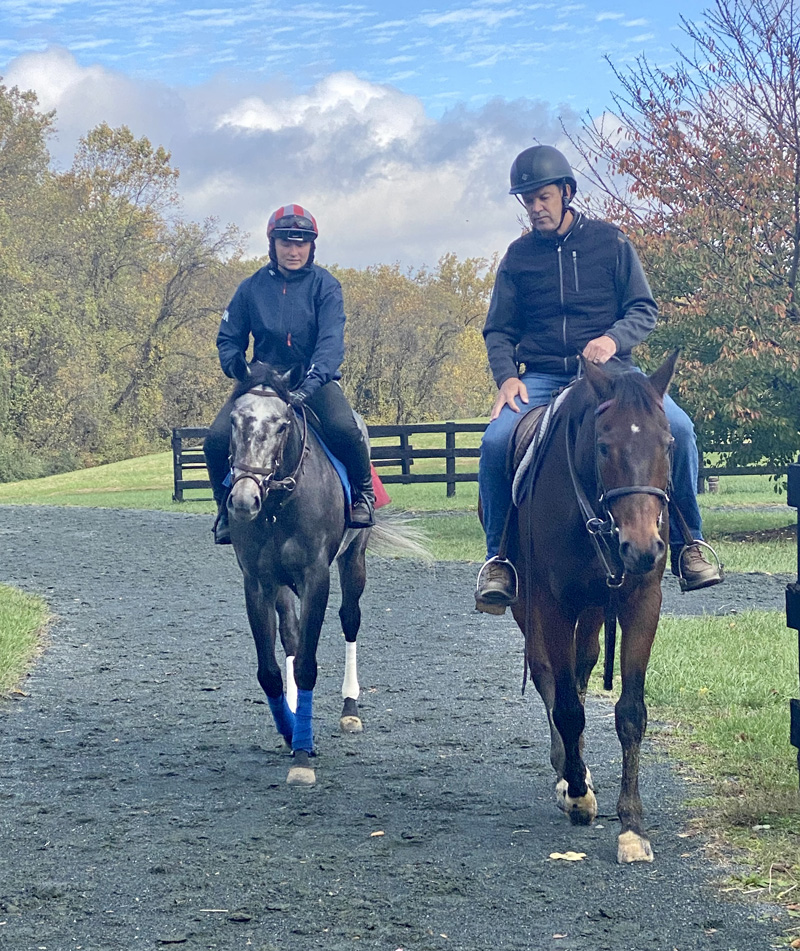
Icabad Crane and Graham Motion (right) lead Caravel and Skylar McKenna. Photo courtesy of Graham Motion
Motion is using Icabad as his personal horse to pony charges including Caravel (Mizzen Mast—ZeeZee ZoomZoom, Congrats), a 4-year-old filly owned by celebrity chef Bobby Flay and her breeder Elizabeth Merryman who is headed to the Breeder’s Cup on Nov. 5.
“I tend to go out with the [young horses] back in the fields, and he either leads them on gallops or watches over them when we’re out,” Motion said. “We have quite a lot of area we can go to, and you can’t get there in a vehicle, so it’s pretty handy to be able to go jump on him and go out with them and watch them go and lead them on some of the sets. I think he was a pretty generous horse on the racetrack and had a great mind and disposition, which is helpful now.”
Icabad lives at the Fair Hill Training Center and gets to spend plenty of time turned out.
When Icabad first went to Phillip after his racing career ended, Motion said he and the racing industry as a whole were starting to see the value of finding new careers for Thoroughbreds, so the timing was right to have an ambassador.
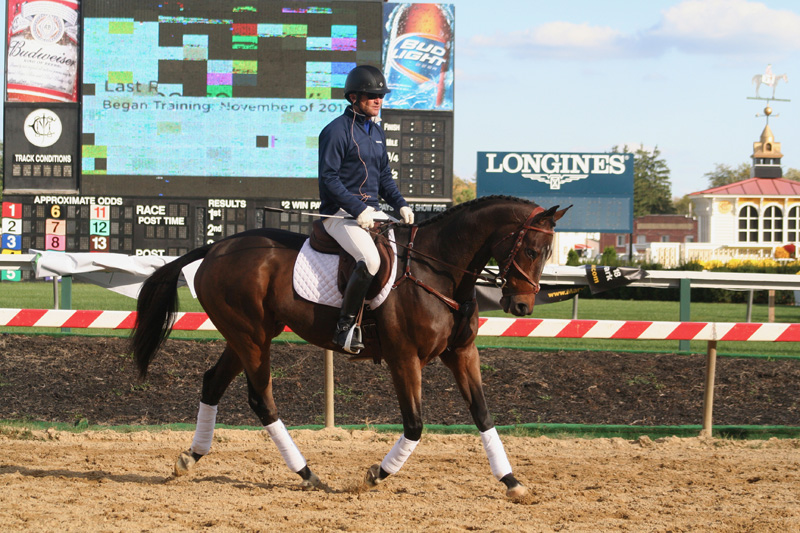
Phillip Dutton and Icabad Crane at the 2014 Retired Racehorse Project’s Thoroughbred Makeover. Erin Harty Photo
“The deal with Phillip came about when we were starting to think about in what ways we could bring attention to retired race horses and what else they can do,” he said. “We started this initiative with Phillip and Evie, and he was one of the first ones we did it with. He was one we always had our eyes on. He was a lovely horse to be around, and everybody loved riding him. We always thought he would really suit, and he did.
“He served a great purpose by bringing attention to that, and I think in racing now we’re so much more conscious about minding the retired race horses. He was a great messenger. Having him with Phillip, who’s well-known and a great rider, didn’t hurt. It’s been a cool sort of family project.”
Phillip said Icabad was a great event horse and became a family and fan favorite during his years at True Prospect. Along with being a shared ride among the Dutton clan, the gelding also helped fellow eventer Peter Barry get back on a horse after he’d suffered a stroke.
“We went through a lot together, and he really brings it home to you how fortunate we are when dealing with horses, especially when you deal with one like Icabad Crane; he’s a pleasure to deal with and wants to learn. We’ve gained as much from him as he’s gained from us,” Phillip said.
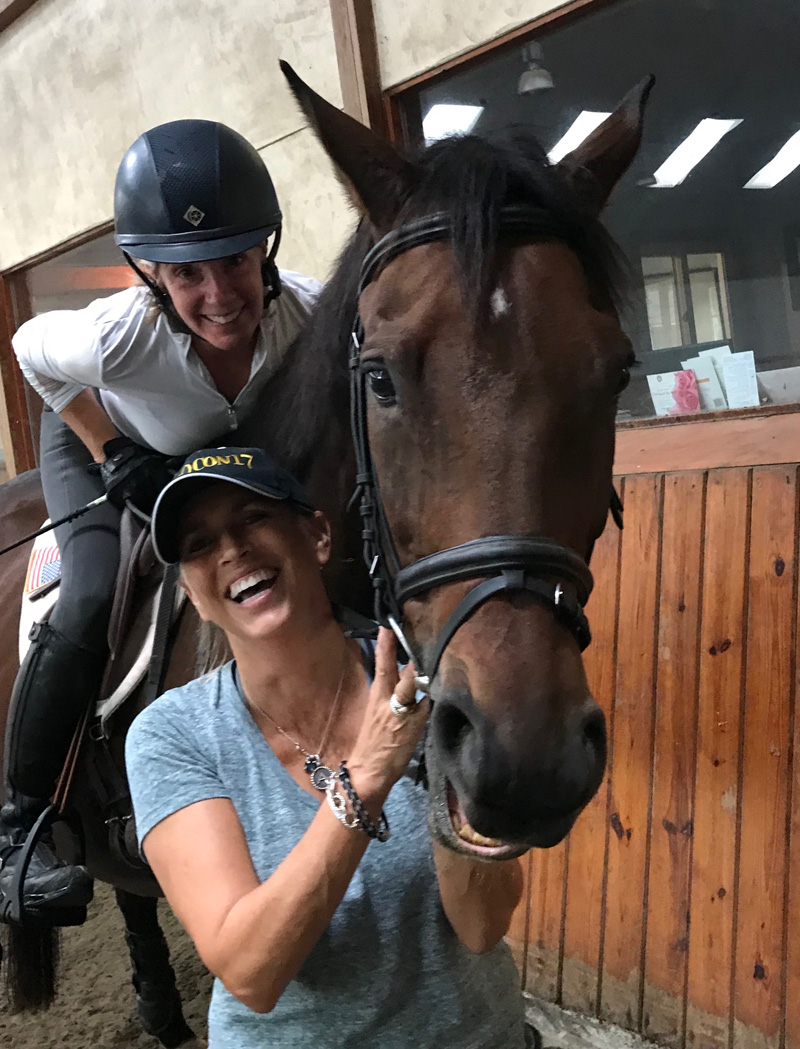
Evie Dutton (mounted) has enjoyed riding Icabad Crane at home, and his former connections, including Anita Motion (standing) have followed his career after the track. Photo courtesy of Evie Dutton
Phillip has always loved Thoroughbreds, but said he’s just looking for good horses when he’s trying to find his next star. Motion and his wife Anita Motion have sent several Thoroughbreds to him since Icabad, including Lincoln’s Address (Union Rags—Sincerely, Meadowlake), a 5-year-old gelding who recently finished fourth in the USEA Young Event Horse East Coast Championships (Maryland). He’s also competing Sea Of Clouds (Malibu Moon—Winner’s Ticket, Jolie’s Halo), another Motion-trained Thoroughbred, at the five-star level.
“There’s been opportunities that have come through Graham and Anita,” he said. “We’ve tried to help them find other homes and lives for their retired horses because they care so much about making sure when the horse is finished racing that they’ll have a good life. From time to time, if one comes through that I think might be suitable for going up the levels, then we’ll try to find a way to acquire that one. Certainly, in eventing, there’s a place for the Thoroughbred horses.”
The post Behind The Photo: Icabad Crane Gets A Third Career appeared first on The Chronicle of the Horse.
]]>The post Court Overturns 20-Year Horse Abuse Sanction Against Endurance Rider appeared first on The Chronicle of the Horse.
]]>The initial FEI Tribunal ruling involved the horse Castlebar Contraband, ridden by Sheik Abdul Aziz Bin Faisal Al Qasimi at the CE1* in Fontainebleau (France) on Oct. 15, 2016. The horse suffered an open fracture to its front right cannon bone during the event and had to be euthanized.
Blood samples collected from the horse post mortem revealed the presence of the xylazine, which is used as a sedative, analgesic and muscle relaxant but is prohibited in FEI competition.
The 20-year FEI suspension, the longest punishment yet handed out by the organization, combined two years for presence of the prohibited medication and 18 years for alleged abuse of the horse.
“The post mortem report revealed the appearance of multiple lesions with a highly targeted location, consistent with recent injections, which the FEI stated demonstrated that the horse had been nerve blocked (desensitized) in training, and both before and during the competition,” the FEI stated in a press release about the CAS decision. “The FEI’s view was that this desensitization, in combination with osteoarthritis in the right front fetlock joint, resulted in stress fractures that ultimately caused the catastrophic injury.”
In making its initial ruling, the FEI Tribunal accepted the explanation of the treating veterinarian who performed the euthanasia that she had followed the standard protocol, which did not include the use of xylazine, refuting the claim by Sheik Abdul’s legal team that xylazine had been used in the euthanasia process.
The CAS, however, ruled that the balance of evidence—namely, the concentration of xylazine and the lack of the sedatives the treating veterinarian said she administered found in the horse’s post-mortem blood sample—favored Sheik Abdul’s argument that it had been administered within an hour of the horse’s euthanasia, most likely, mistakenly, by the veterinarian instead of the other sedatives.
The CAS panel also noted “strong disagreement” between witnesses brought forth by the FEI and Sheik Abdul as to whether the horse was showing signs of pain or attempting to put weight on the broken leg while waiting for veterinary attention.
In considering the allegations of horse abuse, chief among them that the horse had been desensitized to the point it competed on a compromised leg that ultimately fractured, CAS noted “the more serious the allegation and its consequences, the higher certainty (level of proof) the Panel would require to be ‘comfortabl[y] satisfied.’ ”
In its decision, the CAS panel determined that neither the athlete nor his veterinarian could have “reasonably detected” alleged bone fatigue in the horse.
The CAS panel found that, because the horse had passed the horse inspection the day before the event and had also passed the veterinary checks at the vet gates during the competition, it could not be ruled as being unfit to compete. The panel ruled that the FEI had failed to establish that the athlete competed on an exhausted, lame or injufred horse or committed “an action or omission which caused or was likely to cause pain or unnecessary discomfort to a horse.”
As a result, the CAS panel found that Sheik Abdul had not committed a violation of Article 142.1 of the FEI General Regulations and that, therefore, no sanctions for abuse of horse could be imposed. The panel ruled all findings and sanctions imposed by the FEI Tribunal to be “ill founded” and ordered that they be set aside.
“While it is true that circumstantial evidence may have some probative value, the fact remains that, in a case such as the present, which concerns severe allegations of abuse of horse that may, if established, entail heavy sanctions for the Appellant, there must be cogent evidence establishing the commission of the alleged rule violation,” the panel stated in its decision.
“Although we respect the CAS decision, we are extremely disappointed,” FEI Secretary General Sabrina Ibáñez said. “The FEI has to stand up for horse welfare and clamp down on horse abuse, so to lose this case on appeal is more than disheartening. The FEI believed that this was an important case to prosecute in order to protect horse welfare, and the FEI Endurance Rules have been further improved from a welfare perspective since this 2016 case. However, the CAS panel has been clear that they feel that there was insufficient substantive evidence for them to uphold the sanctions imposed by the FEI Tribunal.
“The FEI will of course continue to investigate and prosecute horse abuse cases and we will also work hard to ensure that this CAS decision does not discourage third parties from bringing horse abuse cases forward to the FEI. We need to work together to ensure that those who abuse horses are brought to justice, but we also need to ensure that we have solid and irrefutable evidence.”
The FEI veterinary director, who was an expert witness in both the FEI Tribunal and CAS proceedings, noted that despite the legal outcome, the case has been a catalyst for improvements in FEI horse welfare protocols.
“This particular case was one of the main drivers for the development of the FEI hyposensitivity control system, which provides physical evidence of nerve blocking, something that was virtually impossible previously,” Dr. Göran Åkerström said. “So while the CAS decision sadly does not provide justice for this individual horse, it has resulted in a system that is already being used and which will help prevent similar tragic injuries in the future.”
The CAS decision is published here.
The post Court Overturns 20-Year Horse Abuse Sanction Against Endurance Rider appeared first on The Chronicle of the Horse.
]]>The post Filling The Gaps: Women’s History Month And Museum Collections appeared first on The Chronicle of the Horse.
]]>One of the most awkward and thought-provoking moments I have ever experienced at the National Sporting Library & Museum was in my early years as the George L. Ohrstrom, Jr. Curator when the Museum first opened. It was in 2012, and I was a young and enthusiastic curator of a fine art collection that had grown over the previous decades through generous donations and bequests to the Library and was transferred to the new space under Museum standards and care. I was conducting a private tour with a potential sponsor considering underwriting bus transport for student groups.
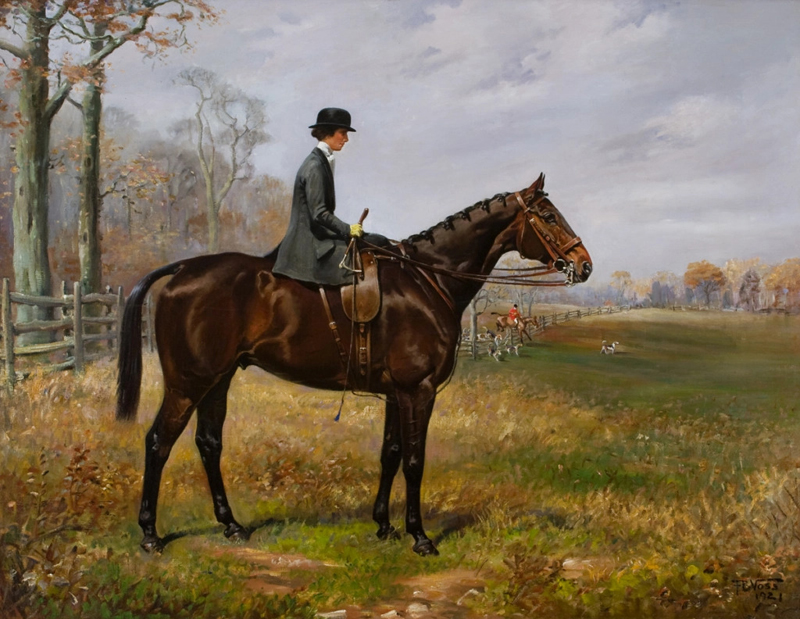
Franklin Brooke Voss (American, 1880–1953), Portrait of Mrs. William C. Langley, Aside on Sandown, oil on canvas, 28 x 36 inches, National Sporting Library & Museum, Gift of Mrs. Eleanor Langley Fletcher, 1962
As we wound our way through the galleries, discussion flowed freely. We chatted about highlights of the collection, challenges of new museums, and growth of the collections. We built a good rapport, and as the tour ended, we exchanged contact information. I was honored by the kind compliments offered as we said goodbye. Then, the visitor paused for a moment and remarked:
“You know, this museum is really beautiful, but I haven’t seen a single woman represented in these spaces today.”
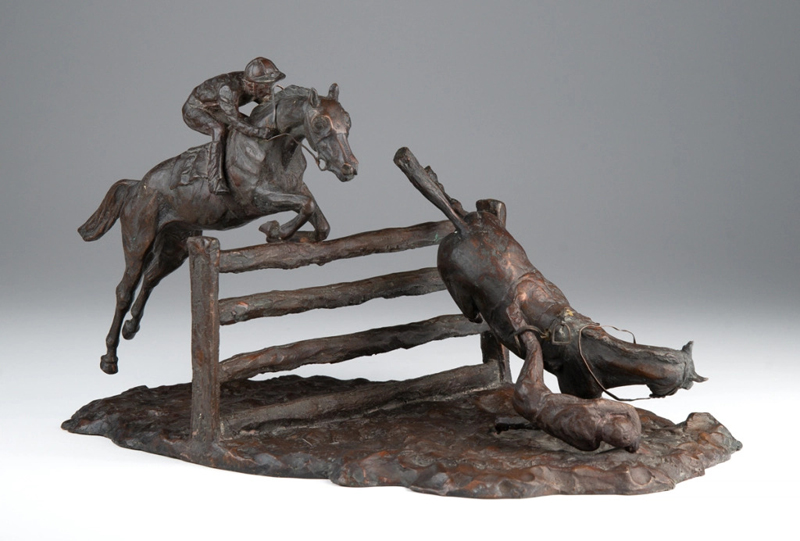
Marie-Louise Radziwill (American, b. 1956), The Maryland Hunt Cup, 1973, bronze, 9 x 12 1/2 x 9 inches, National Sporting Library & Museum, Gift of the artist, 1978
I was taken aback, but upon further reflection, it was an astute observation and largely correct. At that time, there were few works by female artists or depictions of women on view in the Museum galleries. Frankly, we did not have many artworks in this category (in addition to other notable gaps) in the permanent collection that met the bar for Museum display based on condition and prominence set forth in our Collections Management Policy. Needless to say, we did not get the underwriting, and that day I understood that I needed to focus more on making our art collection installations, acquisitions, and permanent and loan exhibitions more diverse representations of the sporting culture of our past, the community our mission serves today, and future interest.
Marie-Rosalie Bonheur (French 1822–1899), Lion studies, oil on canvas, 9 1/8 x 12 1/2 inches, National Sporting Library & Museum, Gift of the Estate of Milton Ritzenberg, 2018
Let me be clear. I am not a revisionist in my role at NSLM. My dedication to our institution is to drill down to finding an accurate account of sporting art and culture in any given era. There are many times when these concepts have not historically converged, but illustrations and satirical images fill in the gaps, opening our eyes to individuals and their stories.
Salle Foster, “The Sporting Woman: A Book of Days,” 1989. Little, Brown, and Company, NSLM Collection; reproduction of John Collet (English, 1720 – 1780), “The Ladies Shooting Poney,” hand-colored mezzotint, Yale Center for British Art, Paul Mellon Collection, New Haven
We have worked hard over the years, not as a politically correct endeavor. The National Museum of Women in the Arts mission and #fivewomenartists campaign remind us that women have historically been significantly underrepresented across museums. (For further reading: Women in Art: The Double X Factor, 2017 blog). Acknowledging this means recognizing that if museums continue to prioritize prominent artists from past eras, this then perpetuates the selection of male over female artists. We countered this at the NSLM by creating a Collecting Plan to equally consider underrepresented artists and subjects as part of our growth.
Mildred Sands Kratz (American, 1928 – 2013), End of the Line, 1970, watercolor on paper, sight size 20 3/4 x 28 inches, National Sporting Library & Museum, Gift of Patricia Cox Panzarella and Thomas Panzarella, 2020
Additionally, we have looked to curating exhibitions featuring female solo artists and introduced new scholarship on sporting women and art, including “The Art of Women and the Sporting Life, Clarice Smith: Power & Grace, and Sidesaddle, 1690-1935.” Most recently we presented “Leading the Field: Ellen Emmet Rand,” a project that re-established the artist’s significant contributions to sporting portraiture during the heyday of sporting life in the U.S. and her prominent career as a pioneering female artist in her lifetime.
Ellen Emmet Rand (American, 1875-1941), Miss Emily Davie, ex-Whipper-in to the Aiken Junior Drag, 1932, oil on canvas, 48 ½ x 31 inches, on loan from the Collection of Geoffrey N. Bradfield to “Leading the Field: Ellen Emmet Rand” exhibition, October 4, 2019 – June 30, 2020
Women’s History Month offers us an opportunity to reflect and reminds us to set new goals for the future, not just in this month but year-round. Women have always been an integral part of sporting culture and art, and it is imperative that we preserve the record of their endeavors and accomplishments.
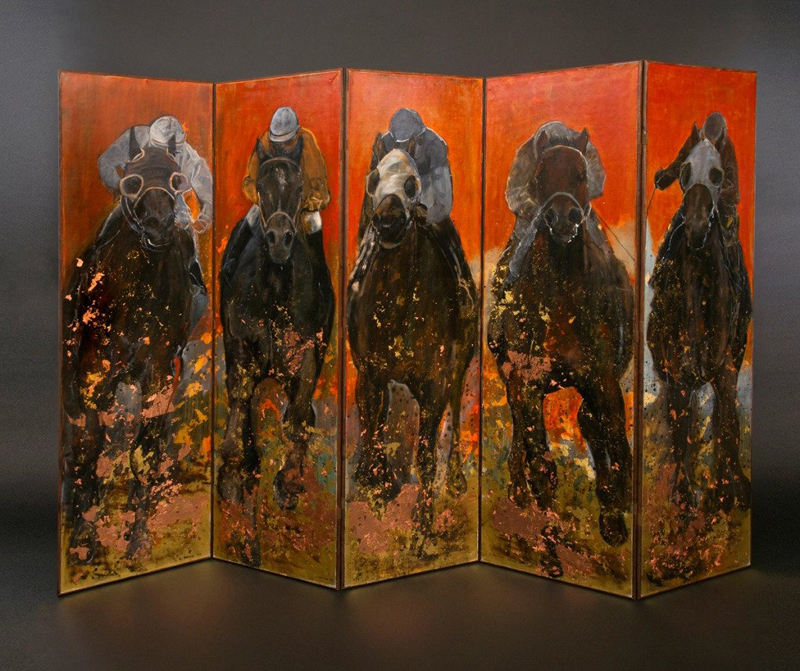
Clarice Smith, (American, b.1933), Gallop, 2009, oil with gold and copper leaf on canvas, on 5-panel screen, 50 x 77 1/2 inches, National Sporting Library & Museum, Gift of Clarice Smith, 2015, © Clarice Smith
Claudia Pfeiffer is the deputy director and George L. Ohrstrom, Jr. Curator at the National Sporting Library & Museum and has been with the organization since the position was first underwritten by the George L. Ohrstrom, Jr. Foundation in 2012. Her primary focus is the research, design, interpretation, writing and installation of exhibitions. E-mail Claudia at cpfeiffer@nationalsporting.org.
The post Filling The Gaps: Women’s History Month And Museum Collections appeared first on The Chronicle of the Horse.
]]>